
The Light He Left in the Dark
Walter Miller was a man constructed of sawdust, motor oil, and an uncompromising, stubborn pride. For forty-eight years of marriage, he was my anchor, a man who spoke through the work of his calloused hands rather than flowery declarations. He could rebuild a carburetor blindfolded and frame a house with mathematical precision, but he had an absolute, vocal disdain for the town library.
“It’s too quiet, Ellie,” he would grumble whenever I asked him to drive me downtown to return my weekly stack of mystery novels. “It smells like trapped dust and other people’s opinions. I’ll wait in the truck.”
And for nearly half a century, he did exactly that. He would sit in the cab of his Ford, listening to the baseball game on the AM radio, while I wandered the stacks. I was a voracious reader, consuming everything from historical biographies to sweeping family dramas. The library was my sanctuary, just as his backyard workshop was his. We understood this fundamental difference about each other, accepting it as one of the comfortable, worn-in grooves of our long marriage.
When Walter was diagnosed with aggressive pancreatic cancer, our entire world shrank to the perimeter of our home. His decline was a grueling, agonizing battle that lasted a year and a half. He passed away two years ago on a quiet Sunday morning, taking the loudest, most vibrant parts of my life with him. The silence he left behind in our house was deafening.
But the silence wasn’t the only darkness creeping into my life.
In the spring of 2020, I was diagnosed with severe macular degeneration. It started as a subtle blurring at the center of my vision, a gray smudge that I initially blamed on a dirty glasses prescription. But the smudge expanded, slowly and ruthlessly devouring my sight. Within two years, my beloved books became entirely illegible. The crisp black text faded into an impenetrable gray fog. Losing Walter broke my heart, but losing the ability to read severed my connection to the outside world. I was seventy-eight years old, living alone, and slowly becoming entirely blind.
Then came yesterday morning.
I was sitting on my front porch, listening to the rhythmic hum of the cicadas in the humid summer air, holding a mug of tea I could barely see. I heard the unmistakable squeak of the front gate, followed by the heavy, measured footsteps of someone approaching the porch.
“Mrs. Miller?” a voice called out gently.
I squinted toward the top of the stairs, making out the vague, blurry silhouette of Marian Higgins, the head librarian of our town’s public branch. She had worked there for thirty years; she knew my library card number by heart.
“Marian?” I asked, setting my tea down on the wicker table. “What brings you out here? I don’t have any overdue books, I’m afraid. I haven’t been able to visit in a long time.”
“I know, Eleanor,” Marian said gently, her voice wavering with a strange, heavy emotion. “But I didn’t come to collect a late fee.”
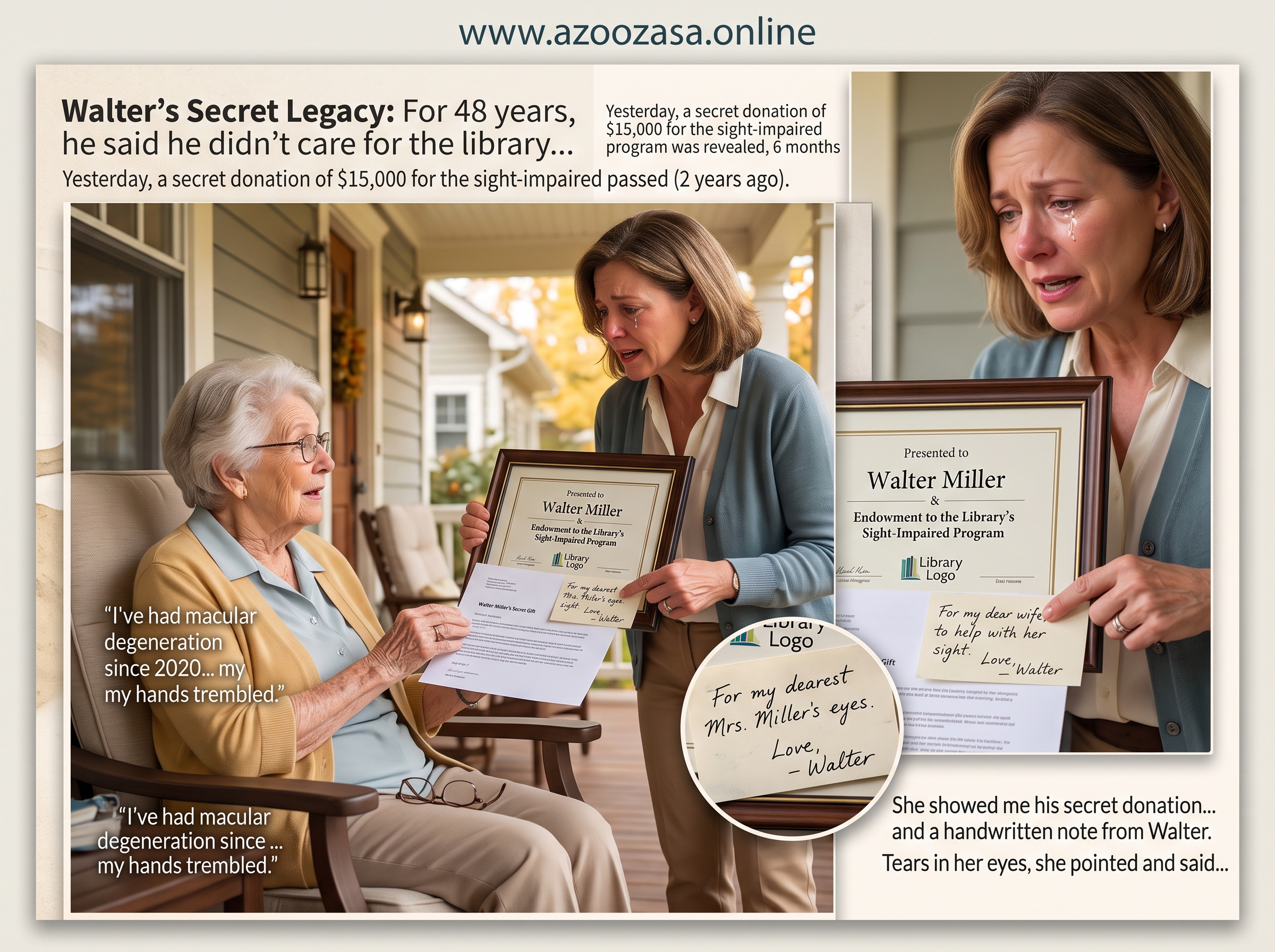
She walked up the steps and knelt beside my chair. She took my hands—my wrinkled, trembling hands—and placed a heavy, wood-framed document into my lap. I ran my fingers over the smooth glass, unable to read the thick calligraphy printed beneath it.
“Mrs. Miller,” she said quietly, “we wanted to present this to you in person.”
She placed a secondary piece of thick parchment into my palm. “This is an official endowment letter from the municipal trust. It shows that your husband, Walter, secretly donated fifteen thousand dollars to the library’s sight-impaired program. He finalized the transfer six months before he passed away.”
The breath caught violently in my throat. My hands trembled so hard the parchment rattled against the glass frame in my lap. Fifteen thousand dollars was a massive sum for us. It was the bulk of Walter’s private retirement savings, the money he had stubbornly hoarded from his days running the auto shop, swearing it was his “rainy day” fund. And he had given it to the one building in town he claimed to despise.
“I don’t understand,” I whispered, tears immediately springing to my useless, failing eyes. “Walter hated the library. He wouldn’t even step past the vestibule.”
“He didn’t hate the library, Eleanor,” Marian said, her voice cracking. She reached forward and gently guided my index finger to a small square of paper taped to the bottom corner of the endowment letter. The paper felt slightly textured, indented with the heavy, forceful press of a ballpoint pen.
“He attached this note to the final check,” Marian continued. She looked at me, tears spilling over her eyelashes, and said, “He wrote: For my Ellie. Because fixing engines was easy, but I couldn’t fix her eyes. And I refuse to let her sit in the dark.“
I let out a broken, shattered sob, covering my mouth with my hand.
Marian squeezed my shoulder. “Eleanor, that fifteen thousand dollars wasn’t just a blind donation. He had a very specific, contractual stipulation for how the money was to be used. He bought the library a state-of-the-art, soundproof audio recording booth, complete with professional microphones and digital editing software. And then, he became its very first patron.”
I stared at her blurry silhouette, my heart hammering a frantic rhythm against my ribs. “What do you mean?”
“For the last six months of his life, when he told you he was driving into the city for his weekly physical therapy and pain management appointments… he wasn’t at the clinic,” Marian explained, wiping her own cheeks. “He was with me, in the library basement. He sat in that booth for four hours every Thursday. He was in terrible pain, Eleanor. Some days he could barely sit up straight in the chair. But he refused to miss a session.”
“What was he doing?” I asked, though my soul already knew the answer, vibrating with a profound, terrifying hope.
“He was reading,” Marian smiled softly. “He asked for your lifetime checkout history. Every mystery novel, every biography, every family drama you ever borrowed more than once. He sat in that booth and he read them out loud into the microphone.”
I couldn’t speak. The sheer magnitude of his final act of love was an ocean that entirely swallowed me. My gruff, stubborn mechanic, a man who had no patience for literature, had spent the excruciating, fading twilight of his life locked in a small room, fighting through the agony of terminal cancer, just to read out loud.
“I brought something else,” Marian said.
She reached into her canvas tote bag and pulled out a small, modern digital audio player. It had large, tactile, high-contrast buttons designed specifically for the visually impaired. She placed it gently onto the wicker table next to my tea, slipped a comfortable pair of cushioned headphones over my ears, and pressed the large, raised triangular play button in the center.
For three seconds, there was only the soft, ambient hiss of a quiet room.
And then, a sound I thought I would never, ever hear again echoed through the headphones. It was the heavy, familiar scraping of a wooden chair being pulled up to a desk. Followed by a deep, wet cough, and the rustling of heavy paper pages.
“Alright, Ellie,” Walter’s deep, gravelly baritone vibrated right into my soul. His voice sounded tired, a little raspy from the illness, but it held that same warm, fiercely protective timbre that had anchored me for forty-eight years. “Marian tells me this microphone picks up everything, so I apologize if you can hear my stomach rumbling. I brought a thermos of black coffee, and we’re going to get through this.”
I closed my eyes, the tears streaming freely down my cheeks, soaking the collar of my blouse. He was right there. He was sitting right beside me.
“I got this book here,” his recorded voice continued. “Pride and Prejudice. By Jane Austen. Now, I already read the back cover, and let me tell you, this Mr. Darcy fellow sounds like an arrogant piece of work. If he drove his carriage into my shop, I’d overcharge him for the axle grease. But you love it, so… here we go. Chapter One.”
I sat on the porch for hours as the humid afternoon melted into a cool, breezy evening. I listened to my husband struggle over nineteenth-century British pronunciations, sighing heavily when the romantic dialogue became too convoluted for his pragmatic sensibilities, occasionally pausing to interject his own colorful, mechanic’s commentary on the poor life choices of the characters. It was the most beautiful symphony I had ever heard.
Marian left quietly at some point, leaving me alone with the audio player and a binder filled with hundreds of digital memory cards.
Walter had recorded eighty-four entire books before his lungs finally gave out. He had recorded them through the nausea of chemotherapy, through the bone-deep exhaustion of his failing body, and through the quiet terror of knowing his time was running out. He had fought death for six months just to ensure that when my world finally went completely gray, his voice would be there to guide me through it.
My macular degeneration has progressed significantly since yesterday. The world is mostly shadows and blurred outlines now. I can no longer see the vibrant green of the maple trees in the front yard, or the delicate patterns of the china cups in my kitchen cupboards.
But I am no longer afraid of the dark.
Every morning, I sit in my favorite armchair by the window, put on my headphones, and press the large triangular button. And every morning, my husband comes back to me. He sits beside me in the quiet, smelling faintly of motor oil and sawdust, and he reads to me. He built me a library that no disease can steal, proving that while eyes may fail and bodies may fade, the truest kind of love never stops speaking.




0 comments