
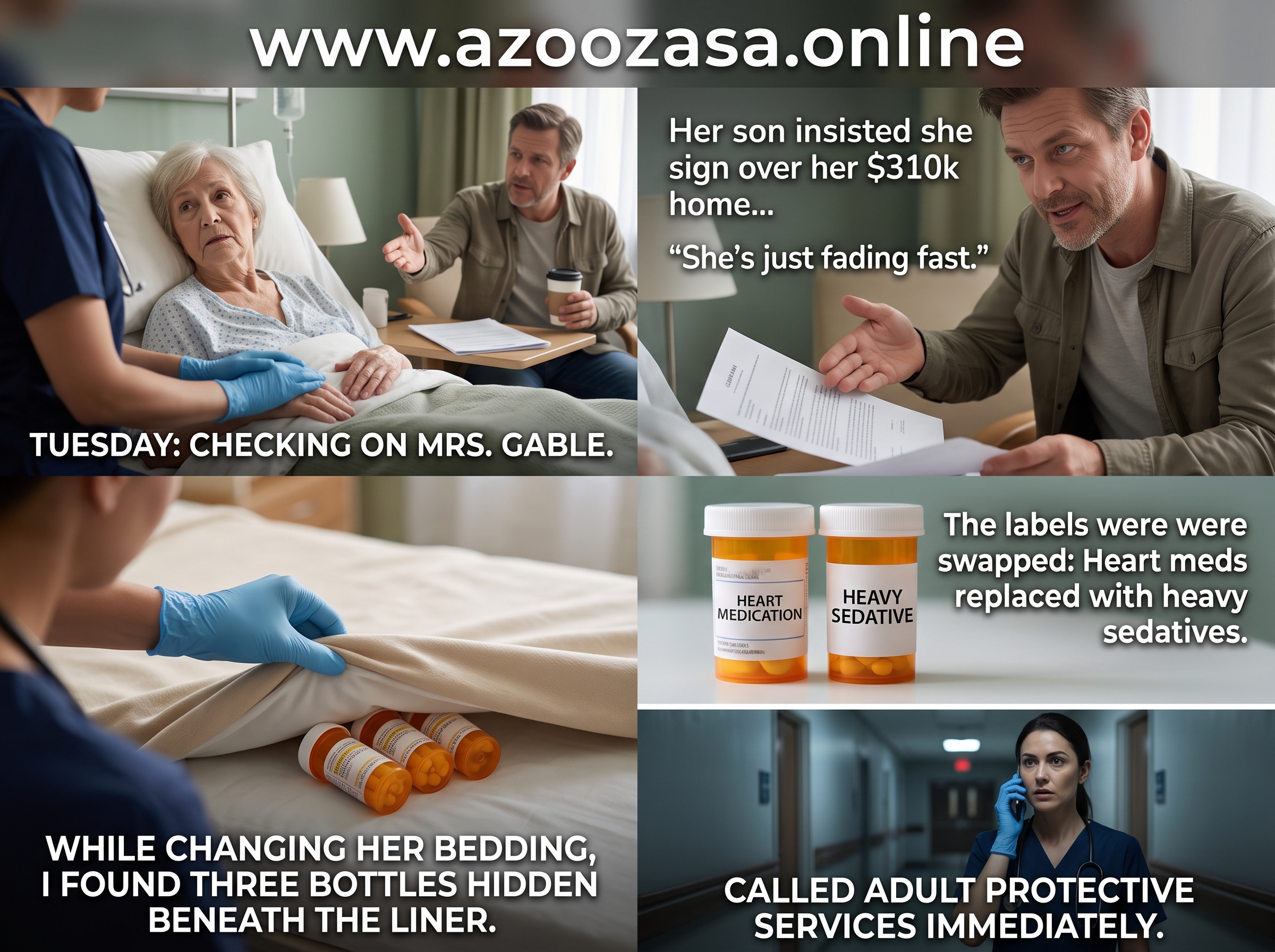
The Lethal Inheritance
For fourteen years, I have navigated the quiet, often invisible front lines of senior care in the United States. My days are measured in hushed tones, the rhythmic hum of oxygen concentrators, and the delicate task of preserving human dignity at the end of life. I have seen the natural, gentle fading of the human body, and I have seen the profound grace of families saying their final goodbyes. But in all my years of practice, I had never encountered a darkness quite like the one lingering in the shadows of Eleanor Gable’s bedroom.
Eleanor was eighty-two, a widow who had lived in her charming, single-story craftsman home for nearly four decades. It was a modest but fiercely loved property, recently appraised at a solid three hundred and ten thousand dollars. Before this month, her medical charts painted the picture of an astoundingly vibrant woman. She maintained a strict daily fitness habit, walking two miles every morning, and her refrigerator was typically stocked with whole foods, leafy greens, and fresh fruit. She had the cardiovascular profile and physical health of a woman twenty years her junior.
Which was why her sudden, catastrophic decline made absolutely zero clinical sense.
I arrived for my Tuesday morning assessment to find her son, Richard, dominating the small living room. He was a man composed entirely of sharp angles and restless, irritable energy. He paced the hardwood floors, checking his expensive watch every three minutes, a man profoundly inconvenienced by his mother’s existence.
“She’s just fading fast,” Richard sneered, setting a lukewarm cup of black coffee onto a delicate antique side table without a coaster. He glanced toward the closed bedroom door with a look of utter detachment. “The lawyer is coming at noon. We’re moving her into a managed care facility by the weekend, so I need her to sign the deed transfer today. Don’t bother her with your usual paperwork or questions. Just make sure she’s awake enough to hold a pen.”
I kept my expression entirely neutral, a professional mask forged over a decade of dealing with difficult relatives. “I still need to perform my standard physical assessment, Richard. It will only take a few moments.”
He rolled his eyes and waved me off, stepping out onto the front porch to take a phone call.
The moment the front door clicked shut, I slipped into Eleanor’s bedroom. The air inside was stifling, heavy with the scent of stale linens and drawn curtains. Eleanor lay in the center of the large four-poster bed, a frail silhouette swallowed by thick quilts.
I approached the bedside and gently took her hand to check her pulse. Her skin was clammy, and the moment my fingers brushed hers, her hands began to shake violently—a severe, neurological tremor that had not been present during my visit last week. Her eyes fluttered open, the pupils constricted to tiny pinpricks. She looked at me, her gaze swimming in a deep, unnatural fog. She tried to speak, but her jaw went slack, producing only a faint, dry rasp.
This was not the natural trajectory of a failing heart. This was profound central nervous system depression.
“It’s alright, Mrs. Gable. It’s Margaret, your nurse,” I whispered, keeping an eye on the bedroom window that looked out onto the porch where Richard was pacing. “I’m just going to freshen your linens and make you comfortable.”
I began to strip the heavy, suffocating layers of blankets away. As I gently rolled Eleanor onto her side to pull the fitted sheet free, I felt a hard, unnatural lump pressing through the mattress liner. My professional instincts, honed by years of navigating complex family dynamics and the darker sides of elder care, flared into high alert.
I slid my hand beneath the quilted liner. My fingers brushed against hard plastic.
I pulled out three amber prescription pill bottles.
I turned my back to the window, shielding the bottles with my body, and examined the labels. The first bottle was supposed to be her daily beta-blocker, a critical medication to regulate her heart rhythm. The pills inside were not the familiar scored white tablets. They were heavy, blue-and-red capsules. I recognized them immediately. They were a powerful, high-dose sedative, a heavy barbiturate typically used in acute psychiatric settings, not for outpatient senior care.
The other two bottles revealed the exact same horrifying truth. Her vital blood pressure medications and diuretics had been entirely replaced with aggressively strong tranquilizers.
My stomach turned to solid ice. The sudden, violent tremors, the pinprick pupils, the inability to speak—Eleanor wasn’t fading. She was being systematically and intentionally poisoned. If a patient abruptly ceases their beta-blockers, they risk a massive, fatal cardiac event. Combine that with a lethal cocktail of heavy sedatives, and Richard wasn’t just incapacitating his mother to steal her home. He was actively manufacturing her death.
I didn’t hesitate. The family drama I had assumed was merely a case of a greedy, impatient son had instantly escalated into an active attempted homicide.
I slipped the three bottles into the deep pockets of my medical scrubs, smoothed the bedding back over Eleanor, and quietly stepped out of the bedroom, pulling the door shut behind me. Richard was still on the porch, his back to the house, arguing aggressively into his cell phone about escrow timelines.
I moved swiftly down the hallway into the guest bathroom, locked the door silently, and pulled out my phone. I bypassed the standard hospice protocol lines and dialed the direct emergency number for Adult Protective Services, a contact I had unfortunately needed to use before, though never under circumstances this deeply sinister.
The line rang twice before a stern, professional voice answered. “Adult Protective Services, Investigator Hayes speaking.”
I leaned against the cool porcelain of the bathroom sink, keeping my voice to a sharp, urgent whisper. “Investigator Hayes, my name is Margaret Evans, I am a registered hospice nurse at 442 Elm Street. I have an immediate Code Red critical situation. The patient, an eighty-two-year-old female, is being actively poisoned by her son.”
“Nurse Evans, slow down,” Hayes said, the typing of a keyboard instantly audible on his end. “Are you in immediate physical danger?”
“The son is outside on the phone. He expects a lawyer here in an hour to force her to sign over the deed to her three-hundred-thousand-dollar home,” I explained, the adrenaline making my hands shake as I relayed the medical facts. “I found her heart medications hidden under the mattress liner. The bottles have been swapped out with heavy, high-dose barbiturates. She is entirely incapacitated and showing signs of acute withdrawal from her actual cardiovascular prescriptions. If she doesn’t get to an emergency room within the next few hours, her heart is going to give out.”
There was a half-second of chilling silence on the line as the gravity of the situation registered.
“I am dispatching paramedics and two black-and-whites to your location right now,” Hayes commanded, his tone shifting into pure operational authority. “They are three miles out. Do not confront the son. Do not let him know you found the medication. Can you stall him?”
“I can stall him,” I whispered.
“Keep the door locked if you have to. We are on the way.”
I hung up, took a deep, shuddering breath to steady my racing heart, and flushed the toilet to maintain the illusion of a normal bathroom break. I unlocked the door and stepped back into the hallway just as the front door swung open.
Richard stepped inside, his face flushed with irritation. He looked at me, his eyes narrowing suspiciously. “Are you done yet? The notary is going to be here early. I need her sitting up.”
“I’m afraid Mrs. Gable’s blood pressure is running a bit abnormally low this morning, Richard,” I said, walking back into the living room and casually blocking the hallway that led to her bedroom. I kept my voice perfectly even, adopting the bland, clinical tone that usually bored family members into compliance. “I need to run a secondary EKG strip just to be certain she’s stable enough to be propped up for the paperwork. If she passes out while holding the pen, the notary won’t legally be able to accept the signature.”
The threat of the failed legal document worked instantly. Richard ground his teeth, checking his watch again. “Fine. Do it fast. I am not losing this closing date because she’s being difficult.”
I nodded, unzipping my medical bag and taking out the portable EKG leads, buying every precious second I could. I dragged the process out, meticulously cleaning the cables, adjusting the settings on the monitor, asking Richard mundane questions about her dietary habits over the last week to keep his attention focused on me rather than the quiet street outside.
“She hasn’t been eating,” he snapped, pacing the room again. “Like I said, she’s fading. It’s natural.”
“It’s certainly something we have to monitor,” I replied smoothly.
Ten minutes later, the heavy, oppressive silence of the house was shattered by the unmistakable screech of tires on asphalt.
Richard froze, turning toward the front window. Through the sheer curtains, the rapid, blinding flash of red and blue emergency lights painted the living room walls. Two county sheriff cruisers had parked diagonally across the driveway, entirely blocking Richard’s sedan, followed immediately by a heavy ambulance.
“What the hell is this?” Richard demanded, spinning to face me, his mask of corporate impatience slipping to reveal genuine panic. “Did you call them? I told you no hospitals!”
“I am a mandated reporter, Richard,” I said, stepping firmly away from him and dropping the clinical facade. “And Mrs. Gable is going to receive the exact medical care she actually requires.”
The heavy knock on the front door was followed immediately by it swinging open. Two deputies stepped inside, hands resting on their utility belts, followed by a plainclothes detective I assumed was Investigator Hayes, and two paramedics with a stretcher.
“Richard Gable?” the lead deputy asked.
“This is a misunderstanding,” Richard stammered, backing away toward the kitchen. “My mother is in hospice. She’s just having a bad morning—”
“Nurse Evans?” Investigator Hayes interrupted, looking directly at me.
I reached into the deep pockets of my scrubs and pulled out the three amber pill bottles. I set them firmly on the antique side table, right next to Richard’s cold cup of coffee.
“These were hidden beneath the patient’s mattress,” I stated clearly, ensuring the deputies heard every word. “Her vital heart medications have been replaced with heavy sedatives. She is in critical condition.”
Richard lunged for the table, but the two deputies were faster. They caught him by the shoulders, driving him back against the wall. The sound of metal handcuffs clicking into place echoed sharply in the small house, a sound of absolute finality.
I didn’t stay to watch him get dragged out. I immediately led the paramedics into Eleanor’s room. We moved quickly, securing her airway, starting a saline drip to flush her system, and carefully transferring her fragile frame onto the transport stretcher.
As we wheeled her out the front door, into the bright, blinding sunlight of the American summer, the fresh air seemed to brush against her face. She was still deeply sedated, trapped in the chemical fog her son had built for her, but she was alive.
Six months later, I drove past that charming craftsman house on Elm Street. The lawn was impeccably manicured, and the curtains were wide open, letting the morning light flood into the living room. Eleanor Gable had survived the acute withdrawal, her heart holding on just long enough for the actual medications to do their work. With her son awaiting trial in the county penitentiary for elder abuse and attempted murder, she had regained her health, her independence, and her home.
I smiled as I watched her slowly walk down her driveway in her tennis shoes, returning to her daily fitness routine. She wasn’t fading. She was fighting. And in this quiet, unseen corner of the world, that was a victory worth every second of the suspense.




0 comments