
The Devil in the Line Items
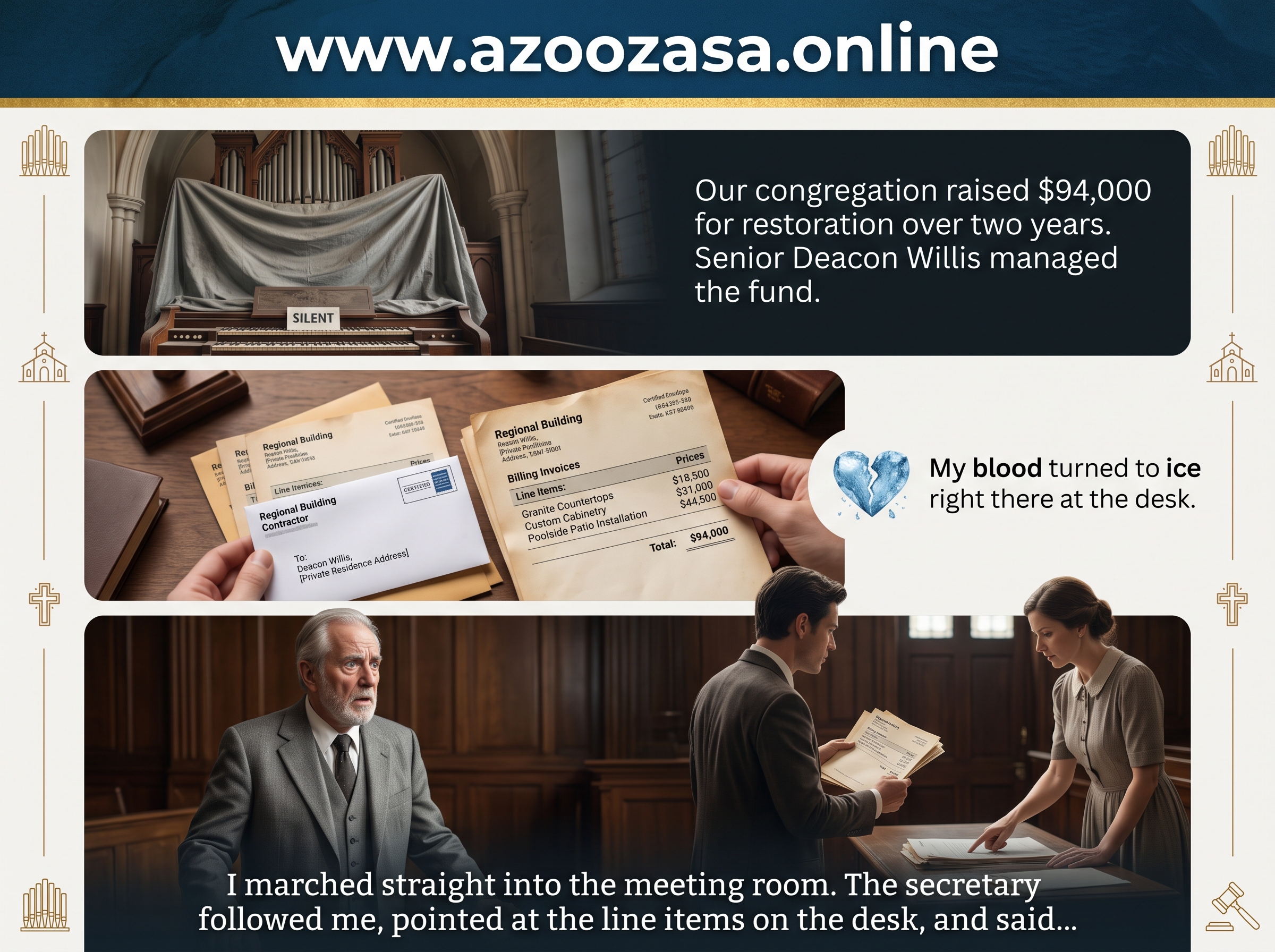
For two long, suffocating years, the great sanctuary of Calvary Fellowship had been anchored by a massive, gray canvas tarp. Beneath that heavy fabric sat the pride of our congregation: a sprawling, nineteenth-century pipe organ that had provided the heartbeat of our services for generations. When its pneumatic leathers began to crack and its brass pipes succumbed to decades of oxidation, the silence it left behind was deafening. The congregation, a tight-knit community of working-class families and fixed-income retirees, had rallied with an unprecedented fervor. We hosted endless bake sales, organized community car washes, and passed a secondary offering plate week after agonizing week.
It took twenty-four months of profound, collective sacrifice to raise the ninety-four thousand dollars required for a complete, master-level restoration.
The man entrusted with holding that sacred purse was Senior Deacon Willis Abernathy. Willis was the patriarch of a wealthy local family, a former real estate developer who had settled into a highly visible, comfortable retirement. He was the kind of man who wore immaculate three-piece suits to Wednesday evening Bible study and spoke in a smooth, practiced baritone that commanded immediate respect. He was universally trusted. Whenever a parishioner gently inquired about the lack of progress behind the altar, Willis would offer a warm, patronizing smile and assure us that the specialized artisans were simply delayed by global supply chain issues. “The Lord’s timing is rarely our own,” he would say, resting a manicured hand on the inquirer’s shoulder.
Out of respect for his authority, we accepted his platitudes. We left the tarp alone, praying for the day the music would return.
Last Thursday afternoon, the illusion of Willis Abernathy’s piety shattered into a thousand jagged pieces.
I was volunteering in the parish administrative office, assisting our long-time church secretary, Martha, with the quarterly filing. The office was quiet, smelling of brewing coffee and old paper. The afternoon mail had just been dropped through the brass slot in the heavy front door. Among the standard utility bills and weekly circulars was a thick, rigid cardboard envelope sent via certified mail.
Martha adjusted her reading glasses, squinting at the return address label. “Oasis Regional Builders,” she muttered, reaching for her silver letter opener. “That’s odd. We haven’t commissioned any structural work since the roof patch in 2018.”
She sliced the envelope open and pulled out a thick stack of stapled, carbon-copy invoices. As she scanned the top page, the casual annoyance on her face rapidly mutated into absolute, blood-draining shock. Her hand began to tremble, rattling the stiff paper against the mahogany desk.
“Martha?” I asked, dropping the folder I was holding. “What’s wrong? Are we being sued?”
She didn’t answer. She simply slid the heavy stack of paper across the desk toward me.
I leaned over the documents, my eyes dragging across the heavily bolded print. The invoice was billed directly to the “Calvary Fellowship Organ Restoration Fund,” routing through the specific parish bank account that Willis controlled. But the line items detailed on the page had absolutely nothing to do with pneumatic leathers, brass tuning slides, or oak paneling.
My blood turned to ice as I read the itemized breakdown.
Item 1: Imported Brazilian Granite Countertops (Kitchen & Master Bath) — $14,500
Item 2: Custom Cherrywood Cabinetry with Soft-Close Hinges — $18,200
Item 3: Travertine Poolside Patio and Deck Resurfacing — $22,000
Item 4: Excavation and Installation of Cascading Infinity Pool — $39,300
TOTAL BALANCE DUE: $94,000
I flipped to the second page, my heart hammering a frantic rhythm against my ribs. There, printed in undeniable black ink, was the delivery and installation address. It wasn’t the church. It was Willis Abernathy’s grand, gated estate on the affluent north side of town. The contractor, unaware of the fund’s true purpose, was simply demanding final payment from the account they had been instructed to bill.
Willis hadn’t been waiting on specialized organ artisans. He had been spending his American retirement living like a king on the backs of widows who had dropped their social security checks into the offering plate. He had stolen our sacrifice to build himself a paradise.
A suffocating, vibrating rage seized my chest. I didn’t stop to think. I didn’t consult the church bylaws or consider the political fallout of accusing the most powerful man in our congregation. I grabbed the entire stack of invoices in my fist and turned toward the door.
“Elias, wait,” Martha whispered, her voice tight with a mixture of terror and realization.
“I’m not waiting,” I snapped, throwing the office door open. “He’s in the fellowship hall right now. The deacons’ finance committee is meeting.”
I marched down the long, carpeted corridor of the administrative wing. The hallway felt like a mile-long tunnel, the silence pressing in on my ears. I could hear Martha’s sensible low-heeled shoes clicking rapidly on the floorboards right behind me. She wasn’t trying to stop me; she was acting as a witness.
When I reached the heavy double oak doors of the fellowship hall, I didn’t knock. I shoved them open with enough force that the brass handles slammed against the interior walls like a thunderclap.
The room fell instantly, deathly silent. Five deacons, including our junior pastor, sat around the polished conference table, frozen mid-sentence. At the head of the table sat Willis Abernathy, a silver cross pinned to the lapel of his tailored navy suit, a gold pen resting delicately in his fingers.
“Elias,” Willis said, his voice dripping with forced, authoritative calm, though his eyes darted nervously to the violent way I had entered. “We are in the middle of a closed-door session. Whatever administrative issue you have, it can wait until—”
“The supply chain issues have finally been resolved, Willis,” I interrupted, my voice trembling not with fear, but with an adrenaline-fueled fury.
I walked the length of the room and slammed the stack of invoices onto the polished wood directly in front of him. The paper slapped the table with a sharp, echoing crack.
Willis looked down. The color drained from his face so fast he looked as though he might physically collapse. His mouth opened, but the smooth, practiced baritone completely failed him. He was a cornered animal staring at the inescapable proof of his own slaughter. The other deacons leaned in, their expressions morphing from annoyance to sheer, unadulterated horror as they recognized the parish account numbers and the grotesque line items.
“Ninety-four thousand dollars,” I said, my voice rising, vibrating with the grief of a betrayed congregation. “Every single dime we raised. You stole it. You looked us in the eye every Sunday and you stole it.”
Willis finally found his voice, a reedy, desperate stammer. “Now, hold on, Elias. There is a profound misunderstanding here. This is a complex financial maneuver. I was temporarily sheltering the funds in a high-yield asset to protect the church against inflation. It was an investment for the congregation’s future—”
“Stop lying!”
The voice didn’t belong to me. It belonged to Martha.
She stepped out from behind me, her small, usually hunched frame perfectly rigid. She walked right up to the edge of the table, her jaw set with thirty years of quiet, unbreakable faith. She didn’t yell. She didn’t need to. The quiet authority in her voice commanded the absolute attention of every man in that room.
The secretary followed me, pointed at the line items on the desk, and said, “I’ve balanced the ledgers for this parish for three decades, Willis. I’ve watched mothers give up their grocery money for this fund. I’ve watched elderly men empty their savings just to hear that organ play one more time before they die.”
She leaned down, her index finger pressing so hard onto the invoice that the nail turned entirely white.
“And in all my years of studying the scripture,” Martha continued, her voice practically vibrating with holy contempt, “I have never once known the Holy Spirit to require a cascading infinity pool to do His work. Nor did He order the imported Brazilian granite.”
The silence that followed was absolute. It was the heavy, suffocating silence of a reign coming to a violent end.
Willis didn’t try to defend himself again. He simply sank back into his leather chair, a deflated, hollow shell of a man, as the junior pastor slowly reached for his cell phone to dial the local authorities.
The fallout was swift and merciless. Willis Abernathy was arrested before the evening sun set over the church steeple. His assets were frozen by the state, and the resulting scandal dominated the county news for months. His family, humiliated by the sheer brazenness of his greed, quietly liquidated the estate to pay full restitution to the church, adding a substantial penalty sum in a desperate attempt to keep themselves out of civil court.
Six months later, the heavy gray tarp was finally pulled down.
The organ restoration did not take two years. With the funds forcibly returned and a new, fiercely transparent committee in place, the artisans completed the work in a matter of weeks. The first Sunday the instrument was finally played, the sanctuary was packed to absolute capacity.
As the organist struck the first heavy, resonant chord of “A Mighty Fortress Is Our God,” the deep, physical vibration of the bass pipes shook the wooden pews, rattling right through the soles of our shoes. I looked across the aisle at Martha, who was wiping a single tear from her cheek. The music was thunderous, a magnificent, roaring testament to survival, ringing out far sweeter than it ever had before. It was the sound of justice, echoing through the rafters, proving once and for all that while men may falter in the dark, the light always finds a way to shatter the silence.




0 comments