
📋 Table of Contents
The Route 9 Confession: Secrets in the Dust
The old cinderblock workshop on Route 9 had been a fixture of my childhood, yet entirely off-limits. For thirty years, it sat slowly surrendering to the encroaching ivy and the brutal Midwestern winters, a silent monument to my late Uncle Elias. His death had been sudden—a massive heart attack at forty-two—leaving behind a legacy of grease-stained coveralls and a single, unyielding directive.
Before Elias passed, his final words to my father were rasped through an oxygen mask in the county hospital: “Never open the metal locker behind the workbench.”
My father, a man forged from stoicism and blind loyalty, honored the request. We locked the heavy iron door of the workshop and never went back inside. To me, it was simply a graveyard of rusting tools and old carburetors. To my father, it was a shrine that demanded absolute reverence.
That was until last July.
The Breach
It was the kind of heatwave that warped the pavement and made the air shimmer like liquid glass. For fourteen straight days, temperatures hovered above a hundred degrees. The ancient wood of the workshop’s rear wall, already softened by decades of rot, finally surrendered to the thermal expansion. Late one Tuesday afternoon, a loud, agonizing crack echoed across our property, followed by a thunderous, metallic crash.
I grabbed a heavy-duty flashlight and jogged across the dead grass. The back wall had completely buckled, bowing outward like a broken ribcage. Pushing open the heavy front door, I was immediately choked by the scent of stagnant air, dry rot, and oxidized metal.
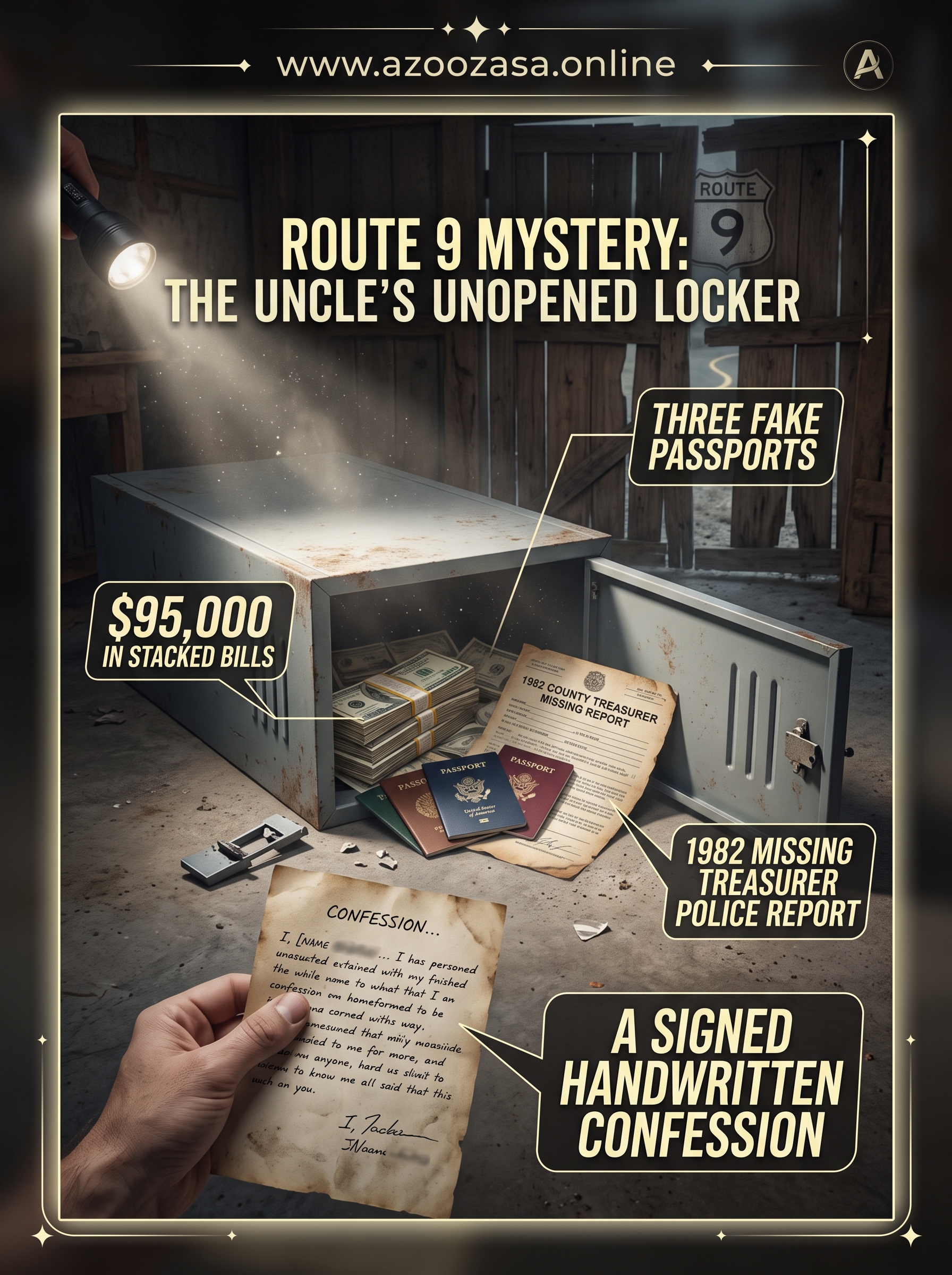
The beam of my flashlight pierced the gloom, illuminating a swirling galaxy of dust motes. There, lying flat on the cracked concrete floor, was the forbidden metal locker. The collapse of the wall had tipped it forward, and the impact had shattered its rusted iron latch. The door hung slightly ajar, daring me to look.
I hesitated. I thought of my father, now frail and resting in his armchair back at the house, still fiercely protective of his brother’s memory. But the pull of a thirty-year-old mystery was intoxicating. I stepped over a scatter of lug nuts, knelt in the dirt, and pulled the locker door open.
The Contents of a Ghost
The inside of the locker was surprisingly clean, sealed airtight for three decades. On the top shelf sat a heavy, olive-drab canvas duffel bag. I unzipped it, my hands trembling slightly in the stifling heat.
The first thing I registered was the smell—the distinct, papery musk of old currency.
Neatly arranged in thick bundles wrapped with brittle rubber bands was exactly $95,000 in cash. The bills were old, none printed later than 1981, staring up at me in a dizzying mosaic of green and gray.
Beneath the money lay a heavy leather pouch. Inside were three passports. I flipped open the first one. A younger version of Uncle Elias stared back at me, his familiar crooked nose and sharp jawline unmistakable. But the name printed beside the photograph sent a chill down my spine that completely defied the hundred-degree heat.
Thomas Vance.
I opened the second. Elias Vance. The third: Arthur Vance.
My uncle’s name was Elias Miller. He was a mechanic. He had never left the state, let alone the country. Yet here he was, staring out from official government documents under assumed names, possessing a small fortune in untraceable cash.
My flashlight beam dropped to the bottom shelf of the locker, illuminating a thick, manila folder. The tab was labeled in faded black marker: COUNTY TREASURER – 1982.
The 1982 Police Report
I carefully opened the folder, spreading the fragile documents across the dusty workbench. The first few pages were photocopies of a 1982 police report detailing a massive embezzlement case. The missing suspect was the county treasurer, a man named Arthur Vance.
According to the report, Vance had vanished in the dead of night with nearly a hundred thousand dollars of municipal funds. The police suspected he had fled the country. There were no leads, no witnesses, and the case had grown colder with each passing year.
I looked back at the passports. The puzzle pieces were colliding, forming a picture that made my stomach churn. My Uncle Elias, the quiet, hardworking mechanic who spent his Sundays drinking cheap beer on our porch, was somehow intimately connected to the county’s most notorious unsolved crime. Had Elias helped Vance escape? Had he robbed him? Or worse, was Elias an accomplice from the very beginning?
My knees felt weak as I reached for the final document at the very bottom of the folder. It was rolled tight, tied with a piece of brittle twine.
The Confession
I slipped the twine off and unrolled the stiff parchment. It wasn’t a police document or a bank statement. It was a handwritten letter, penned in blue ink that had barely faded in the dark confinement of the steel box.
I began to read, the flashlight beam trembling in my grip.
To whoever finds this,Elias had nothing to do with it. He only wanted to fix cars and be left alone. I was the one who found out what Vance was doing with the town’s pension fund. I confronted him at the quarry. I only wanted him to put the money back, but Vance pulled a gun. We struggled. The gun went off.I didn’t mean to kill him. I panicked. I took the money because I thought it would look like he ran away. I went to Elias for help, like I always did when I messed up. Elias took the cash and the forged passports Vance had prepared for his escape. He locked them away in this box. He told me to go home to my family, to raise my child, and to never speak of it again. He carried the weight of my sin so I wouldn’t have to.I am a coward. Elias is a saint.
The handwriting wasn’t my uncle’s blocky, mechanic’s scrawl. It was elegant, leaning slightly to the right, a script I had seen on every birthday card, every permission slip, and every check written throughout my entire life.
I looked down at the bottom of the page, where the ink pressed deep into the paper.
Tucked inside was a handwritten confession signed by Robert Miller. My father.
The Aftermath
The oppressive heat of the workshop suddenly felt suffocating. The air was too thick to breathe. Thirty years of my family’s history—the quiet respect for my uncle, the strict rules about the workshop, my father’s stoic, unbothered demeanor—shattered into a thousand irreconcilable fragments on the concrete floor.
My uncle hadn’t been a criminal. He had been a vault. He had taken his brother’s darkest secret, locked it behind iron and steel, and carried the key to his grave to protect our family. And my father, the man I revered for his unwavering moral compass, had let him do it.
I slowly packed the money, the passports, and the file back into the canvas bag. I closed the locker, the broken latch clinking uselessly against the frame.
I walked out of the workshop and back into the blinding July sun, the heavy canvas bag slung over my shoulder. Across the dying lawn, the back door of our house stood open. Through the screen, I could see the silhouette of my father sitting in his armchair, unaware that the thirty-year-old dam he had built had just spectacularly collapsed.
I stopped at the edge of the porch, the weight of the bag digging into my shoulder. I had to make a choice. I could walk inside, drop the bag at his feet, and demand the truth. Or, I could turn around, find a deep, quiet place in the woods, and become a vault myself.
If you were standing on that porch holding the evidence of your father’s darkest secret, how would you approach him?


0 comments