
📋 Table of Contents
The False Bottom: How a Dusty Shoe-Shine Box Unlocked a $310,000 Secret
The heavy oak doors of the law office closed with a definitive thud, sealing the remaining members of the Vance family inside. It had only been three days since we buried our father in the rain-soaked earth of the county cemetery, but my older brother, Marcus, was already acting like a king surveying his newly conquered territory.
Marcus sat at the polished mahogany conference table, his muddy work boots kicked out arrogantly in front of him. He had always been a man of loud, physical force—a man who measured worth in calluses and diesel fumes. I, on the other hand, had taken a completely different path. I spent my days designing digital media content and social media story graphics, building a dedicated audience for my platform, www.azoozasa.online. My career was built on crafting complex, suspenseful family dramas and intricate mystery plotlines for my readers.
Marcus had never missed an opportunity to mock my profession. To him, anything that didn’t involve a tractor or a sweat-stained shirt was entirely illegitimate.
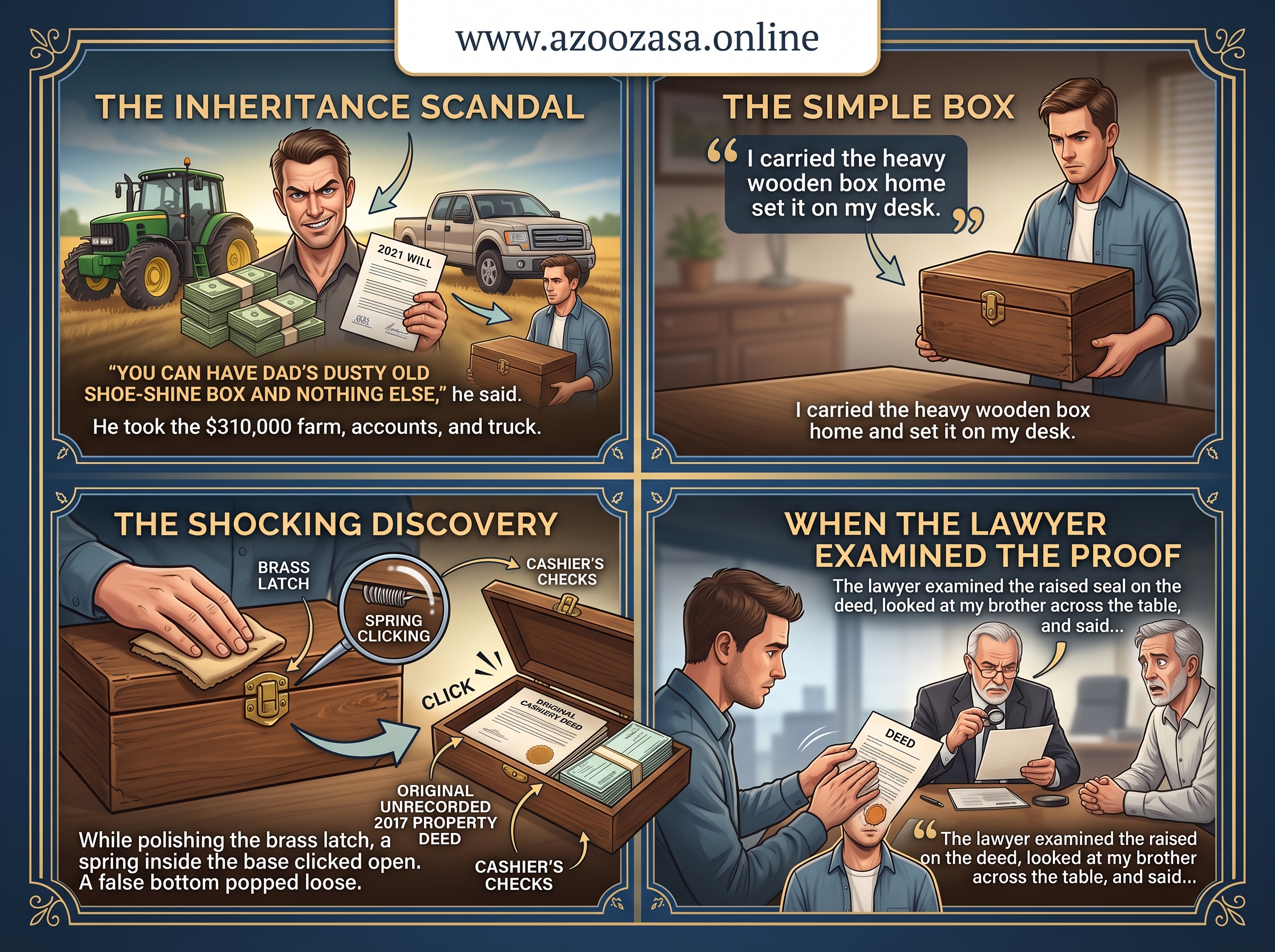
When the estate attorney, Mr. Abernathy, had read the 2021 will an hour prior, Marcus had practically glowed with triumph. According to the document, Marcus was to inherit the entirety of the estate: the $310,000 family farm, the commercial bank accounts, and the heavy-duty pickup truck.
“Well, that settles it,” Marcus had announced, standing up and snatching the keys to the F-150 off the table. He looked down at me, a cruel, satisfied smirk twisting his features. “You can have Dad’s dusty old shoe-shine box and nothing else.”
I hadn’t fought him. I had simply picked up the heavy, cedar box from the corner of the room, walked out to my sedan, and driven home.
The Cedar Heirloom
I carried the heavy wooden box into my home office and set it gently on my desk, right beside my glowing dual monitors. It looked entirely out of place—a relic of a bygone era sitting amidst modern digital technology.
But to me, it was the most valuable thing my father owned.
Every Sunday night, for as long as I could remember, my father would sit on the front porch with this box resting on his knees. He would carefully polish his heavy leather work boots, transforming the scuffed, mud-caked leather into a mirror-like finish for church the next morning. It was his quiet ritual of restoration, a silent testament to the value of maintaining the things you loved.
The box itself was beautifully crafted. It was made of thick, aromatic cedar, joined with perfect dovetails, and finished with heavy brass hinges that had oxidized to a dull, murky green over the decades.
Yesterday evening, needing a break from mapping out a new story layout on my computer, I decided to clean it. I retrieved a soft microfiber cloth and a tube of brass polish from the kitchen.
I started with the front latch. The brass was cold and tarnished, practically black from years of neglect. I applied the polish in slow, deliberate circles. As the grime began to lift, revealing the bright, gleaming metal beneath, I applied a bit more pressure to the lower bracket.
Click.
It wasn’t a sound of breaking wood. It was the sharp, metallic snap of a spring releasing under tension.
I paused, my heart suddenly hammering against my ribs. I had crafted enough fictional mysteries to recognize a hidden mechanism when I felt one. I pressed the bracket again, sliding it a fraction of an inch to the right.
The heavy, solid-wood base of the shoe-shine box shifted. A false bottom, perfectly disguised by the overhang of the side panels, popped loose and dropped half an inch onto my desk.
The Hidden Archive
I set the polishing cloth aside, my hands trembling. I carefully lifted the top half of the box away, exposing the hidden compartment beneath.
It was lined with faded green felt. Nestled perfectly inside were two items.
The first was a heavy, sealed bank envelope. I tore it open. Inside was a stack of three cashier’s checks, all issued by the county credit union, all made out directly to my name. I stared at the numbers printed across the watermarked paper, my breath catching in my throat. Each check was for exactly $15,000.
Forty-five thousand dollars in total.
I set the checks down and reached for the second item. It was a thick, legal-sized document, bound with a blue manuscript cover. Unfolding it, I recognized the heavy, archaic language of a property deed.
But it wasn’t just any deed. It was an original, unrecorded property deed for the entirety of the $310,000 family farm.
-
Grantor: Thomas Vance
-
Grantee: [My Name]
-
Execution Date: October 14, 2017
At the bottom of the final page, my father’s signature was scrawled in bold black ink, directly next to the raised, embossed seal of a public notary.
The reality of the situation washed over me in a dizzying wave. The 2021 will that Marcus had paraded around the lawyer’s office was a farce. My father had known exactly what Marcus would do when his health began to fail. He knew Marcus would bully, threaten, and coerce him into signing over the estate.
So, my father had simply given the farm away four years before that will was ever drafted. He had drained his private savings to leave me a financial cushion, hid the unrecorded deed in the one object he knew Marcus would view as utterly worthless, and let his arrogant eldest son believe he had won.
The Final Confrontation
I didn’t call Marcus. I called Mr. Abernathy.
This morning, the three of us were back in the same mahogany-paneled conference room. Marcus looked supremely irritated, repeatedly checking his expensive watch and aggressively tapping his boots against the carpet.
“I don’t know why we’re here, Abernathy,” Marcus snapped, crossing his heavy arms. “The estate is settled. I have a contractor meeting at the farm in an hour to talk about tearing down the old barn.”
I sat quietly across the table, my posture perfectly straight. I slid the blue manuscript cover and the three cashier’s checks across the polished wood, stopping them directly in front of the attorney.
“I found these hidden inside the shoe-shine box,” I said, my voice eerily calm.
Mr. Abernathy adjusted his wire-rimmed glasses and opened the folder. The room fell into a heavy, suffocating silence. I watched the attorney’s eyes scan the document, flick to the raised notary seal, and then widen in profound shock.
“What is that?” Marcus demanded, leaning forward, a sudden flicker of uncertainty crossing his face. “If it’s a bill, it’s coming out of the estate accounts.”
Mr. Abernathy slowly closed the folder and folded his hands over it. He looked up, his expression shifting from surprise to a grim, professional finality.
The lawyer examined the raised seal on the deed, looked at my brother across the table, and said, “Marcus, this is a fully executed, notarized warranty deed from 2017. In it, your father irrevocably transferred the entirety of the farm, including all outbuildings and acreage, directly to your sibling.”
Marcus scoffed loudly, slamming his hand on the table. “That doesn’t matter! The will I have is from 2021. The most recent document wins. That’s the law!”
“That is the law regarding wills,” Mr. Abernathy corrected, his voice hardening. “But a will can only distribute assets that the deceased actually owns at the time of their death. Because your father executed this deed and relinquished the property in 2017, the farm was no longer his to give away in 2021.”
The blood drained rapidly from Marcus’s face, leaving him a mottled, ashen gray. “You’re telling me… he left me nothing?”
“Not quite,” Mr. Abernathy said smoothly, pulling a separate ledger from his briefcase. “According to the 2021 will, you inherited the commercial bank accounts and the F-150 truck. However, as I was preparing the final probate documents this morning, I discovered that the bank accounts were completely drained four years ago—presumably to fund these cashier’s checks. Furthermore, your father took out a heavy title loan against the truck last year. You inherited exactly forty-two dollars in checking, and an eight-thousand-dollar lien on a vehicle.”
Marcus sat completely paralyzed, the crushing weight of his father’s final, silent judgment bearing down on him. He had spent his entire life valuing only what he could conquer, completely ignoring the quiet, meticulous details that held the world together.
I stood up, carefully gathered my documents and the three cashier’s checks, and slipped them into my leather briefcase.
“Enjoy the truck, Marcus,” I said quietly, walking toward the heavy oak doors. “Just make sure you don’t track mud into my house when you come to collect your things.”
As I stepped out into the bright morning sun, I felt a profound sense of peace. My father had trusted me to look beneath the surface, to appreciate the narrative hidden beneath the dust. And as I drove home to continue my work, I knew exactly what kind of story I was going to write next.
If you were left an item of purely sentimental value that turned out to be the key to a family secret, would you share the discovery with the relatives who dismissed you, or quietly secure your own future?


0 comments