
📋 Table of Contents
The Winter Ledger: The $28,000 Secret My Husband Left in the Cold
The autumn wind had already begun to strip the maple trees bare, leaving the quiet suburban street in a blanket of brittle, golden leaves. It had been exactly three months since Bernard’s heart simply stopped in his sleep. After forty-two years of marriage, the silence in our home was no longer just an absence of noise; it was a physical weight, pressing down on my chest every time I walked past his empty armchair.
Navigating the American retirement landscape on my own had quickly become an isolating endeavor. Without Bernard, the endless stretch of leisure time felt less like a hard-earned reward and more like a vast, empty room I was forced to sit in. I spent my mornings drinking black coffee on the front porch, watching the neighborhood wake up, desperately missing the man who used to read the paper beside me.
That Tuesday morning, a faded blue pickup truck rattled to a halt at the curb. The door creaked open, and out stepped Arthur Vance, the owner of the local hardware store where Bernard had spent practically every Saturday of his adult life.
Arthur walked slowly up the concrete path, his weathered face set in a solemn expression. In his hands, he clutched a thick, heavy manila envelope.
“Morning, Mrs. Miller,” Arthur said, his voice a gravelly whisper. He took off his corduroy cap and wrung it in his hands. “I’m sorry to intrude. But Bernard asked me to deliver this to you after his estate settled and the dust had cleared.”
The Hidden Cost of Warmth
I stood up, pulling my cardigan tighter across my chest, and took the envelope. It was heavy, packed tight with what felt like a lifetime of paperwork.
“Thank you, Arthur. Would you like to come in for some coffee?” I offered, my voice trembling slightly.
“No, ma’am. I think you’ll want to read this alone,” he replied gently. He hesitated, shifting his weight from one work boot to the other. “Bernard was the best man I ever knew. You’ll see why.”
Arthur tipped his head and walked back to his truck, leaving me alone with the mysterious package.
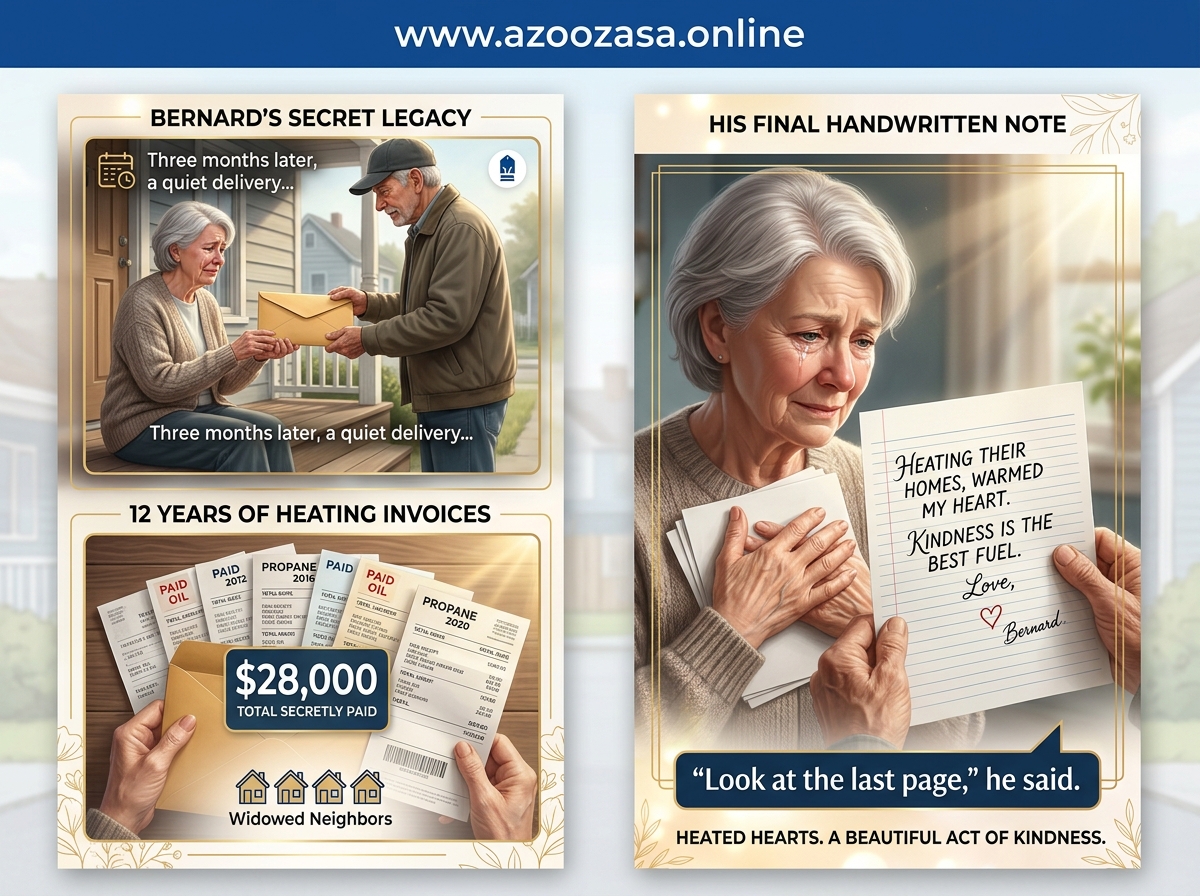
I sat back down in the wicker chair and peeled open the brass clasp. Inside was a meticulously organized folder, bound with heavy rubber bands. I pulled out the top stack. They were invoices. Hundreds of them, printed on the carbon-copy paper of our local heating oil and propane supplier, dating back twelve entire years.
I flipped through the pages, my brow furrowing in confusion. The billing name on the account wasn’t ours, but the payment method was a cashier’s check drawn from Bernard’s private credit union account—an account I thought he used to fund his woodworking hobby.
I pulled out a calculator from the kitchen drawer and began to tally the numbers. The grand total sat at the bottom of the ledger in bold, unmistakable red ink: $28,000.
My breath caught in my throat. Twenty-eight thousand dollars over twelve years.
But it wasn’t the amount that made my hands shake; it was the delivery addresses. The fuel hadn’t been pumped into our tanks. The invoices listed four specific houses on our very street.
-
742 Elm Street: Martha Higgins
-
750 Elm Street: Evelyn Clark
-
758 Elm Street: Beatrice Lowe
-
764 Elm Street: Agatha Pennington
They were the four widows of Elm Street.
I knew these women well. They were fixtures of our neighborhood, elderly women navigating the precarious reality of senior care in the United States on fixed Social Security incomes. I knew the painful choices they often had to make. When Medicare premiums rose and the cost of living spiked, luxuries vanished first. Then, the necessities began to shrink.
I remembered how Bernard used to quietly look out for them. He believed strongly in maintaining their physical health and independence. During the brutal Midwestern winters, he was always the first one out at dawn, aggressively shoveling and salting their walkways so they could maintain their daily exercise routines without the fear of a devastating fall. In the summers, he would harvest the bulk of our garden, marching up the street with heavy baskets of fresh vegetables, insisting that the nutritional benefits of whole foods were better than any prescription pill the doctors could write.
I had always known my husband was a kind man, a man of quiet, localized service. But I had never known the sheer financial magnitude of his guardianship. He had been secretly paying their heating bills for over a decade, ensuring that four vulnerable women never had to choose between buying their blood pressure medication and turning on their furnaces when the January freeze set in.
Tears blurred my vision. I pressed the stack of crinkled, carbon-copy invoices against my collarbone, overwhelmed by the profound, invisible legacy of the man I loved. He had sacrificed his own leisure, his own retirement savings, to be the silent protector of our street.
The Final Note
The crunch of gravel pulled me from my thoughts. Arthur hadn’t left. He had parked his truck at the end of the street and walked back. He climbed the porch stairs, his eyes shining with unshed tears.
“You found the addresses,” Arthur said softly, nodding at the paperwork in my lap.
“He paid for all of them,” I whispered, the tears finally spilling over my cheeks. “For twelve years, Arthur. He never said a word.”
“Bernard was a vault,” Arthur agreed, stepping closer. He reached out and gently tapped the heavy manila folder still resting on my knees. “But you haven’t read the most important part. Turn to the very last page, Mrs. Miller.”
My trembling fingers sifted through the remaining invoices, pulling aside the heavy cardboard backing of the folder. Tucked at the very bottom was a piece of plain, lined notebook paper. It was covered in Bernard’s unmistakable, blocky handwriting.
Arthur pointed to the center of the page. “Read what he wrote.”
I wiped my eyes with the back of my sleeve and focused on the blue ink.
My Dearest Eleanor,If you are reading this, it means I have gone on ahead of you. I know you will be looking at these numbers and wondering why I kept such a large secret from my best friend.For years, I watched Martha, Evelyn, Beatrice, and Agatha navigate this life alone after their husbands passed. I saw how quiet their houses became, and how cold the winters felt when there was no one left to share the blanket. I helped them because it was the right thing to do.But as the years went on, and my own health began to falter, my reasons became entirely selfish.I knew that one day, my heart would give out. I knew that one day, you would become a widow on Elm Street, too. The thought of you sitting in this house alone, facing the terrifying quiet of those winter months without me, was a weight I could not bear.I didn’t just pay their heating bills, Eleanor. I was making an investment. I was building a community. I kept their houses warm for twelve years, so that when my time finally came, they would be there to keep your heart warm.Let them in, my love. You are not alone.
The Warmth of Community
The paper fluttered to the porch deck as a ragged sob broke from my throat. Bernard hadn’t just been protecting them; he had been preemptively protecting me. He had spent a decade carefully orchestrating a safety net for his wife, ensuring that the day he left this world, I would be immediately caught by the very women he had saved.
Arthur squeezed my shoulder, offered a sad, beautiful smile, and quietly walked back to his truck.
I sat on the porch for a long time, the cold autumn wind whipping around me, yet I felt an overwhelming, radiant heat blooming in my chest.
About an hour later, I saw movement at the end of the block.
Martha Higgins stepped out of her front door, clutching a covered casserole dish. A moment later, Beatrice Lowe emerged, leaning heavily on her cane but walking with determined steps. Soon, Evelyn and Agatha joined them.
The four widows of Elm Street were walking together down the leaf-strewn sidewalk, heading directly toward my house.
They didn’t know about the $28,000. They didn’t know about the secret ledger or the invoices in my lap. They only knew that their neighbor was hurting, and they were coming to do exactly what Bernard knew they would do.
I stood up, wiped my face, and walked down the porch steps to meet them halfway. The winter was coming, and the house behind me was painfully quiet, but as I opened my arms to the women approaching my driveway, I knew I would never truly be cold again.
If you were to discover a secret act of long-term generosity left behind by a loved one, how would you choose to honor their hidden legacy in your own life?


0 comments