
📋 Table of Contents
Forged in Silence
The Three Thousand Five Hundred Dollar Disgrace
Fourteen years is a terrifying amount of time to be wrong. It is five thousand, one hundred and ten days of waking up, brewing coffee, and aggressively justifying a mistake that quietly eats you alive from the inside out.
The night I broke my family was unseasonably warm. My son, Mitchell, was nineteen years old. I was a senior partner at a mid-sized accounting firm, a man who measured human worth in degrees, GPAs, and white-collar trajectories. For two years, I had been funneling money into a college savings account, determined that my son would follow in my footsteps, or at least attend the state university to study business.
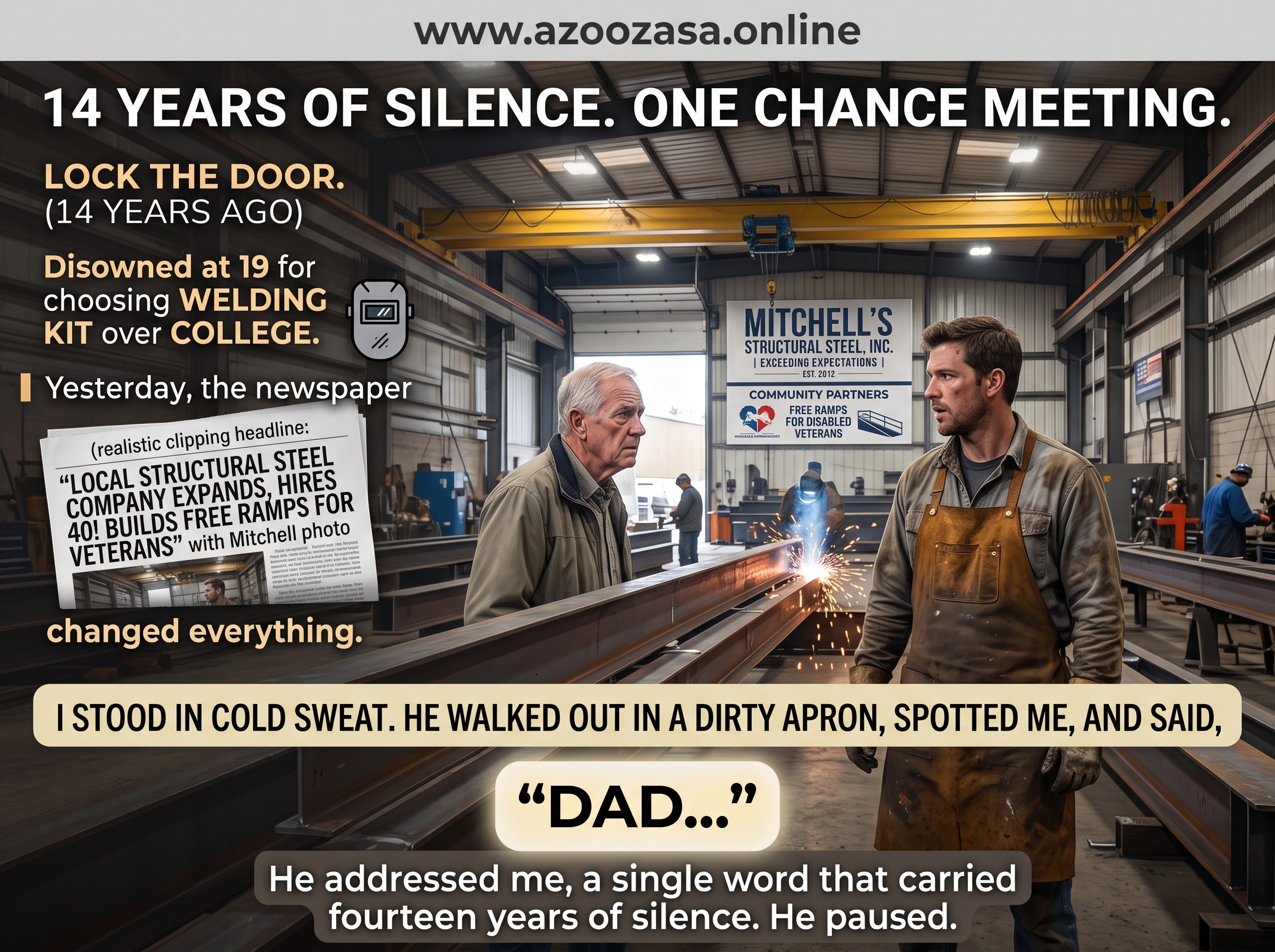
Instead, Mitchell came home smelling of ozone and burnt metal. He stood in the center of our pristine living room, grease smeared across his cheek, and announced he wasn’t going to college. He had emptied his own savings account—three thousand, five hundred dollars he had earned working the graveyard shift at a local warehouse—and purchased a used, heavy-duty Miller Bobcat engine-driven welder.
“It’s a down payment on my life, Dad,” he had pleaded, his young eyes fierce and bright with a passion I refused to understand. “I want to build things. Real things. I can make a business out of this.”
I didn’t see passion. I saw blue-collar failure. I saw the death of the polished, socially acceptable future I had arrogantally scripted for him. The argument escalated quickly, fueled by my wounded pride and his desperate need for validation.
“You’re throwing your life away to be a mechanic!” I had shouted, the veins in my neck throbbing. “I didn’t raise you to crawl around in the dirt. If you walk out that door with that ridiculous machine, you’re a disgrace to this family. Do not come back until you’re ready to apologize and enroll in classes.”
Mitchell looked at me. The fierce brightness in his eyes extinguished, replaced by a cold, hardened steel. He didn’t yell. He didn’t cry. He simply picked up his duffel bag, walked out the front door, and started his beat-up truck.
I locked the deadbolt behind him, completely certain he would be back within the week when his money ran out.
He never came back.
The County Chronicle
For a decade and a half, the silence between us was absolute. I refused to call, anchored by my own toxic stubbornness, and Mitchell granted me the exact exile I had demanded. My wife passed away seven years into the silence, her heart broken by the chasm between the two men she loved most. Even at her funeral, Mitchell stood at the back of the cemetery, a solitary figure in a dark suit, leaving before I could gather the courage to cross the wet grass.
Then came last night.
My younger brother, Ray, came over for our weekly game of chess. He didn’t bring the board. Instead, he walked into my kitchen and slapped the Sunday edition of the county newspaper onto the granite island.
“You need to look at this,” Ray said quietly. “And then you need to get over yourself.”
I pulled my reading glasses down and looked at the cover of the County Chronicle’s business section. There, standing in front of a massive, half-constructed commercial warehouse, was Mitchell. He was thirty-three now. His shoulders were broad, his jawline sharp and dusted with dark stubble, and his eyes held the weary, confident weight of a man who had built an empire with his bare hands.
The headline read: HEAVY METALS, HEAVY HEARTS: LOCAL STEEL FIRM EXPANDS, GIVES BACK.
I sat down on the barstool, the breath leaving my lungs in a rushed exhale. I read the article three times, my vision blurring with a mixture of profound shock and crushing guilt. The statistics of his “ridiculous machine” were staggering:
| The Genesis (14 Years Ago) | The Reality (Today) |
| Initial Investment: $3,500 used welder | Annual Revenue: Nearing $8.5 Million |
| Workforce: Just Mitchell | Workforce: 40 full-time, union-waged local fabricators |
| My Assessment: “A disgrace” | Community Assessment: “A pillar of local industry” |
But the numbers weren’t what broke me. It was the sidebar of the article. Over the last three years, Mitchell’s company, Apex Structural, had been quietly donating materials, labor, and engineering time to build free, high-grade steel ADA ramps for disabled combat veterans across the state.
“We build the heavy stuff so other people don’t have to carry the weight,” Mitchell was quoted as saying at the end of the piece.
I had locked him out for choosing a path of failure. He had spent the next fourteen years becoming a better, more successful, and vastly more compassionate man than I had ever been.
The Cold Sweat
I barely slept. By 7:00 AM, I was in my car, driving toward the industrial park on the outskirts of town.
The morning air was crisp, but the collar of my dress shirt was already damp with a cold, terrifying sweat. I was driving into a world I had mocked, to face a man I didn’t know, carrying fourteen years of compounded apologies that suddenly felt entirely inadequate.
I pulled into the massive, gravel-paved lot of Apex Structural. The sheer scale of the operation was intimidating. Flatbed trucks idled near the gates, loaded with massive, rust-colored I-beams. The air smelled sharply of diesel exhaust, burning ozone, and grinding metal.
I parked my sedan near the main office, a small brick building dwarfed by three massive, corrugated steel garage bays. The massive bay doors were rolled up, revealing the chaotic, brilliant ballet of heavy fabrication. Blue light flashed in intense, rhythmic bursts as a dozen welders joined joints, sending showers of golden sparks cascading across the concrete floor.
My legs felt like lead as I stepped out of the car. I didn’t go to the office. I walked slowly toward the largest garage bay, the deafening roar of angle grinders and heavy machinery vibrating in my chest.
I stood near the edge of the bay, feeling completely out of place in my slacks and polished loafers. I searched the floor, looking past the sparks and the forklift traffic.
The Forklift Lane
Then, I saw him.
Mitchell was walking out of a smaller, adjoining fabrication room. He was wearing a heavy, fire-resistant canvas apron, blackened with soot and scarred by years of flying slag. His welding helmet was flipped up on his head, and he was wiping grease from his hands with a red shop rag.
He was talking and laughing with one of his foremen, projecting the easy, commanding presence of a natural leader.
I took a step forward, my heart hammering violently against my ribs.
Mitchell turned his head. His laughter stopped instantly. He froze, the red shop rag hanging limply in his hands. From fifty feet away, across a noisy, crowded workshop floor, the air between us suddenly grew incredibly still.
He didn’t run. He didn’t shout. He simply handed a clipboard to his foreman, murmured something, and began walking toward me.
Every step he took felt like a physical blow to my chest. He was taller than I remembered. The boy I had yelled at in my living room was entirely gone, replaced by a formidable man forged in the exact fire I had tried to extinguish.
He stopped five feet away from me. The smell of burnt steel and ozone clung to his clothes. He looked at my polished shoes, then up to my aging, terrified face.
For ten agonizing seconds, neither of us spoke. I opened my mouth, but the grand, sweeping apology I had rehearsed in the car evaporated in my throat.
Mitchell finally broke the silence. His voice was deep, steady, and entirely devoid of the anger I expected.
“You’re standing in the forklift lane, sir,” Mitchell said softly.
The formality of the word sir cut me deeper than any insult ever could. It was a professional boundary, a reminder that in this world—his world—I was just a visitor who had lost his privileges a long time ago.
“Mitchell, I…” My voice cracked, sounding frail and old over the roar of the shop floor. I took a shaky breath and stepped out of the painted yellow safety lane. “I saw the paper last night. Your uncle Ray brought it over.”
Mitchell nodded slowly, his face an unreadable mask. “It was a good write-up. The boys in the shop deserve the recognition. The ramp project was their idea.”
“It’s incredible,” I said, my voice trembling. “What you’ve built here. It’s… it’s incredible. I was wrong, Mitchell. I was so arrogant, and so completely wrong about everything.”
I looked down at the concrete, unable to meet his eyes as the shame finally overtook me. “I don’t expect you to forgive me. I don’t deserve it. You took that three thousand dollars and you built an empire, and I spent fourteen years building a prison out of my own pride. I’m sorry. I am so, so terribly sorry.”
A heavy silence fell between us again, insulated from the noise of the shop. I waited for him to tell me to leave. I waited for him to point to the gate and echo the words I had thrown at him fourteen years ago.
Instead, I heard the heavy sigh of a man who had carried his own heavy weight for too long.
“Mom loved this place, you know,” Mitchell said quietly.
My head snapped up.
“She used to come by on Tuesday afternoons,” Mitchell continued, looking out over the shop floor. “She’d bring sandwiches for the crew. She sat right over there on those steel pallets and watched us work. She always asked why you wouldn’t come.”
The tears finally broke, spilling hot and fast down my cheeks. My wife had known. She had bridged the gap in secret, loving him when I refused to.
Mitchell pulled a pair of heavy leather work gloves from his apron pocket. He looked at me, his jaw tightening slightly as he navigated the ghosts standing between us.
“I have a client meeting in twenty minutes, and a structural load test on a municipal bridge beam after that,” Mitchell said, his tone shifting back to the pragmatic rhythm of a business owner.
I nodded, wiping my eyes, preparing to turn and walk back to my car.
“But,” Mitchell added, his voice softening just a fraction, “the coffee in the breakroom is terrible. Like, battery-acid terrible. If you want to go sit in there and wait… I can take a late lunch at one o’clock. We can talk.”
It wasn’t instant forgiveness. It wasn’t a tearful embrace. It was simply a tiny, steel-reinforced bridge over a fourteen-year canyon. It was grace, freely given by a man who knew how to build things that last.
“I’d like that,” I whispered. “I’d like that very much.”
Mitchell gave a single, firm nod. He pulled his welding helmet down over his face and walked back into the shower of sparks, leaving me standing safely on the edge of the forklift lane, finally ready to begin the heavy work of repair.


0 comments