
📋 Table of Contents
The Weight of Unshed Tears
The Tuesday Delivery
The sky was a bruised, heavy purple the afternoon the stranger knocked on my door. It had been twenty-two years since my world effectively ended, and twenty years since I decided to navigate the wreckage alone.
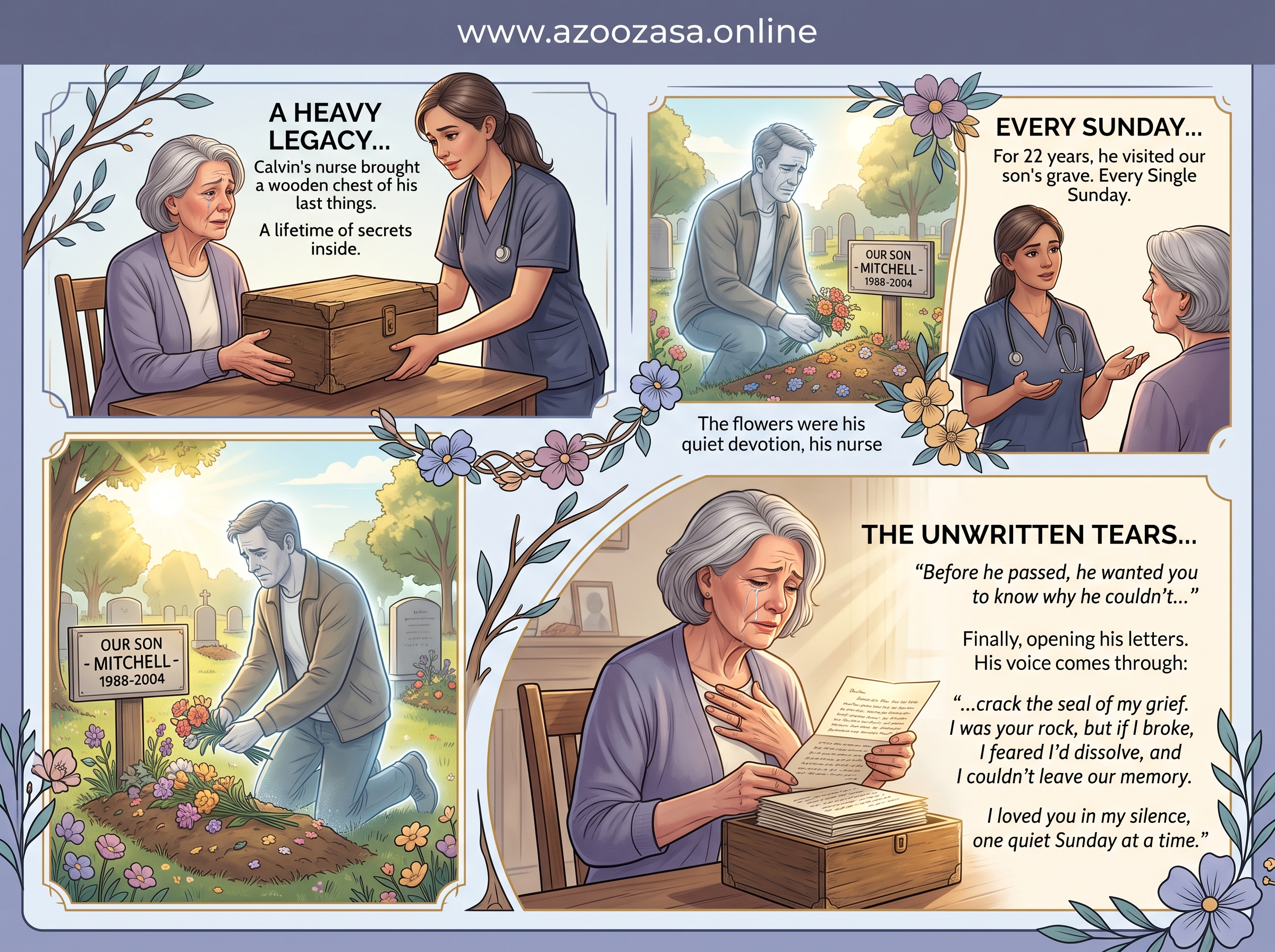
I opened the front door to find a woman in her early thirties, wearing floral scrubs and a weary but gentle expression. In her arms, she held a large, heavily varnished wooden box. It looked like an old ammunition crate, its brass hinges oxidized and green with age.
“Helen?” the woman asked, her voice soft against the low rumble of distant thunder. “My name is Sarah. I was your ex-husband’s hospice nurse.”
My breath hitched, catching sharply in my throat. I had received the brief, sterile phone call from the county three weeks prior notifying me that Calvin had passed away in an assisted living facility two states over. I hadn’t attended the funeral. I had mourned the man I married two decades ago; the man who died last month felt like a ghost I had intentionally left behind.
“I’m sorry for your loss, Sarah, but I think you’ve made a long drive for nothing,” I said, my voice defensive and brittle. “Calvin and I haven’t spoken since the divorce.”
“I know,” Sarah replied gently, shifting the heavy box to her hip. “He told me. But he made me promise on his last day to bring this to you personally.”
Reluctantly, I stepped aside and let her into the foyer. She set the wooden box down on the entryway table. It landed with a dull, heavy thud that seemed to rattle the floorboards.
“He was a quiet man,” Sarah said, lingering near the door. “He didn’t talk much to the staff. But every Sunday, for the two years he was at our facility, he would have a local florist back in this town deliver fresh white carnations to a grave at St. Jude’s Cemetery. He said it was for his son. He said he hadn’t missed a single Sunday in twenty-two years.”
I stared at her, the blood rushing in my ears like a physical roar. White carnations.
Every Sunday since my sixteen-year-old son, David, died in that horrific crash on Route 9, I had visited his grave. And every Sunday, there was already a fresh bouquet of white carnations resting against the headstone. For twenty-two years, I had assumed the groundskeeper or a charitable cemetery committee was placing them there. The thought that Calvin—the man who hadn’t shed a single tear at our son’s funeral—had been the invisible architect of that tribute was impossible to process.
Sarah reached out and placed her hand over mine. Her skin was warm, grounding me in the chilling foyer.
“He loved you both very much,” Sarah whispered, her eyes shining with unshed tears of her own. “Before he passed, he wanted you to know why he couldn’t… why he couldn’t let you see him break.”
The Ice Age
After Sarah left, I sat in the silent hallway for an hour, just staring at the wooden box.
When David’s car skidded off the wet asphalt and hit the embankment twenty-two years ago, the police arrived at our house at two in the morning. I collapsed on the porch, screaming until my vocal cords tore. I fractured into a million jagged pieces right there on the welcome mat.
But Calvin hadn’t reacted. He had stood perfectly still, his face an unreadable mask of stone. He calmly took the officer’s card, thanked him, and then turned to me with dry, empty eyes.
Throughout the nightmare that followed—the agonizing identification, the funeral arrangements, the burial itself—Calvin remained entirely stoic. While I wept until I was physically sick, he handled the catering, shook hands with our weeping relatives, and stared blankly at the polished mahogany casket. I needed a partner in my grief, someone to share the crushing, suffocating weight of the loss. Instead, I found myself married to a statue.
I mistook his shock for apathy. I mistook his silence for a lack of love. The resentment built up like frost on a windowpane, eventually freezing us completely out of each other’s lives. Two years later, I handed him divorce papers. He signed them with that same blank expression, packed his bags, and left.
The Unlocking
My hands trembled as I finally reached out and unlatched the oxidized brass clasp of the wooden box. The lid creaked open, releasing the faint, nostalgic scent of cedar, old paper, and Calvin’s favorite drugstore aftershave.
The box was filled to the brim. There were no grand legal documents or hidden fortunes. Instead, the crate contained the meticulously preserved artifacts of a man who had secretly refused to move on.
-
The Ledgers: Three small, leather-bound notebooks detailing every floral arrangement he had ordered for David’s grave for over two decades.
-
The Relics: David’s tarnished silver pocket watch, the one he had in his jacket on the night of the crash, polished until it gleamed.
-
The Letters: Stack upon stack of unlined, yellowing envelopes, all addressed to me in Calvin’s unmistakable, sharp handwriting.
I reached for the first stack of envelopes, bound together by a brittle rubber band that snapped the moment I touched it. The earliest letter was dated just three days after David’s funeral.
I unfolded the thick paper, bracing myself for the echoes of a dead man.
The Confession in Ink
My Dearest Helen,I am writing this from the kitchen table while you sleep. The doctor gave you a sedative, and it is the first time in four days you aren’t shaking. I am watching you breathe from the doorway, terrified that if I take my eyes off you, you will stop.I know you are looking at me with hatred. I can see it in your eyes when I try to hand you a glass of water. You think I don’t care. You think because I haven’t cried, I am hollow inside. God, Helen, if you only knew.The truth is, I am holding back an ocean that is drowning me from the inside. When the officer told us David was gone, I felt my mind physically detach from my body. But then I looked down and saw you collapse. I saw the absolute destruction of the only other person on this earth I love.I made a choice in that fraction of a second. I decided that one of us had to survive this to keep the other alive. If I let go, if I let myself feel the absolute, blinding agony of losing my boy, I knew I would shatter. And if we were both shattered, who was going to arrange the funeral? Who was going to answer the door? Who was going to carry you when your legs gave out?I built a dam inside my chest to protect you. But I didn’t realize that a dam doesn’t just hold back the water; it turns the land around it into a desert. I am so sorry I can’t be what you need. I am so sorry my strength looks like abandonment.
The tears I hadn’t shed in years suddenly spilled over my cheeks, dropping heavily onto the yellowed paper.
I tore through the envelopes, reading letter after letter, chronologically tracing the agonizing slow-motion collapse of our marriage through his eyes. He wrote to me every single week. He documented his silent suffering, his desperate desire to reach out to me, and his paralyzing fear that breaking his stoic facade would somehow traumatize me further.
I finally reached an envelope near the bottom of the box, dated the night before our divorce was finalized. The handwriting was erratic, the ink smeared in several places.
Helen,Tomorrow I will sign the papers, and I will leave this house. It is the hardest thing I have ever done, but I know it is the only way you can heal. The sight of my face only reminds you of the coldness you felt when we buried our son.But before I walk out that door, I need to confess my greatest sin. It wasn’t just to protect you that I locked my tears away. It was my punishment.You didn’t know this, but the night David took the car, we had a fight in the driveway. He was upset about a girl at school, and he was crying. I was tired, irritable from work, and I lost my temper. The last words I ever spoke to our sixteen-year-old son were, “Stop crying, David. Be a man and hold it together.”Two hours later, he was dead.When the police arrived, those words echoed in my head like a death knell. I told my son not to cry, and then he died. How could I dare to shed a tear for him when I had shamed him for doing the exact same thing? I didn’t cry at the funeral because I didn’t believe I deserved the release of tears. I had forfeited my right to mourn him the moment I mocked his own sorrow.I will spend the rest of my life buying him flowers, hoping that wherever he is, he knows his father finally learned how to weep. I love you, Helen. I will always love you. Please forgive my silence.
The Sunday Vow
I sat on the floor of my foyer for hours, surrounded by twenty-two years of a man’s agonizing penance. The rain outside had turned into a steady, rhythmic downpour, masking the sound of my own violent, heaving sobs.
I had spent two decades despising Calvin for a lack of feeling, completely blind to the fact that he was carrying a burden of grief so profound it had slowly crushed him to death. He hadn’t abandoned me in my grief; he had martyred his own emotional survival to ensure I wouldn’t have to carry the logistical nightmare of our tragedy. He had sentenced himself to a life of silent exile because of one terrible, fatherly mistake in a driveway.
The following Sunday morning, the sky was a brilliant, unblemished blue.
I drove to St. Jude’s Cemetery, carrying a fresh bouquet of white carnations. I walked the familiar path down the grassy hill toward David’s headstone.
For the first time in twenty-two years, the space against the granite marker was entirely empty. There were no anonymous flowers waiting for me. The invisible caretaker was finally at rest.
I knelt down on the damp grass and placed the carnations against the stone. I traced the engraved letters of my son’s name, and then I closed my eyes.
“He loved us, David,” I whispered to the crisp morning air, the heavy weight of decades of resentment finally lifting from my shoulders. “He loved us so much it broke him.”
I stood up, leaving the flowers behind. I walked back to my car, knowing that the next day, I would be calling the cemetery director to purchase the empty plot directly beside my son, ensuring that when my time came, the three of us would finally be together again, resting in a place where there were no more secrets, and no more tears to hide.

0 comments