
📋 Table of Contents
The Mechanics of Arrogance: A Spark in the Dark
The Chasm of Class
My sister Elise and I grew up in the same modest suburban house, sharing a bathroom and a hand-me-down sedan, but somewhere in our twenties, our paths violently diverged. Elise married Preston, a corporate litigation attorney whose family name was practically etched into the brass plaques of every courthouse in the state. I married Jack. Jack didn’t wear Italian leather shoes; he wore steel-toed boots. He didn’t carry a leather briefcase; he drove a Ford F-250 loaded with diagnostic computers and hydraulic wrenches. Jack is a heavy-equipment mechanic, the guy they call when a fifty-ton earthmover dies at the bottom of a quarry.
Elise and Preston’s tenth anniversary party was designed to be a coronation rather than a celebration. They had rented the botanical gardens of a historic estate, stringing the ancient oak trees with thousands of fairy lights. A string quartet played softly in the background while waitstaff in crisp white shirts circulated with silver trays of tuna tartare and champagne.
Jack and I stood near the edge of the patio. He looked handsome in his charcoal suit, though he tugged uncomfortably at the collar. His hands, resting on the edge of a cocktail table, told the story of his life. They were broad, heavily calloused, and bore the faint, permanent shadow of industrial grease embedded deep within the knuckles. I loved those hands. To me, they represented safety, hard work, and an unwavering reliability. To my brother-in-law, they were a punchline.
The Intellectual Burden
Two hours into the evening, Preston cornered us near the open bar. He was three scotches deep, his face flushed with the warm glow of his own perceived superiority. He had just finished regaling a group of his law partners with a story about a multi-million dollar settlement he had negotiated, laughing a little too loudly at his own brilliance.
He turned to Jack, his eyes dropping briefly to the scuffed knuckles wrapped around my husband’s glass of sparkling water.
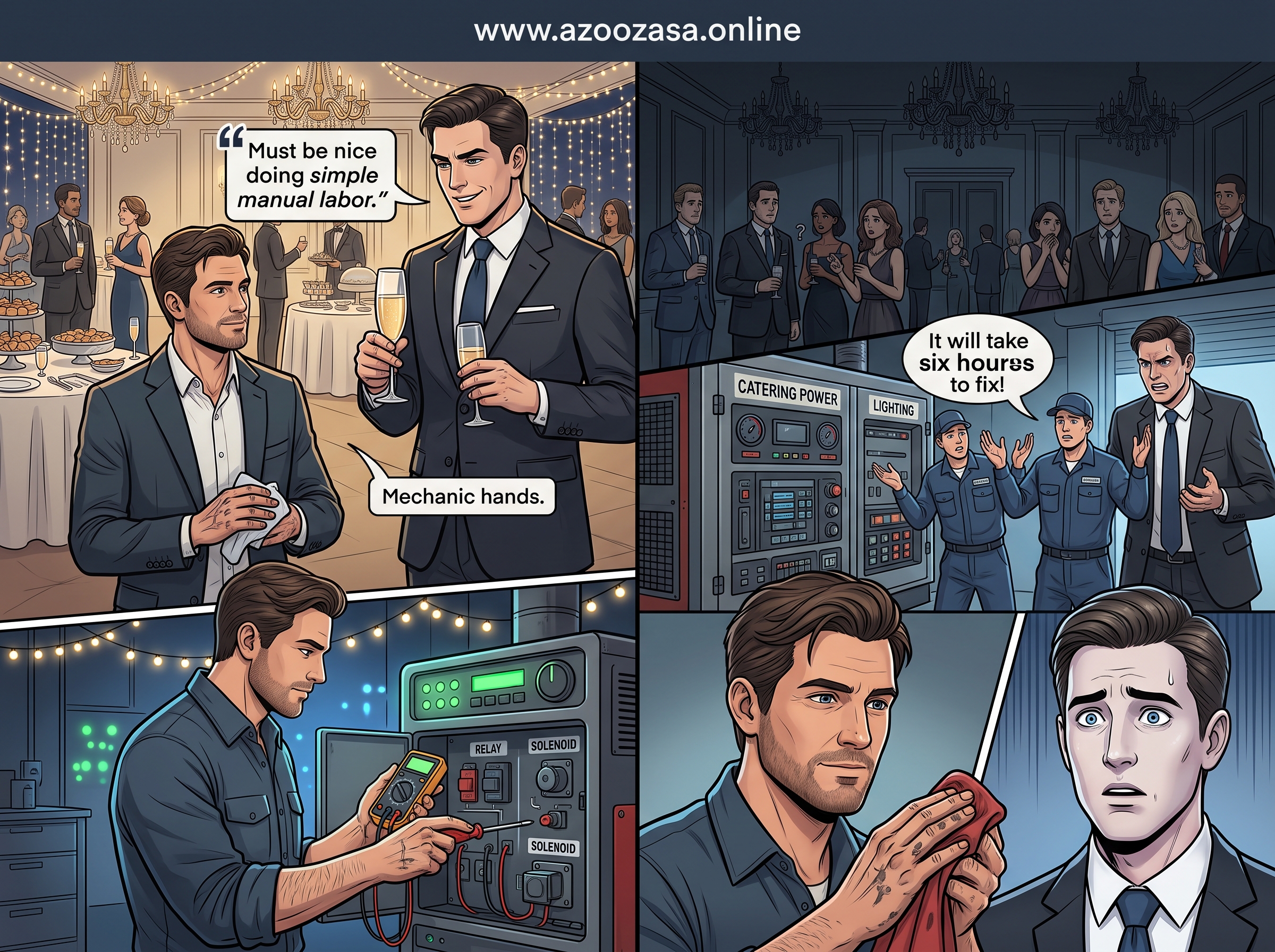
“You know, Jack, I often envy you,” Preston slurred slightly, a condescending smirk playing on his lips. “Must be nice doing simple manual labor. You clock out at five, wash the dirt off, and your day is done. No intellectual burden. No complex problem-solving keeping you awake at night. Just… turning wrenches. There’s a beautiful, primal simplicity to it.”
The surrounding circle of lawyers went deathly quiet. I felt a hot, jagged spike of anger flare in my chest. I opened my mouth to tear into Preston, to explain that diagnosing a CAN-bus communication error on a computerized diesel engine required more analytical thinking than filing boilerplate injunctions, but Jack gently placed a hand on my arm.
He didn’t take the bait. He just looked at Preston with a calm, unbothered expression.
“It has its moments, Preston,” Jack said softly. “Congratulations on ten years.”
He turned and led me away toward the gardens. I was vibrating with rage, but Jack just smiled, kissing the top of my head. “Don’t let him rent space in your head, honey. He only knows what he knows.”
The Blackout
Exactly twenty minutes later, just as the catering director announced that the $18,000 prime rib and lobster dinner was about to be served, a loud, concussive POP echoed from the maintenance driveway behind the hedges.
Instantly, the estate plunged into absolute, pitch-black darkness.
The fairy lights died. The string quartet screeched to a halt. The ambient glow from the catering tents vanished. A collective gasp rose from the two hundred guests, followed quickly by the panicked voices of the catering staff.
Without power, the massive commercial refrigerators holding the seafood would begin warming immediately. The electric carving stations were dead. The carefully curated ambiance dissolved into a chaotic, blind stumble.
Through the darkness, the frantic voice of the venue manager cut through the noise. He was talking into a radio. “The main generator tripped. Send the techs out back, now.”
Ten minutes dragged by in total darkness, illuminated only by the frantic bouncing beams of smartphone flashlights. Preston was shouting at the venue manager, his polished composure completely shattering as his perfect night fell apart.
I stood with Jack, who was quietly sipping his water. “Sounds like the standby unit failed to carry the transfer load,” he murmured, mostly to himself.
Three hired technicians in polo shirts jogged past us toward the service driveway, carrying a small toolbox. Ten minutes later, they emerged, looking defeated.
We heard one of them report to the hyperventilating venue manager. “The logic board is locked out. It’s not recognizing the fuel pressure sensor. We can’t clear the fault code without the proprietary diagnostic software, and our shop is closed. It’s going to take at least six hours to get a senior tech out here with a laptop.”
Preston looked like he was going to be physically sick. “Six hours? The food will be ruined! This whole night is ruined! Do you know who I am? Fix it!”
A Masterclass in Manual Labor
Jack sighed. He set his water glass down on the edge of a stone fountain. “I’ll be right back.”
He jogged out to the gravel parking lot. A minute later, he returned, carrying a heavy, scuffed Pelican case. Without asking for permission, he pushed past Preston, the venue manager, and the bewildered technicians, striding directly toward the massive, industrial 150kW diesel generator sitting in the maintenance bay.
I followed close behind, holding up my phone flashlight so I could watch. Preston trailed behind us, sputtering indignantly.
Jack popped the heavy metal latch on the generator’s control panel. He didn’t look at the flashing digital screen that had defeated the technicians. He looked at the mechanical architecture behind it.
Here is how the situation played out over the next two hundred and forty seconds:
| The “Experts” Approach | Jack’s Blue-Collar Methodology |
| Focus: The digital interface and fault codes. | Focus: The physical flow of electricity and fuel. |
| Tool of Choice: Proprietary software (unavailable). | Tool of Choice: A $40 multimeter and a schematic in his head. |
| Diagnosis: A catastrophic software failure. | Diagnosis: A mechanical failure triggering a false digital safety lockout. |
Step 1: The Assessment. Jack pulled a digital multimeter from his kit. He ignored the computer completely and tested the leads on the primary wiring harness. “Voltage drop across the safety circuit,” he muttered.
Step 2: The Identification. He traced the thick wire down to a metal block near the fuel pump. “The computer is fine,” Jack said, his voice echoing in the metallic housing. “The vibration from the initial startup rattled the primary fuel shutoff relay loose. The computer thinks there’s no fuel pressure because this physical switch lost contact, so it killed the engine to save the injectors.”
Step 3: The Bypass. He reached into his kit and pulled out a small set of wire strippers and a heavy-gauge jumper wire. The hired technicians gasped.
“Hey, buddy, you can’t hotwire a commercial rig like that!” one of them yelled. “You’ll fry the board!”
Jack didn’t even look up. “Only if you bypass the load resistor. Which I’m not doing.”
He clamped the jumper wire, bypassing the faulty, loose relay, and tightened the connections with a socket wrench. He stepped back, wiping his hands on a blue shop towel he pulled from his back pocket.
“Stand back,” Jack ordered. He reached out and manually engaged the massive starter solenoid.
The diesel engine cranked once, twice, and then roared to life with a deafening, beautiful rumble. A second later, the transfer switch slammed shut with a heavy THUNK.
The fairy lights blazed back to life. The catering tents illuminated. The quiet hum of the refrigerators kicked back in. The entire estate was bathed in warm, triumphant light. It had taken him exactly four minutes.
The True Cost of Power
A massive cheer erupted from the patio. The venue manager nearly collapsed in relief.
Jack calmly closed the heavy steel panel on the generator, latched it securely, and tossed his tools back into the Pelican case. He picked up his shop towel and began meticulously wiping the diesel soot from his calloused knuckles.
Preston stood near the edge of the driveway, illuminated by the harsh security light above the maintenance bay. All the blood had drained from his face. His mouth hung slightly open, the arrogance entirely stripped away, leaving only the embarrassing reality that he had been completely helpless to save his own perfect evening.
Jack picked up his heavy tool case. He walked over to Preston, stopping just inches away. The contrast between the two men had never been sharper.
Jack didn’t raise his voice. He didn’t boast. He just offered Preston a polite, devastatingly calm smile.
“That’s the funny thing about simple manual labor, Preston,” Jack said, his voice steady over the rumble of the diesel engine. “When the world goes dark, a law degree won’t turn the lights back on. Enjoy your dinner.”
He didn’t wait for a response. Jack turned and walked back toward the party, his hand reaching out to find mine. The rest of the night, Preston didn’t say a word to us. He sat quietly at the head table, picking at his eighteen-thousand-dollar prime rib, staring into the bright, fairy-lit canopy above him—lights that were only shining because a man with grease on his hands knew exactly how to carry the burden of a broken world.
If you found yourself in a situation where your partner was being belittled for their profession, how would you handle the confrontation?


0 comments