
📋 Table of Contents
The Ghost of Westford
The Tuesday Routine
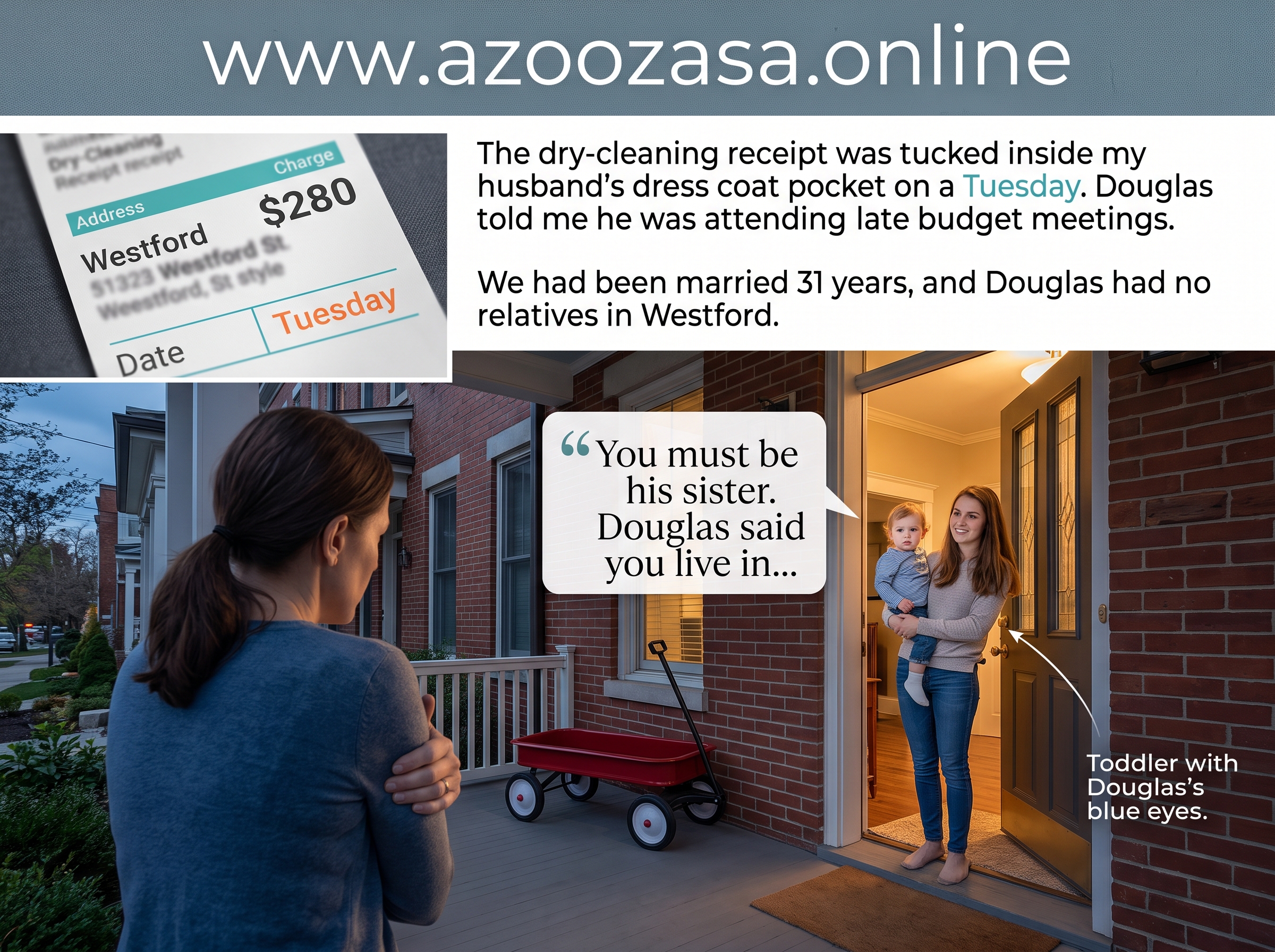
The dry-cleaning receipt was tucked inside my husband’s dress coat pocket on a Tuesday. It was a mundane, overcast morning, the kind of day that blends seamlessly into the background of a thirty-one-year marriage. I was gathering the weekly dry cleaning, checking Douglas’s pockets out of sheer habit—a practice born from years of finding forgotten ballpoint pens and crumpled toll receipts.
My fingers brushed against a stiff piece of thermal paper in the inner breast pocket of his charcoal wool overcoat. I pulled it out, expecting a coffee receipt. Instead, I stared at a charge from “Elite Cleaners” for $280. The itemized list detailed three women’s winter coats: a cashmere trench, a wool peacoat, and a child’s heavy down parka.
They had been delivered to a residential address in Westford, a suburban town eighteen miles away.
We had been married for three decades. Our own children were grown, living in different time zones. Douglas had no relatives in Westford, no female colleagues he was close enough with to manage their dry cleaning, and certainly no reason to be paying for a child’s winter coat. For the past two years, he had been coming home later and later, sighing heavily as he dropped his briefcase by the door, blaming the exhaustions of late budget meetings at his corporate office.
The Drive
I drove to the Westford address the next evening with a cold knot in my chest. The drive took exactly thirty-two minutes down the interstate, the setting sun casting long, skeletal shadows through the bare autumn trees. With every mile marker I passed, I tried to construct a logical, innocent explanation. Perhaps it was a charity donation. Perhaps a colleague had fallen on hard times. But thirty-one years of intimacy affords you a sixth sense about your spouse, and the terrifying, icy dread pooling in my stomach told me the truth long before my GPS announced I had reached my destination.
It was a beautiful brick townhouse at the end of a quiet cul-de-sac. The lawn was impeccably manicured. On the front porch, resting next to a pair of muddy miniature rainboots, was a bright red toy wagon.
I parked across the street, my hands gripping the leather steering wheel so tightly my knuckles ached. I sat there for ten minutes, watching the warm yellow light spill from the townhouse windows. Finally, operating on a strange, detached autopilot, I stepped out into the crisp evening air and walked up the paved driveway.
I rang the doorbell.
A young woman answered the door. She looked to be in her early thirties, with warm, tired eyes and hair pulled up in a messy clip. Resting on her left hip was a toddler, no more than two years old. As the porch light illuminated the child’s face, the breath left my lungs in a violent rush. The boy had Douglas’s exact, striking blue eyes and the same slight, asymmetrical dimple on his left cheek.
The woman looked at me, a polite, questioning smile on her lips. Then, her eyes dropped to my face, studying my features. A flash of sudden, joyous recognition washed over her.
“Oh, my goodness,” she breathed, her smile widening into something entirely genuine and welcoming. “You must be his sister, Eleanor.”
I froze, the blood roaring in my ears like a freight train.
“Douglas said you live in Maine,” she continued, shifting the toddler to her other hip. “He told me you rarely travel because of the winters and your husband’s health. I’m Elena. I am so, so glad you finally came to visit. Please, come inside!”
The Architecture of a Lie
“The most dangerous lies are the ones built on a foundation of partial truths.”
I didn’t scream. I didn’t cry. A strange, clinical calm washed over my panic, freezing it into something sharp and dangerous. I was not Eleanor, his sister—Eleanor had died of a heart defect when Douglas was just twenty. I was Clara, his wife. But in that horrific, suspended second on a stranger’s porch, I realized the absolute magnitude of my husband’s deception. He hadn’t just had an affair. He had constructed an entirely parallel existence.
“I… I can’t stay long,” I managed to say, forcing my voice to mimic a warm, apologetic tone. “I wanted it to be a surprise, but I have a flight to catch.”
“Oh, Douglas will be so devastated he missed you!” Elena said, her face falling slightly. “He’s in Chicago for his quarterly board retreat. He won’t be back until Friday.”
Chicago. Douglas had kissed my cheek that morning, telling me he had back-to-back strategy meetings at the downtown office and would be staying at the corporate apartment all week.
“He works so hard for us,” Elena sighed affectionately, gently bouncing the toddler. “Leo here misses his daddy terribly when he travels. But Douglas always says the sacrifice is worth it to give us this life, especially after everything he went through.”
“Everything he went through?” I asked softly, carefully fishing for the narrative he had spun.
Elena’s expression softened into one of deep, sorrowful empathy. “Losing his first wife to cancer ten years ago. He told me how hard that was on you, too. I know it took a long time for him to open his heart again. But we’re so happy, Eleanor. I just wish you could stay for dinner.”
I was dead. In this brick townhouse, with this beautiful young woman and this blue-eyed child, Clara did not exist. I had been killed off by a fictitious illness a decade ago to clear the stage for his second act.
“I’m so glad he found you,” I whispered. It was the only honest thing I said all night. I was glad she was innocent. I was glad she loved the man she thought she knew. Because the devastation I was about to rain down on his life would spare her the worst of the legal fallout, but it would shatter her heart anyway.
The Accounting of Betrayal
I walked back to my car, my legs feeling like lead, my mind racing with terrifying clarity. I didn’t drive home immediately. I pulled into a brightly lit diner two towns over, ordered a black coffee, and pulled a notepad from my purse.
For the next two hours, I sat in a vinyl booth and cross-referenced the last three years of our marriage against the horrifying reality I had just discovered. The discrepancies, once hidden by my absolute trust, now glowed like neon signs.
| Douglas’s Alibi (The First Marriage) | The Reality (The Second Family) |
| “Emergency Dental Surgery” in September 2024. Claimed he needed to isolate in the guest room for a week. | The exact timeframe of Leo’s birth, based on the toddler’s apparent age. |
| “Corporate Salary Restructuring” in 2023. He claimed his base pay was reduced in exchange for stock options. | Funneling forty percent of his liquid income to afford the Westford townhouse mortgage and Elena’s expenses. |
| “Quarterly Board Retreats” out of state. | Long weekends spent playing the devoted, tragic widower in the suburbs. |
He was a master illusionist, funding his pristine new life with the financial foundation we had built over three decades. Our joint accounts, the equity in our home, the retirement funds we had dutifully contributed to—he was bleeding our history dry to finance his delusion.
The Friday Reckoning
I did not confront Douglas when he returned from “Chicago” on Friday evening. Confrontations offer the guilty an opportunity to explain, to manipulate, to beg. Douglas had forfeited his right to a conversation the moment he buried me alive in his own twisted narrative.
Instead, I spent Thursday morning in the sleek, glass-walled office of the most ruthless family law attorney in the city. By Thursday afternoon, an emergency forensic accountant was pulling the threads of our joint finances, locating the hidden LLC Douglas had used to purchase the Westford property. By Friday morning, a judge had quietly frozen our primary assets to prevent capital flight, pending the formal service of divorce papers.
When Douglas finally walked through the front door of our home at 6:00 PM on Friday, the house was entirely dark.
He dropped his keys on the entryway table. “Clara? Honey, I’m home. The traffic on the interstate was a nightmare.”
He walked into the kitchen, flipping on the overhead lights. He stopped dead.
The house was perfectly clean, but practically empty of my existence. My coats were gone from the mudroom. My favorite ceramic mugs were missing from the rack. The framed photographs of our children that usually lined the hallway had been packed away.
Sitting dead center on the marble kitchen island was a single, neatly arranged display.
There was the $280 dry-cleaning receipt from Elite Cleaners. Next to it was a printed photograph I had taken from across the street in Westford, showing the red toy wagon on the porch. Resting on top of the photograph was his heavy gold wedding band—the one he claimed to take off when he played golf, but clearly removed before he pulled into the cul-de-sac.
And finally, a small, handwritten note on my personal stationery. It read:
“Dear Douglas, I am writing to inform you that a miracle has occurred. Your first wife has been cured of her terminal cancer. Unfortunately, her resurrection comes with the complete liquidation of your assets, the exposure of your hidden LLC, and a very detailed phone call to Elena. My lawyer will be in touch. Enjoy the coats.”
I was already three states away, driving toward my daughter’s house, watching the sun set in my rearview mirror. For thirty-one years, I had built a life with a ghost. Now, it was his turn to be haunted by the wreckage of the truth.


0 comments