
📋 Table of Contents
The Escapement of Truth
The Main Course of Condescension
The dining room of Corinne and Sterling’s newly constructed, hyper-modern mansion always felt less like a home and more like a sterile, aggressively lit art gallery. We sat around a massive slab of polished marble that served as a dining table, picking at a catered truffle risotto that was rapidly cooling. For the past two hours, the conversation had been a thinly veiled exercise in asserting dominance, a family drama playing out over expensive silverware.
I had spent the last thirty years of my life in the conservation laboratories of the metropolitan museum. My career was defined by quiet, meticulous patience—stabilizing cracking sixteenth-century tempera, coaxing tarnished silver back to life, and carefully documenting the invisible scars of history. It was a career of preservation, of respecting the past. To my brother-in-law Sterling, a hedge fund manager who viewed history only as an asset class to be hoarded, and his wife Corinne, my work was entirely incomprehensible.
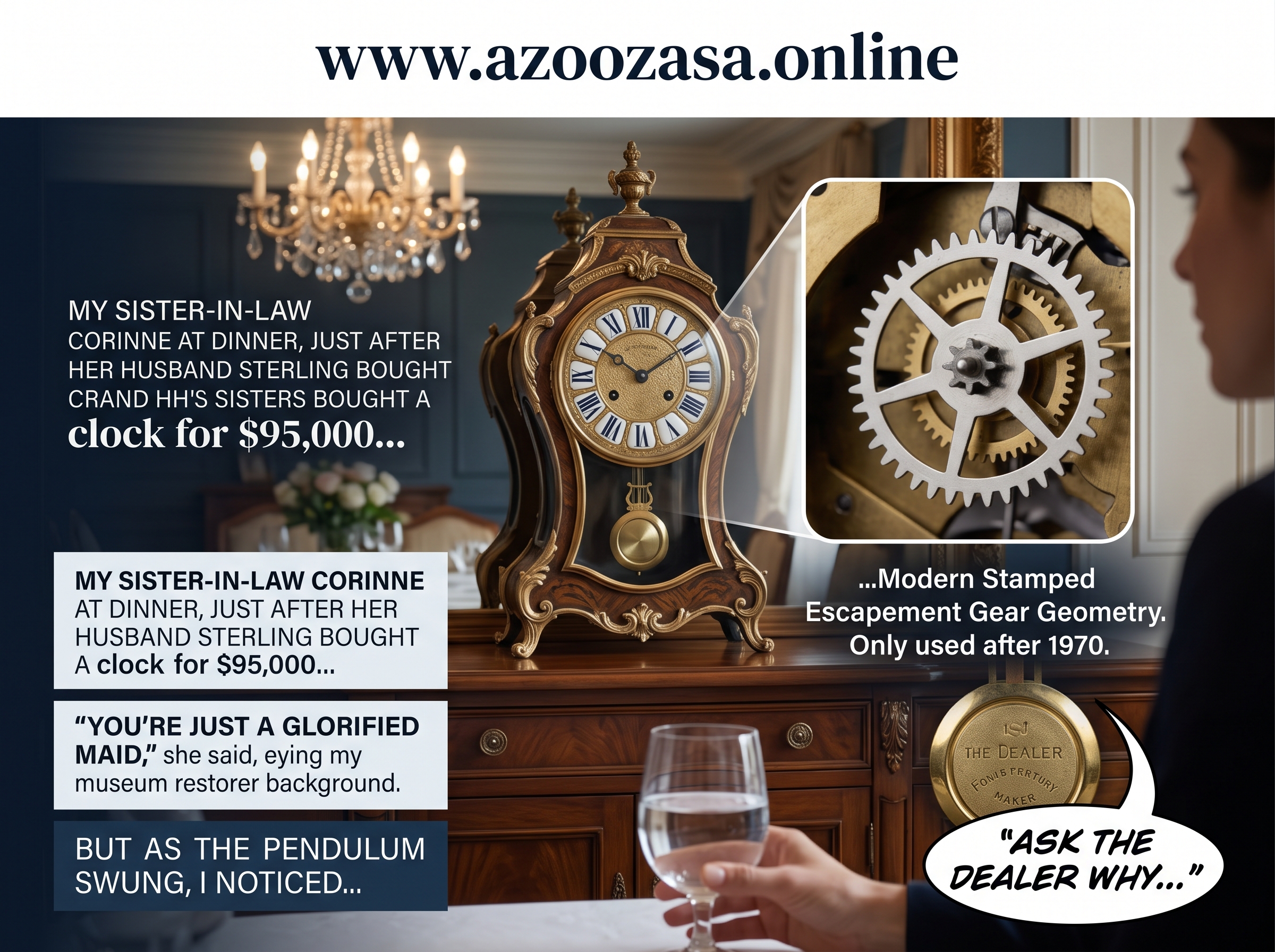
“I just don’t understand how you don’t get bored,” Corinne said, resting her chin on her hand, the diamonds on her tennis bracelet catching the harsh overhead light. She offered me a smile that didn’t reach her eyes. “Thirty years in a dusty basement, wiping grime off old bowls. Honestly, when you think about it, you’re just a glorified maid.”
The insult hung in the air, heavy and deliberate. Across the table, my husband shifted uncomfortably, opening his mouth to defend me, but I placed a gentle hand on his knee under the table to stop him. I didn’t need defending against Corinne. Her arrogance was a shield for her own insecurities, and I had learned long ago that reacting only gave her the validation she desperately craved.
Sterling chuckled, swirling a generous pour of twenty-year-old scotch in his crystal glass. He clearly saw this as his cue. He had invited us to dinner for one specific reason, and Corinne’s barb was just the opening act. He wanted to mock my three decades of expertise by showing off what his money could buy.
“Speaking of old things,” Sterling announced, his chest puffing out beneath his tailored Italian shirt. “I acquired a new piece for the collection today. An investment, really. It requires no dusting, Corinne, I assure you. I had the dealer bring it over this afternoon before I wire the final balance tomorrow.”
The Ninety-Five Thousand Dollar Boast
Sterling stood up and gestured grandly toward the long mahogany sideboard at the edge of the dining room. Sitting in the center, flanked by two horrific modern art sculptures, was a mantle clock.
Even from ten feet away, it was visually arresting. It was a heavy, ornate piece of supposedly 18th-century French craftsmanship. Gilded bronze figures—allegorical representations of Time and Virtue—draped themselves over a central marble column that housed a brilliant white enamel dial.
“Louis XVI period,” Sterling declared, his voice booming with unearned authority. “Attributed to the workshop of Jean-Antoine Lépine, circa 1785. The dealer assured me it belonged to a minor count in the Loire Valley before the Revolution. Total steal at ninety-five thousand dollars. I put a ten percent deposit down today.”
He walked over and proudly opened the glass rear door of the clock to expose the movement, wanting us to appreciate the mechanics of his wealth. He gave the pendulum a gentle nudge.
Tick. Tick. Tick.
“Men talk of killing time, while time quietly kills them.” — Dion Boucicault
As the pendulum swung, establishing its rhythmic heartbeat, the atmosphere in the room shifted for me. My eyes, trained by thirty years of looking at the microscopic details of historical artifacts, immediately locked onto the exposed brass movement.
While Sterling continued to pontificate about the superiority of French horology and how museum curators like me “couldn’t afford to touch” pieces of this caliber, my mind went entirely quiet. The sound of the ticking was… wrong. It was too crisp. The acoustic resonance lacked the subtle, organic irregularity of hand-filed brass teeth engaging with steel pallets.
I stood up from the table, my napkin slipping from my lap. I didn’t say a word as I walked over to the sideboard, ignoring Sterling’s smug grin.
“Careful now,” Sterling warned condescendingly. “Don’t get your fingerprints on the ormolu. It’s highly sensitive to oils.”
I ignored him, leaning in close. I watched the escapement wheel—the toothed gear that interacts with the pendulum to regulate the release of energy. The geometry of the gear teeth was absolutely flawless. Perfectly symmetrical, with microscopic shear marks on the interior edges.
I let my eyes trail down the backplate, following the swing of the pendulum. Hidden just behind the brass suspension spring, stamped into the metal in a place most buyers would never think to look closely, was a tiny, perfectly uniform maker’s mark. It wasn’t an engraved signature of a French master. It was a machine-pressed serial code.
The Anatomy of a Fraud
I stood back, took a slow sip of my water, and looked directly at my brother-in-law. The smugness on his face was practically radiating, completely oblivious to the reality ticking away on his sideboard.
I pointed to the maker’s mark hidden under the pendulum brass and said, “Before you wire the rest of the money tomorrow, Sterling, ask the dealer why a master Parisian clockmaker working under Louis XVI in 1785 was utilizing a mechanized, progressive die-stamping technique pioneered in Dayton, Ohio, during the Nixon administration.”
The dining room fell so silent you could hear the rain starting to patter against the floor-to-ceiling windows.
Sterling’s confident smirk vanished, replaced by a deep, defensive frown. “What are you talking about? You’re being ridiculous. It comes with a certificate of authenticity. The dealer is highly respected in the city.”
“Certificates can be printed,” I said, my voice calm, projecting the steady authority of the museum laboratory. “But metallurgy and manufacturing techniques cannot lie.”
“You’re just jealous,” Corinne snapped, standing up abruptly. Her face was flushed red. “You spend your whole life looking at dirty old junk and you can’t stand that Sterling bought a real masterpiece!”
“I’m not jealous, Corinne,” I replied gently. “I’m trying to save your husband from losing eighty-five thousand dollars on a well-constructed Frankenstein.”
I turned back to the clock and motioned for Sterling to come closer. Reluctantly, he did, his bravado rapidly draining as he stepped into my domain of expertise.
“Look right here,” I instructed, pointing the tip of my index finger near, but not touching, the escapement wheel.
To break down the deception clearly, I mentally categorized the evidence just as I would in a condition report for the museum’s acquisitions committee. I laid out the stark contrasts for them:
| Expected 18th-Century Characteristics | What Sterling Actually Bought |
| Gear Teeth: Hand-filed, showing slight, microscopic irregularities under magnification. | Gear Teeth: Perfectly uniform geometry with shear marks indicative of modern hydraulic die-stamping. |
| Maker’s Mark: Deeply hand-engraved, often uneven, usually on the lower backplate. | Maker’s Mark: A shallow, perfectly kerfed alphanumeric code (post-1970) stamped near the suspension. |
| Patina: Natural, uneven oxidation of the brass resulting from centuries of atmospheric exposure. | Patina: An artificial, uniform chemical wash designed to mimic age, lacking depth. |
“The case is likely authentic,” I conceded, gesturing to the marble and bronze exterior. “Perhaps early 19th century, rather than 18th. But the original movement must have been destroyed or lost. Someone took a modern, mass-produced Ohio clock movement—likely manufactured for a reproduction catalog in the 1970s—chemically aged the brass with a liver of sulfur solution, and retrofitted it into this antique case.”
Sterling leaned in, squinting at the tiny alphanumeric stamp I had pointed out. He swallowed hard. The color completely drained from his face, leaving him looking sickly under the harsh lighting.
“A seventy-dollar movement in a decent antique case,” I summarized, stepping away from the sideboard. “At auction, as a marriage of parts, it might fetch three or four thousand dollars. For its decorative value. Certainly not ninety-five thousand.”
The Final Chime
Corinne looked frantically between her husband, me, and the clock. “Sterling? Tell her she’s wrong. Tell the glorified maid she doesn’t know what she’s talking about.”
But Sterling was silent. He was arrogant, but he wasn’t entirely stupid. He could see the microscopic, perfectly uniform stamp I had pointed out. He realized the fatal error he had made in trying to flex his wealth in front of someone whose entire life was dedicated to verifying historical truth.
“I… I need to make a phone call,” Sterling muttered, his voice barely a whisper. He didn’t look at me. He didn’t look at Corinne. He just turned and practically fled the dining room, pulling his phone from his pocket with shaking hands.
Corinne stood frozen, her mouth opening and closing like a fish out of water, the cruel confidence entirely stripped away. The humiliation was absolute, amplified by the fact that it was delivered with simple, irrefutable facts.
I walked back to the table, picked up my purse, and looked at my husband, who was trying very hard, and failing, to suppress a massive grin.
“I think we’ll skip dessert, Corinne,” I said, my tone polite but final. “The risotto was quite enough. Have a lovely evening. And do let us know how things go with the dealer.”
As we walked out of the sterile, echoing house and into the cool evening air, the only sound left in the dining room was the crisp, perfectly modern, terribly expensive tick, tick, tick of a fraud.
What techniques do you think modern forgers use to try and bypass the scrutiny of professional conservators and authenticators?



0 comments