
### The Stolen Canvas
The smell of turpentine and linseed oil was the only inheritance Elena had ever truly wanted. For thirty years, that scent had drifted through the drafty, attic-turned-studio of Julian Vance, a man whose brushstrokes commanded millions and whose ego commanded the oxygen in any room he entered. To the world, Julian Vance was a titan of modern impressionism—a visionary whose canvases captured the melancholic light of coastal France and the raw grit of urban solitude.
To Elena, he was simply the shadow under which she painted.
Whenever Elena showed her work to gallery owners, the critique was always the same: *“Lovely technique, my dear, but it lacks your father’s fierce vitality. You inherited his blood, but not his fire.”*
She had spent her life trying to strike that fire from her own flint, believing her artistic inadequacies were a personal failing. Then, her father died of a sudden stroke at seventy-four, leaving behind a grieving public, a fiercely protective estate managed by her older siblings, Marcus and Victoria, and a multi-million-dollar art empire poised to soar even higher in value.
—
The dismantling of a legacy is a quiet affair. It begins with cardboard boxes and bubble wrap.
A week after the funeral, Elena was tasked with clearing out her father’s private study—a locked sanctum sanctorum where no one, not even his wife during her lifetime, had been allowed to clean without supervision. Tucked behind a heavy, dust-covered mahogany wardrobe, Elena found a loose floorboard. Inside lay a heavy, oil-stained leather portfolio that smelled faintly of lavender and old paper.
Inside were no sketches of Julian’s famous coastal scenes. Instead, there were charcoal studies, personal journals, and signature stamps belonging to Elena’s mother, Clara.
Clara had died when Elena was twelve, remembered by the family history as a gentle, domestic soul who occasionally dabbled in watercolors to pass the time. But as Elena flipped through the yellowed pages of her mother’s diary, the ink bled a devastating truth.
> *“Julian cannot bear the gallery’s rejection of his new portrait series,”* Clara had written in 1988, her handwriting sharp and elegant. *“He wept tonight, saying bankruptcy looms. He took my ‘Seascape in Grey’ and signed his name to the corner before I could stop him. He said it was for our family, for our security. He promised it was a one-time necessity. But the galleries cheered. And the door closed behind me forever.”*
Page after page, entry after entry, the portrait of a marriage was rewritten into a grand theft. Clara had painted the “Vance Masterpieces”—the iconic *Solitude Series*, the celebrated *Midnight Harbor*, the very canvases hanging in museums across Europe and America. Julian had provided the signature, the charisma, and the ruthless ambition. When Clara attempted to paint under her own name years later, Julian had locked her away from supplies, convincing her, and the few friends she had left, that her mind was too fragile for the public eye.
Elena sat on the dusty floorboards, the portfolio heavy in her lap, as the tears finally came—not of grief for her father, but of fierce, incandescent rage for the ghost of her mother.
—
Marcus and Victoria arrived that evening, their faces flushed with the excitement of a preliminary appraisal.
“The *Solitude* piece alone is clearing eight million at Christie’s next month,” Marcus announced, tossing his car keys onto the kitchen counter. “Dad was a genius to the very end. We’re going to set up a foundation in his name, Elena. You’ll get a small stipend, of course, to keep you painting your little landscapes.”
Elena didn’t look up from the kitchen table, where the leather portfolio lay open.
“Dad didn’t paint them,” she said softly.
Victoria laughed, pouring a glass of wine. “Oh, stop being dramatic, Elena. Jealousy doesn’t become you, especially now.”
“He stole them from Mom,” Elena said, her voice rising, cutting through the kitchen like broken glass. She slid Clara’s diary and the initial sketches across the marble counter. “He stole every single stroke. He silenced her, broke her spirit, and built an empire on a lie.”
The silence that followed was absolute. Marcus picked up the diary, his eyes scanning a page detailing the exact mixing technique Julian had famously claimed as his own trade secret. Color drained from Marcus’s face.
“Burn this,” Marcus whispered, dropping the book as if it were burning hot. “Are you out of your mind? Do you know what this does? The estate value drops to zero. The lawsuits from collectors, the fraud investigations—we’ll be ruined. Everything we have is tied up in those paintings.”
“Good,” Elena said, standing up to her full height. “Because none of it belongs to us.”
Victoria stepped forward, her voice venomous. “You listen to me, Elena. You keep your mouth shut. If you try to pull this stunt, we will cut you out completely, sue you for defamation, and destroy whatever pathetic little career you’re trying to build.”
—
The art world loves a scandal, but it despises a disruption of its economy.
When Elena walked out of the family estate that night, she didn’t take her clothes or her savings; she took the portfolio. She didn’t go to the police—art forgery laws from decades prior were a legal labyrinth, and her father’s powerful friends controlled the boards of major institutions. Instead, she went public.
Elena launched a digital campaign titled **#TheTrueVance**.
Using social media, she published high-resolution scans of Clara’s original sketchbooks side-by-side with Julian’s celebrated masterpieces. She posted excerpts from Clara’s diaries, detailing the psychological abuse, the forced isolation, and the systematic theft of a woman’s artistic identity. She didn’t ask for money; she asked for truth.
The internet erupted. Within forty-eight hours, #TheTrueVance was trending worldwide. Independent art historians began digging into Julian Vance’s archives, finding anomalies in his brushwork timelines—sudden stylistic leaps that made no sense until viewed through the lens of a second, hidden hand.
Marcus and Victoria fought back viciously. They hired high-priced crisis PR firms, claiming the diary was a bitter fabrication by an unstable, untalented daughter seeking posthumous fame. They filed emergency injunctions to shut down Elena’s social media accounts, threatening her with ruinous lawsuits.
Museums holding the *Solitude Series* panicked, pulling the paintings from display pending authenticity reviews. Shares in the Vance Estate holdings plummeted. The multi-million-dollar empire was bleeding out in real-time.
—
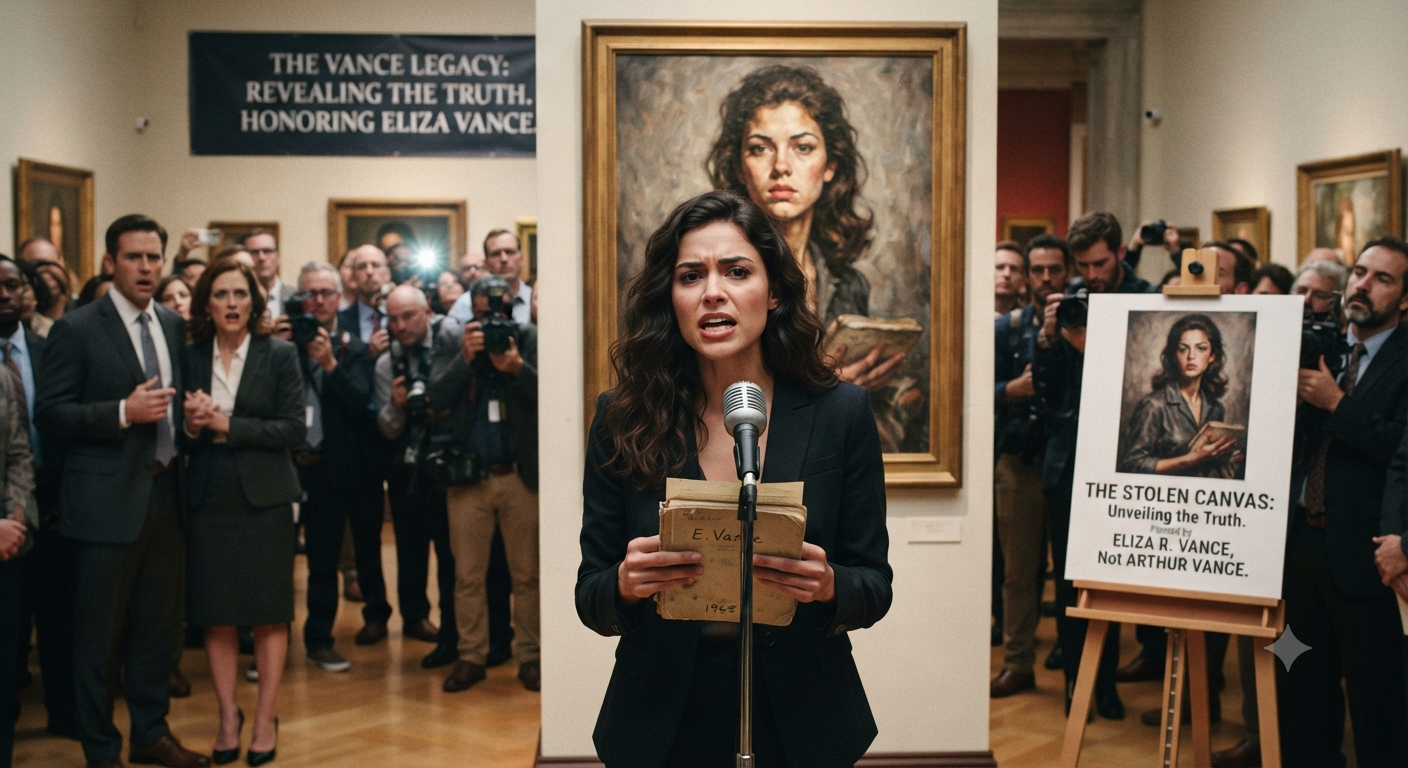
Three months after finding the portfolio, Elena stood inside a modest, independent downtown gallery—not her father’s grand uptown sanctuary.
The room was packed to capacity. Cameras flashed, reporters crowded the aisles, and prominent curators whispered among themselves. Marcus and Victoria were nowhere to be found, having fled public scrutiny after a major auction house officially suspended sales of the Vance collection pending a federal fraud inquiry.
On the main wall hung a single canvas. It wasn’t one of Julian’s grand, deceptive masterpieces. It was Clara’s *Seascape in Grey*—the very painting that had started the nightmare, now cleaned and restored to its original brilliance.
In the bottom right corner, beneath the heavy, fraudulent signature of Julian Vance, a small, elegant restoration had been made. A conservator’s delicate touch had revealed the original signature, hidden for decades beneath a layer of protective varnish: *Clara Vance, 1988.*
Elena stepped up to the microphone, the glare of the television lights washing over her face. She looked tired, but her shoulders were unburdened. The shadow was gone.
“My father was a gifted man,” Elena spoke into the microphone, her voice steady and clear, echoing across the silent room and into millions of homes livestreaming the event. “He had a gift for promotion, for persuasion, and for marketing. But he was not a painter.”
She turned and looked up at her mother’s work, watching the turbulent, beautiful grey waves painted so many years ago by a woman forced into silence.
“Today, we aren’t destroying a legacy,” Elena smiled, her voice ringing with quiet triumph. “We are finally letting a true artist see the light.”



0 comments