
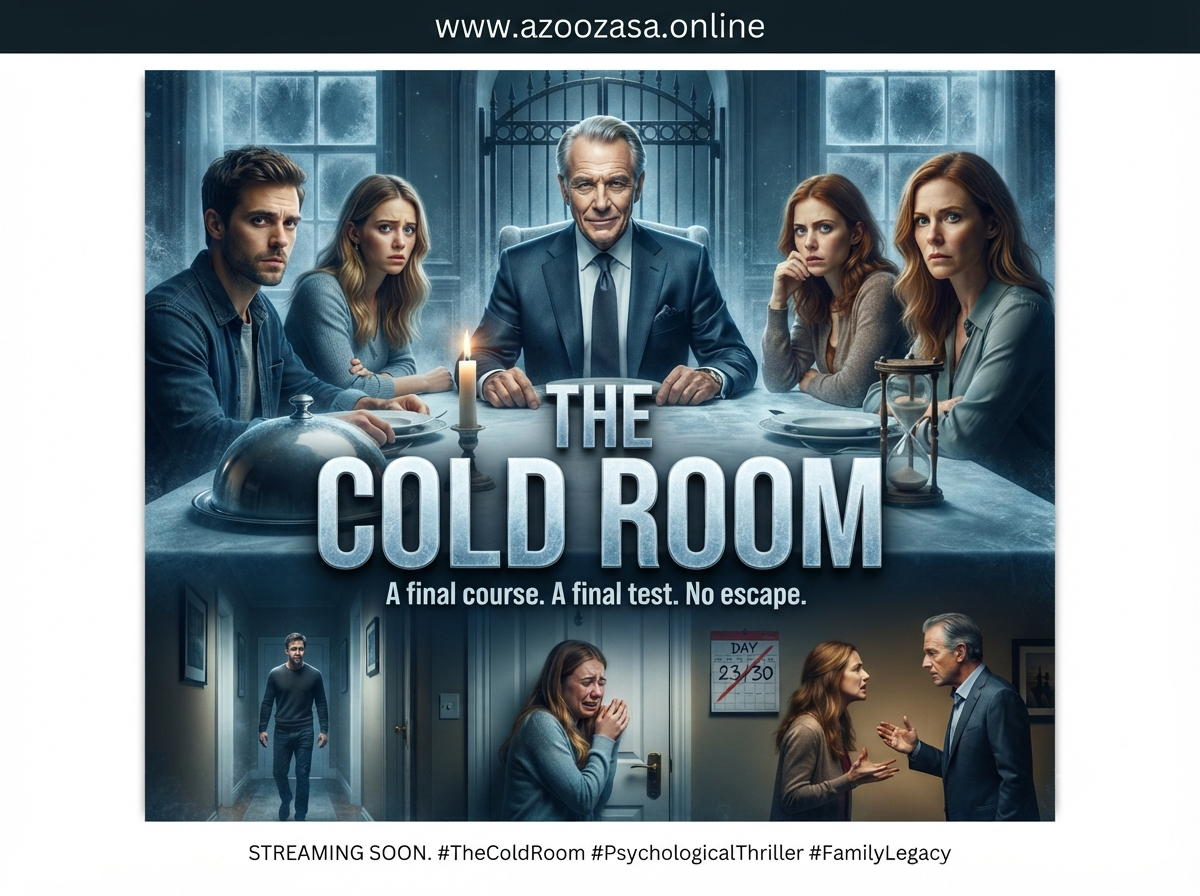
The dining room of the estate smelled of roasted venison, aged truffles, and calculated cruelty.
At the head of the massive, dark-oak table sat Marcus Sterling, his silver hair immaculate, his eyes sharp as butcher’s steel. For forty years, Marcus had been the most feared food critic in the country, a man who could destroy a Michelin-starred restaurant with a single, devastating adjective on the pages of the *Times*. Tonight, however, he wasn’t reviewing a meal; he was consuming his own children.
Around the table sat his three adult offspring, strangers brought together by a summons they couldn’t ignore. There was Julian, the eldest, a frantic hedge-fund manager whose designer suit couldn’t hide the tremor in his hands; Maya, the middle child, an investigative journalist with cynical eyes and a posture carved from defensive iron; and Leo, the youngest, a failed sculptor whose fingernails were permanently stained with cheap turpentine.
Marcus set down his silver fork with a deliberate, echoing *clink*.
“You’re all wondering why I brought you out here to this forgotten patch of upstate New York,” Marcus said, his voice a low, gravelly baritone that commanded the room effortlessly. He dabbed his mouth with a linen napkin, smiling faintly. “The food is exquisite, isn’t it? Enjoy it. It’s your last supper of subsidized luxury.”
Julian frowned, setting his wineglass down. “Dad, cut the theatrics. What is this about? You said you had an announcement regarding the estate.”
Marcus leaned back, steepling his fingers. “I do. Two announcements, actually. First: I have stage-four pancreatic cancer. I have precisely two months left.”
A heavy, suffocating silence dropped over the room. Maya stared at him, her fork hovering halfway to her mouth. Leo’s breath hitched. Even Julian looked momentarily stunned, though his eyes quickly darted to the tall mahogany sideboard—where the legal documents usually lived.
“Dad… God, I’m—I’m sorry,” Leo stammered, starting to stand.
“Save your breath, Leo,” Marcus interrupted, his tone chillingly clinical. “I don’t want pity, and I certainly don’t want your amateur grief. Which brings me to my second announcement: I have rewritten my will. My multi-million-dollar estate, the royalties, the portfolios, and this historic home—it all goes to whichever one of you stays at my bedside until the very end.”
Julian’s eyes flared with greedy calculation. “That’s… that’s generous. Of course we’ll stay—”
“There is a catch,” Marcus cut in, his smile widening into something predatory. “A crucible, if you will. To prove your devotion, you must remain locked inside this estate together for thirty days. No phones. No laptops. No outside communication of any kind. The iron security gates are sealed, and the analog timers on the doors won’t release until the month is up. If any of you walks out before the thirty days expire, you forfeit everything.”
Maya slammed her wineglass down, red liquid sloshing across the white tablecloth. “Are you out of your mind? This isn’t a family gathering, Dad. This is a hostage situation.”
“Call it whatever you like,” Marcus said, standing up with a deliberate, theatrical flourish. He picked up his cane. “The kitchen is fully stocked. The library is open. Let’s see if sibling rivalry is stronger than your desperate need for my money. Goodnight, children.”
With that, the patriarch turned and walked out, the heavy oak doors clicking shut behind him with the finality of a prison cell.
—
By day fourteen, the illusion of civilization had completely evaporated.
The estate, once a majestic sanctuary of art and literature, had devolved into a pressure cooker of paranoia and mutual loathing. Without the digital pacifiers of modern life—no Twitter feeds, no stock tickers, no ambient noise to drown out their thoughts—the siblings were forced to stare into the ugly, unresolved mirror of their childhood.
Julian spent his days pacing the length of the grand hallway like a caged tiger, shouting imaginary stock orders into the empty air, sweating through his expensive shirts as the realization of missed margin calls drove him to the brink of madness.
Leo retreated entirely to the drawing room, chain-smoking smuggled cigarettes by the hearth, glaring at his siblings with sullen resentment.
Only Maya remained functional, but her focus had shifted from anger to investigation.
On the fifteenth night, while Julian and Leo were downstairs arguing over a stale loaf of bread, Maya slipped quietly up the grand staircase toward her father’s private quarters on the third floor.
Marcus stayed locked in his master suite most of the day, attended only by the automated dumbwaiter that sent up his meals. But tonight, Maya noticed a thin strip of golden light bleeding from beneath his study door.
She crept down the hall, holding her breath, and pressed her ear against the heavy wood.
“…yes, the shipment of aged ribeye arrived fresh from Chicago this morning,” Marcus’s voice murmured from within. It didn’t sound raspy or weak. It sounded robust, confident, and entirely healthy. “And make sure the wine steward sets aside three bottles of the ’82 Bordeaux for next week. The kids are finally starting to tear into each other. It’s magnificent theater.”
Maya’s blood turned to ice water.
She didn’t hesitate. She threw the door open.
Marcus sat at his mahogany desk, a glass of scotch in one hand, speaking not into a dying breath, but into a sleek satellite phone—the one device forbidden to them all. He froze, looking up at his daughter, the smug satisfaction slowly draining from his features.
Maya stared at him, her voice a dangerous whisper. “You’re not sick.”
Marcus slowly lowered the phone to the desk. He didn’t look panicked; if anything, he looked mildly disappointed that his show had been cancelled early.
“Stage-four pancreatic cancer,” Maya said, stepping into the room, her eyes blazing. “It was all a lie. A sick, manipulative lie to trick us into locking ourselves in here.”
Julian and Leo, having heard the commotion, appeared breathless in the doorway a moment later, staring in shock from Maya to their father.
Marcus sighed, leaning back in his leather chair. He took a slow sip of his scotch. “Not a lie, Maya. An *exaggeration*. Let’s call it creative license. The doctors found a benign cyst six months ago. Completely harmless. But when I looked at the three of you—estranged, bitter, spending your lives tearing each other down over petty inheritance scraps—I realized something profound.”
“You lied to us,” Leo whispered, his voice trembling with a terrifying mix of betrayal and relief. “You made us think you were dying.”
“I gave you a deadline,” Marcus corrected coldly. “I gave you a pressure vessel. For twenty years, you couldn’t be in the same room for twenty minutes without screaming. Look at you now. You’ve talked, you’ve fought, you’ve stripped away your defenses. You actually know each other again.”
“We hate you,” Julian hissed, stepping forward, his face purple with rage. “I lost millions on the market because I was trapped in this hellhole for a twisted game!”
“And you survived,” Marcus replied unflinchingly. He stood up, walking slowly toward the fireplace. “The will is real, Julian. The money is real. But the condition wasn’t about staying by my bedside. The condition was about surviving *each other*.”
Marcus picked up a small silver key from the mantelpiece and tossed it casually onto the desk.
“The thirty days aren’t up for another two weeks,” Marcus said, looking at his three children with an inscrutable expression. “The gates are still locked. You can walk out right now if you call the police and expose my little experiment. Or… you can go back downstairs, finish the month, and claim your empire. The choice is yours.”
He turned his back on them, staring out the rain-streaked window into the dark New York night.
—
Two weeks later, the iron security gates of the Sterling estate groaned open with a loud, mechanical hiss.
The morning sun cut through the autumn mist as three figures walked side-by-side down the long gravel driveway. They weren’t smiling, and they weren’t holding hands. But as Julian adjusted his duffel bag, Leo offered him a stick of gum without being asked. And when Maya stumbled slightly on a loose stone, Julian automatically reached out to steady her elbow.
They had left Marcus behind in his massive, empty fortress—a king sitting alone in an empty dining room, surrounded by his ghosts.
As they reached the edge of the property line where their waiting cars were parked, Maya looked back once at the towering stone chimneys of the estate, then turned to her brothers.
“Well,” Maya said, a faint, wry smile touching the corners of her mouth. “That was easily the worst meal of my life.”
Julian let out a short, genuine laugh, pulling his car keys from his pocket. Leo joined in, shaking his head.
Without looking back again, the three of them climbed into their respective cars and drove out into the morning light, leaving the old critic behind with his brilliant, bitter masterpiece.


0 comments