
## The Blueprint of Strangers
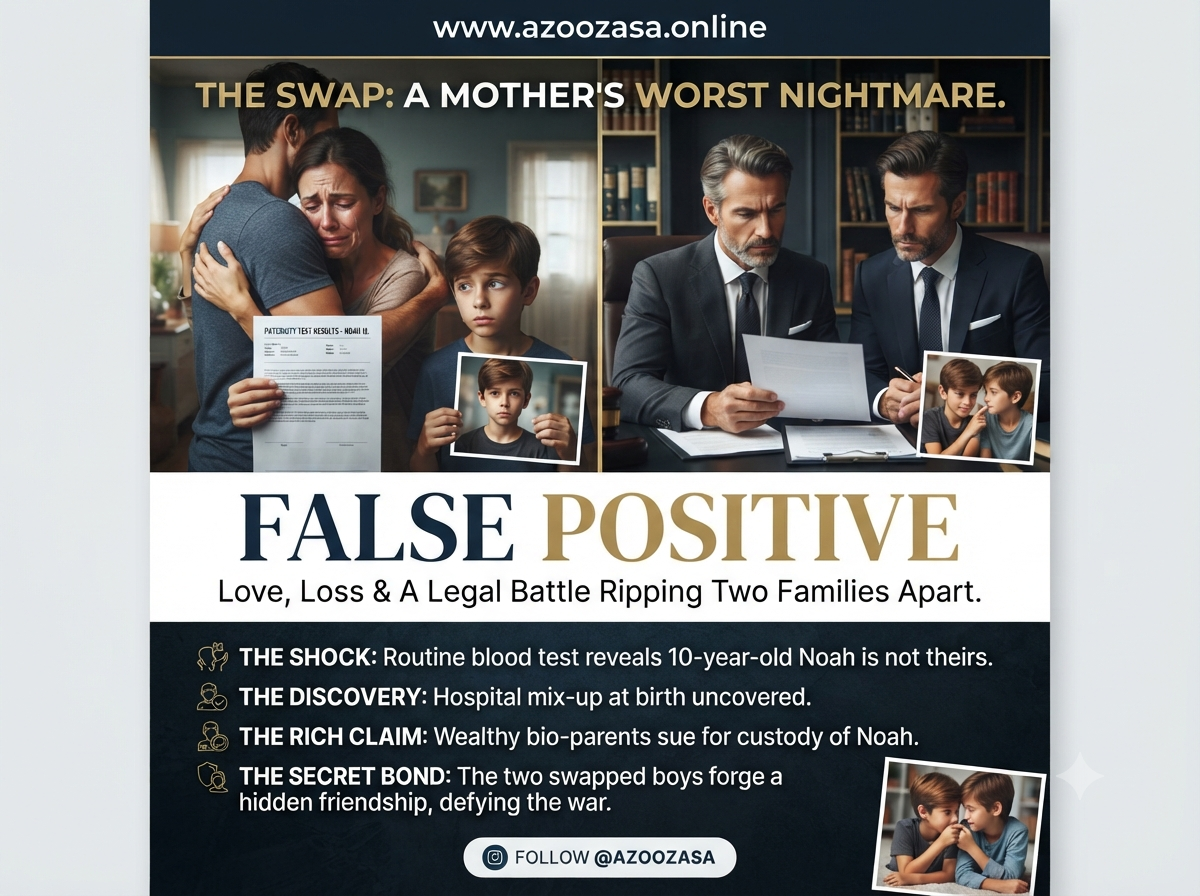
The envelope sat on the Formica kitchen table like a ticking device. Liam stared at the medical logo of St. Jude’s Valley Health, his thumb tracing the jagged edge of his coffee mug. Beside him, Sarah hadn’t touched her tea. Her eyes were fixed on the folded sheet of paper, the clinical jargon blurring into a single, terrifying sentence.
*No genetic concordance. Paternity index: 0.0%. Maternity index: 0.0%.*
“It has to be a clerical error,” Liam whispered, though the hollow weight in his chest told him otherwise. “A swapped tube. A typo at the lab.”
“They ran it twice, Liam,” Sarah said, her voice trembling as a single tear cut a clean path down her cheek. “Because the first time, they thought it was a mistake, too.”
Ten-year-old Noah was out in the backyard, laughing as he chased their old mutt through the sprinkler, his shock-red hair catching the afternoon sun—hair that neither Liam nor Sarah possessed. For a decade, they had laughed away the mismatched traits, chalking them up to recessive genes from distant ancestors. Now, looking at the genetic panels, the truth tore through their reality like a physical blow. The boy sleeping down the hall in a room covered in dinosaur posters and half-built Lego sets wasn’t theirs.
And somewhere out there, another child belonged to them.
—
The investigation was a slow-motion catastrophe. A sympathetic family law attorney, taking their case pro bono, subpoenaed hospital records from October 2015.
It didn’t take long to find the glitch: a power outage in the maternity ward, a frantic shift change, and two baby boys born within twenty minutes of each other.
The trail led two towns over, past the wrought-iron gates and sprawling manicured lawns of Oakridge Estates.
The biological parents were Marcus and Eleanor Sterling. Marcus was a venture capitalist whose name regularly graced the business journals; Eleanor sat on three corporate boards and chaired the county museum. When Liam and Sarah appeared at their front door with court-appointed social workers and DNA verification in hand, the Sterlings didn’t scream or slam the door. They processed the shock with the cold, calculated precision of executives managing a hostile takeover.
Within forty-eight hours, the polite shock evaporated, replaced by a terrifying display of legal firepower.
The Sterlings didn’t just want to meet their biological son; they wanted absolute control. Their high-priced legal team filed an emergency petition for custody, painting Liam—a union carpenter whose work had slowed down—and Sarah, a part-time preschool teacher, as financially unstable, emotionally ill-equipped, and fundamentally unfit to raise an heir to the Sterling name. Tabloids picked up the story, splashing headlines across the screens: *The Billionaire’s Heir Raised in a Working-Class Cottage.*
“They’re treating Noah like a piece of misplaced property,” Sarah sobbed in the office of their attorney, pacing the floor as another court summons was slapped onto the desk. “They have three private investigators watching our house. They’re digging through our credit scores, our medical histories, our pasts.”
“We won’t let them take him,” Liam said, though his jaw was clenched tight with a helplessness he had never felt before. “We’re his parents. Love isn’t written on a lab report.”
But in a courtroom of mahogany and leather, love was cheap currency against a war chest of millions.
—
Ten miles away, behind the towering stone walls of the Sterling estate, another boy was learning a similar, agonizing lesson. His name was Leo. He wore tailored blazers to private school, lived in a house with an indoor pool, and had never shared a bedroom, but he felt just as displaced.
When the adults’ legal wrangling forced mandated supervised visits—neutral ground at a quiet county park halfway between their worlds—the two boys finally met.
The first meeting was agonizingly awkward. Noah clutched a worn baseball glove like a shield; Leo stood stiffly in a crisp Ralph Lauren polo, looking like a prince visiting a foreign, uncivilized province. The lawyers and social workers watched from twenty yards away, clipboards poised.
“Do you like video games?” Noah finally asked, kicking a pebble into the grass.
“Yeah,” Leo said, his shoulders dropping a fraction. “Mostly strategy stuff. You?”
“Lego. Star Wars mostly.” Leo’s eyes lit up. “I have the massive Millennium Falcon. The one with seven thousand pieces.”
“No way,” Noah breathed, forgetting his rehearsed anger. “My dad—my *real* dad—helped me build the small one, but missing pieces we had to fake with random blocks.”
That single crack in the armor was all it took. By the third visit, under the bored gaze of the supervising social worker who was busy scrolling on her phone, the boys began plotting.
They weren’t just victims of a hospital swap; they were bright, ten-year-old strategists who realized the adults were tearing their universes apart out of ego, pride, and fear.
“They’re trying to prove you guys are poor,” Leo whispered during a game of catch behind a thick cluster of maples, safely out of view of the legal teams. “My dad’s lawyers are digging up every debt your family ever had.”
“Your mom’s lawyers called my mom uneducated on television,” Noah muttered, gripping the baseball hard. “They think we’re stupid. They think we don’t know what we want.”
“So, let’s tell them,” Leo said, his eyes flashing with the same fierce ambition that made his biological father a billionaire. “They want to control everything? We won’t let them.”
—
The climax of the legal battle arrived on a stifling Tuesday in July. The courtroom was packed with reporters, flashbulbs popping as the Sterlings walked in flanked by a team of three attorneys in bespoke suits. Liam and Sarah sat at the defense table, holding hands so tightly their knuckles were white.
Judge Harrison looked weary. He had read the hundreds of pages of asset disclosures, psychological evaluations, and expert testimonies.
“Before I issue my temporary injunction regarding custody and domicile,” Judge Harrison announced, adjusting his glasses, “both minor children were granted a brief, unprompted statement submitted through their court-appointed advocate. We will enter those into the record now.”
Marcus Sterling smirked slightly, leaning down to whisper to his lead counsel. Eleanor adjusted her pearls, looking confident. They assumed the boys had been coached by the opposing side.
The advocate, a kind-faced woman with tired eyes, stepped forward. She didn’t read from a legal brief. She held up two sheets of loose-leaf notebook paper, covered in messy, hurried handwriting.
“Your Honor,” the advocate began. “With the court’s permission, Master Noah and Master Leo requested their words be read verbatim.”
She cleared her throat.
*“Dear Judge,”* she read, her voice echoing in the silent room. *“We know you have to decide who we live with based on money, houses, and blood tests. But you got it wrong. Both families got it wrong. We aren’t pieces of luggage you can check into different flights.*
*If the court orders us to live apart, or forces us into houses where we don’t belong, we’ve already agreed on something. We’re trading bikes, we’re swapping our favorite sneakers, and the first chance we get, we’re running away together to the treehouse behind Noah’s house. Because no matter what the DNA paper says, Liam and Sarah are my mom and dad, and Marcus and Eleanor are Leo’s mom and dad. You can’t swap families like trading cards just because a hospital messed up.*
*Signed, Noah Vance and Leo Sterling.”*
A dead, echoing silence fell over the courtroom.
Eleanor’s face went chalk white. Marcus slowly stopped whispering to his lawyer, his mouth slightly open as he stared not at the judge, but across the aisle at the working-class couple holding their son.
Judge Harrison looked down from the bench. He looked at the high-priced legal team, then at the exhausted parents, and finally at the open window where a soft summer breeze drifted in.
“Case law,” the judge said slowly, his voice laced with iron, “deals with custody, finance, and biology. It rarely accounts for human resilience. The emergency petition for full, exclusive custody by the plaintiffs is denied.”
A sharp intake of breath echoed through the gallery.
“Furthermore,” the judge continued, leveling a stern look at the Sterling legal team, “any future rulings will mandate joint family counseling, shared visitation, and zero interference with the emotional bonds these boys have already established. Court is adjourned.”
—
Six months later, the tension of the courtroom had faded into a bizarre, unprecedented new normal.
The legal battles were quietly settled out of court, resulting in a shared custody framework that looked nothing like a traditional family, and everything like a community. The Sterlings funded a trust for Noah’s education, while Liam helped build a sprawling treehouse in the Sterling estate’s back acreage—complete with a bridge connecting it to a zip line.
On a breezy Saturday afternoon, the backyard of the small working-class home was alive with noise. A sleek black luxury SUV was parked awkwardly in the gravel driveway next to Liam’s dented pickup truck.
Inside the fenced yard, Marcus Sterling was standing awkwardly by a charcoal grill, wearing a baseball cap that said *World’s Okayest Dad*, trying to flip burgers while Liam laughed and coached him on the fire. On the lawn, Sarah and Eleanor were sitting side by side on picnic chairs, laughing as they watched two boys race across the grass.
Noah and Leo—both wearing matching mud stains on their knees—burst past them, chasing the old family mutt with handfuls of water balloons.
They weren’t just the children of a swapped destiny anymore. They were the architects of a bridge between two worlds, proving that family isn’t just a matter of blood, but a masterpiece built out of the chaos we choose to love.


0 comments