
### The Last Exit
The rain in the Berkshires didn’t fall; it slashed. By the time Julian, Marcus, and Leo hit Route 2, the windshield wipers were fighting a losing war against a blinding sheet of ice and sleet. They were driving back to Boston in a silence heavier than the snow piling up on the roof of Julian’s sedan—a suffocating quiet born of a fresh grave, old wounds, and ten years of deliberate estrangement.
They had buried their mother, Eleanor, earlier that afternoon. For half a century, Eleanor had been the unyielding anchor of a fractured family, a woman who ruled her household with a velvet-covered iron fist and kept her sons at arm’s length through quiet expectations and carefully doled-out praise.
As the temperature plummeted, the highway sign loomed out of the swirling white chaos: *Last Exit – 1 Mile. Diner / Fuel*.
With a sickening skid, Julian’s tires lost traction, forcing him to wrench the wheel and slide down the off-ramp just as a state trooper flashed a red flare across the interstate, closing the pass ahead due to a multi-car pileup.
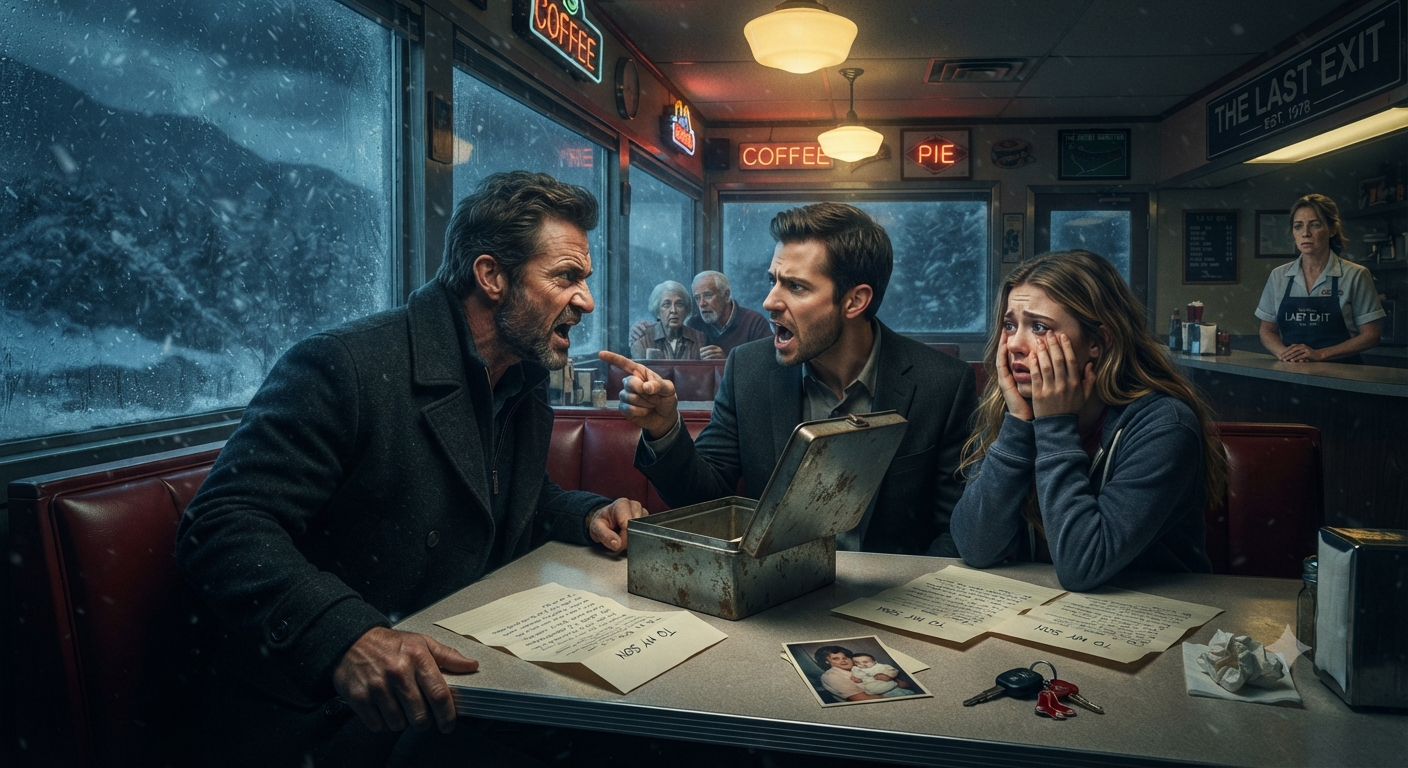
The Pine Cone Diner looked like a neon beacon sinking into a snowbank. Inside, it smelled of stale grease, brewed coffee, and damp wool. The only other occupant was an elderly waitress wiping down the counter with a frayed rag. The brothers slid into a vinyl booth in the far corner—red seats cracked and taped over, a grease-stained jukebox glowing faintly in the corner.
For the first few miles of the drive, the metal lockbox resting on Julian’s lap had remained unopened. It was a heavy, square container of brushed steel that Eleanor had explicitly instructed them to open together, *“when the road gets too cold to travel.”*
Julian, the eldest and a meticulous corporate lawyer whose life was meticulously bound by contracts, set the box on the Formica table. He flicked the brass latches. The lid popped open with a dry hiss, releasing the faint scent of lavender and old paper.
Inside sat three identical, thick cream envelopes, each sealed with a drop of red wax stamped with the family crest, and each addressed with a name in Eleanor’s sharp, uncompromising cursive: *Julian*, *Marcus*, and *Leo*.
“What is this?” Marcus muttered, leaning forward. Marcus was the middle brother, a contractor whose hands were permanently calloused and whose bank accounts were perpetually overdrawn. “I thought she kept her will in the safety deposit box at Cambridge Trust.”
“She did,” Julian said, his throat tight. He picked up the envelope bearing his name, his fingers trembling slightly. “This isn’t a will.”
Each brother took his envelope, peeled back the wax, and unfolded the single sheet of heavy parchment inside.
Julian read his first. Then Marcus. Then Leo, the youngest, an idealistic freelance photojournalist who had spent the last five years backpacking through South America to stay as far away from his mother as possible.
The words on the page were identical for all three.
*“One of you was not born of my body. One of you was taken in from the cold thirty years ago, wrapped in a blanket on my porch during a blizzard much like this one. I raised you all as my own, loved you all the same, and never had the heart to find out which of you belonged to another mother. But one of you is a stranger by blood. Find out who, if you dare.”*
The diner seemed to tilt.
Leo let out a harsh, disbelieving laugh that turned into a cough. “Is this some kind of sick joke? Mom’s idea of a final ghost story?”
“Look at the notary stamp at the bottom,” Julian whispered, his face draining of all color. “It’s real. She had it filed with her attorney thirty years ago.”
The silence that followed was broken only by the mechanical hum of the neon sign outside and the rising whistle of the wind battering the diner’s reinforced glass.
—
Then, the dam broke.
“Well, if anyone’s adopted, it’s Leo,” Marcus snapped, his eyes flashing with sudden, venomous resentment as he slammed his fist against the table, rattling the ketchup bottles. “He skipped out on Mom’s hip replacement surgery three years ago. He spent Christmas in Peru while the rest of us took care of her. Real sons don’t run away.”
“I ran away because I couldn’t breathe in that house, Marcus!” Leo shot back, his voice rising, cracking with years of suppressed fury. “Because no matter what I did, I was never the golden boy like Julian, and I was never the loyal workhorse like you! You stayed because you expected a payday!”
“Shut up, both of you,” Julian hissed, standing up so fast his coffee mug tipped over, spilling dark liquid across the table. For a decade, Julian had carried the invisible crown of the eldest—the one who paid the bills, managed the estate, and swallowed his own miseries to keep up appearances. “You think I wanted to be the golden boy? Do you have any idea how much money I burned trying to keep Marcus’s failing construction business afloat behind Mom’s back? Loans she never knew about? I drained my own savings for this family, and what did I get? Resentment from both of you!”
The accusations hit the air like shrapnel.
For ten minutes, the cramped diner booth became a theatre of war. Every buried grievance—childhood favoritism, broken promises at Christmas, unreturned phone calls, and unspoken jealousy—boiled over into screaming matches that echoed off the greasy kitchen tiles. The waitress vanished into the back room, leaving them alone in the storm.
They fought about everything: who loved their mother more, who abandoned her first, who was a failure, and who was a fraud.
And then, as abruptly as it started, the storm outside seemed to find its way inside, draining the oxygen from the room.
Julian sank back down onto the cracked vinyl bench, burying his face in his hands. His shoulders shook, not with anger anymore, but with a crushing, hollow grief.
“She didn’t write this to give us a puzzle,” Julian said, his voice barely audible over the wind. “She wrote this because she knew we were tearing ourselves apart. She spent her whole life watching us compete for a love she gave us equally, and even in death, we’re still fighting over who belongs.”
Marcus stared down at his scarred, dirt-stained hands. The anger drained out of him, leaving behind a profound, aching weariness. He looked across the table at Julian, then at Leo.
“When I was twelve,” Marcus said quietly, his voice rough, “and I broke my arm falling off the old oak tree in the backyard… remember who sat by my hospital bed all night holding an ice pack?”
Julian looked up. “Mom made me do it.”
“No,” Marcus shook his head, a faint, sad smile touching his lips. “Mom went home to sleep. You stayed. You missed your basketball district finals because you wouldn’t leave my room.”
Leo swallowed hard, looking down at his own envelope. He reached across the table, sliding his paper toward the center. Next to it, Marcus laid his down. Julian added his own.
Three identical papers. Three identical secrets.
“Does it matter?” Leo asked softly. The wind outside had started to die down, leaving a deep, quiet stillness over the world. “Does it matter which one of us wasn’t born of her blood?”
Julian looked at his two brothers—men he had shared a roof with, fought with, and avoided for a decade. He saw Marcus’s stubborn loyalty, Leo’s fierce independence, and his own unbearable weight of responsibility. They were cut from the exact same cloth, forged in the exact same household, and marked by the exact same quiet scars.
Julian reached out, taking the three papers, and ripped them deliberately into halves, quarters, and tiny shreds, letting the pieces fall into the empty coffee cup.
“No,” Julian said, his voice steady and clear. “It doesn’t matter at all.”
—
An hour later, the amber light of dawn broke over the Berkshire mountains, painting the freshly pillowed snow in blinding shades of gold and rose.
The highway plows had cleared the exit ramp.
The three brothers walked out of the Pine Cone Diner together into the crisp, biting morning air. They didn’t speak of the letters again. As they climbed back into Julian’s sedan, Marcus tossed his duffel bag into the trunk, sliding into the front passenger seat, while Leo took the back, stretching his long legs out across the bench.
Julian turned the ignition. The engine hummed to life, heating the cabin against the morning frost.
As they pulled back onto the open interstate, heading east toward Boston, the sun climbed higher over the snow-covered pines. For the first time in ten years, the road ahead wasn’t a divide, but a shared horizon.


0 comments