
### The Open Gate
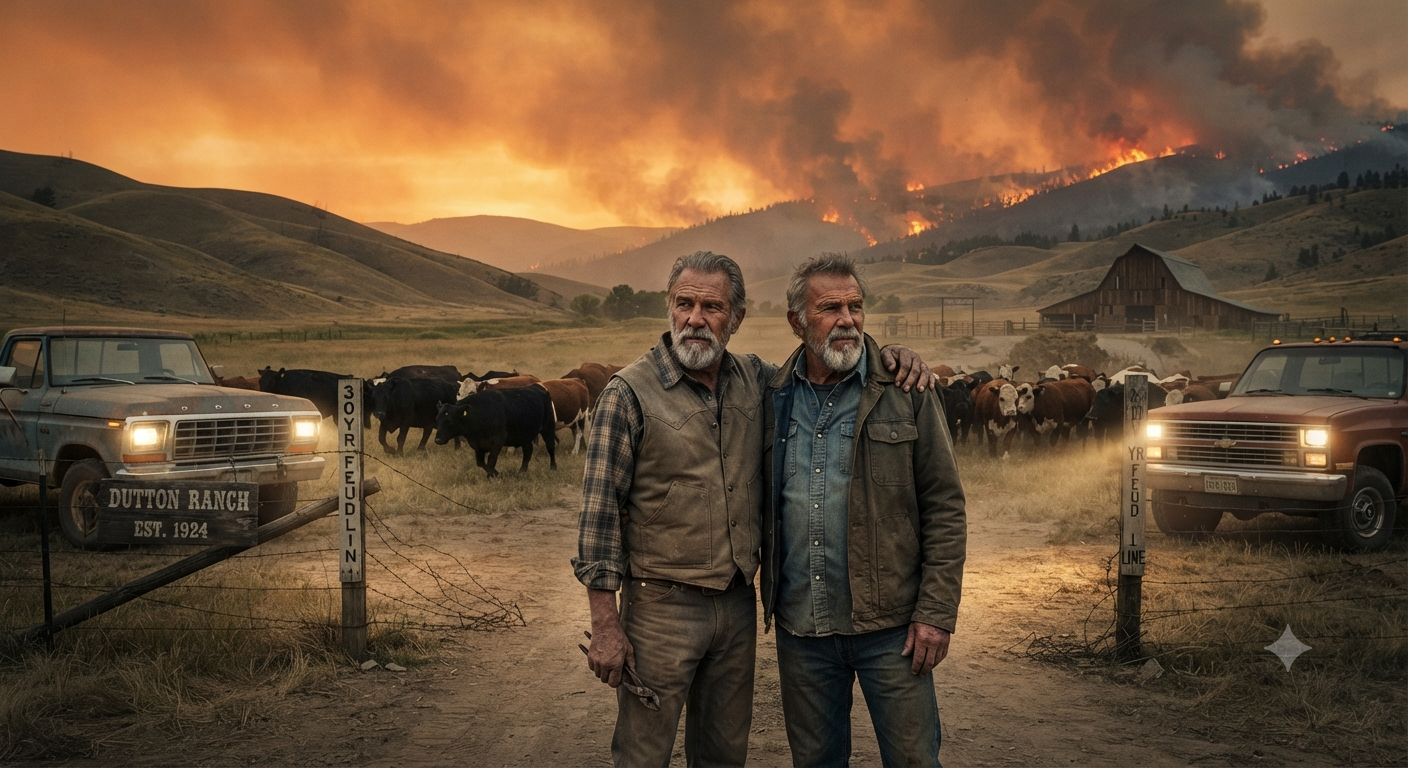
The fence was not merely a boundary of cedar posts and rusted barbed wire; it was a monument to stubbornness, built with three decades of silence and watered by mutual stubbornness. It cut straight down the middle of the Lazy D valley, dividing the sprawling ranch the Dutton brothers had inherited from their father a hundred years ago.
On the north side lived John, gaunt and weathered, wearing a faded canvas coat that smelled of old diesel and horse sweat.
On the south side lived Hank, stockier, with a perpetual scowl carved deep into his face and a limp from a rogue steer back in the nineties. For thirty years, they had lived a half-mile apart across a no-man’s-land of dry scrub brush and sage, sleeping under the same prairie stars, drinking the same well water from separate pipes, and refusing to utter a single word to one another.
The feud had started over a bull—or perhaps over a woman, or a misplaced water right. By now, the exact origin had dissolved into local folklore, leaving only the scar of the fence behind.
Then came October, and with it, the dry wind.
It blew in from the west like a furnace door flung open by the devil. For weeks, the grass had been crisp as cornflakes, the humidity hovering near zero. By mid-afternoon, the sky over the distant ridgeline didn’t turn blue or grey; it turned a bruised, apocalyptic copper.
John stepped out onto his porch, shading his eyes against the stinging grit. The wind shrieked through the cottonwoods, and the air tasted of acrid, chemical ash. Up on the crest of Black Ridge, a towering plume of black smoke was climbing into the stratosphere, billowing out like an expanding fist.
*A crown fire,* John thought, a cold knot tightening in his stomach. With this wind, it wouldn’t crawl; it would sprint.
Across the barbed wire, three hundred yards away, Hank was standing by his corral, staring up at the ridge. Even at that distance, John could see the rigid set of his brother’s shoulders. Both men knew the geography of the valley. The ranch was a bowl, ringed by timbered hills. If the fire crested the ridge, it would sweep down both sides of the fence simultaneously, trapping their livestock against the impassable canyons at the eastern end.
John walked back inside, grabbed his heavy leather gloves, and reached for the landline. Then he stopped, his hand hovering over the receiver. There was no power, and the cell towers had already gone down.
There was only one way.
—
When John drove his battered Ford pickup down to the fence line, Hank was already there, idling his own truck on the southern side. The two trucks stopped nose-to-nose, separated only by four strands of high-tensile steel and a row of cedar posts.
Neither man got out immediately. They sat in their cabs, the wind rocking the heavy vehicles, staring at each other through dust-caked windshields. Thirty years of unspoken grievances hung heavy in the stifling air.
Finally, Hank pushed his door open and stepped out, slamming it shut behind him. He walked up to the wire, holding a pair of heavy wire cutters in his right hand. His face was streaked with sweat and soot.
John killed his engine and stepped out into the howling gale. The heat was already palpable, pressing down on the valley like a heavy wool blanket. The roar of the approaching fire sounded like a freight train barreling through a tunnel.
Hank didn’t look at John’s face; he looked past him, toward the orange glow spilling over the western horizon.
“The timber’s going,” Hank shouted over the rising din, his voice cracked and unused. “If we keep the fence up, my herd piles into the east ravine and burns. If you keep yours on your side, they drift into the gully and suffocate.”
John walked up to the fence on his side, his boots crunching on the brittle cheatgrass. He looked down the endless line of wire stretching toward the foothills.
“We need to drop the whole stretch,” John yelled back. “Open it up. Combine the herds and drive them down to the bottom pasture by the creek. It’s the only bare earth for five miles.”
Hank stared at him, his jaw working. Dropping the fence meant erasing thirty years of absolute separation. It meant admitting that the boundary they had bled for, fought for, and cursed each other over was nothing more than kindling in the face of nature’s wrath.
“Do it,” Hank spat, and without another word, he locked his wire cutters onto the top strand and snapped it.
—
The work was brutal, frantic, and dangerous. There was no time for apologies or reconciliation; survival was an immediate, physical demand.
Working side-by-side, the aging brothers tore down the barrier that had kept them apart for a generation. They pulled staples with frantic jerks, dropped posts, and rolled up the barbed wire, tossing it aside into the dust. As the fence fell flat, the two divided herds—confused, spooked by the smell of smoke, and milling blindly in the heavy air—began to mingle.
“Get your truck!” John roared over the deafening wind as the first embers began to drift overhead like glowing fireflies. “Drive them south! I’ll sweep the north ridge!”
They moved with a synchronized, instinctive rhythm they hadn’t shared since they were boys working their father’s land. Years of arthritis and estrangement vanished beneath a surge of adrenaline. They shouted, waved their hats, and coaxed the terrified cattle away from the creeping tongues of orange flame licking down the hillsides.
The world dissolved into smoke and chaos. The sun disappeared entirely, swallowed by an artificial night illuminated only by the advancing wall of fire. Embers rained down like fiery snow, sizzling as they hit the dry dirt.
Driving their combined herds down the narrow chute toward the creek bottom, John’s truck sputtered and died, choked by the thick, particulate-laden air. He cursed, slammed his fist on the steering wheel, and jumped out into the blinding smoke, coughing violently.
Before he could even catch his breath, Hank’s truck appeared out of the grey haze, sliding to a halt beside him. Hank leaned across the seat and shoved the passenger door open.
“Get in, you old fool!” Hank yelled, his eyes watering from the smoke.
John didn’t hesitate. He climbed into the cab, slamming the door against the gale. As Hank threw the truck into gear and bounced over the rocky terrain, the brothers sat shoulder-to-shoulder in the cramped cab, the heat radiating through the floorboards.
They pushed the last of the cattle into the muddy, wide-open basin surrounding the creek just as the ridge behind them exploded into a wall of flame. The fire consumed the dry timber with a deafening roar, racing down the slopes they had just cleared.
For hours, the brothers sat in the idling truck by the creek bank, watching the inferno rage around them. They didn’t speak. They didn’t need to. They simply watched the fire devour the dry brush of both their properties, burning away the old weeds, the dead wood, and every remnant of the past thirty years.
—
Dawn broke pale, grey, and dead silent over the Lazy D valley.
The fire was gone, checked by the wide creek basin and the backfire they had managed to set in the nick of time. The landscape was transformed. The hills were a blackened, smoking expanse of ash, stretching as far as the eye could see.
Hank killed the engine. The cab was dead quiet, save for the ticking of cooling metal.
Outside, scattered across the surviving green grass of the creek bottom, hundreds of cattle grazed peacefully, mixed together in one unified herd. There was no north side. There was no south side.
The brothers stepped out of the truck, their boots sinking into the fine layer of grey ash coating the earth. They stood side-by-side on the boundary line where the fence used to be, looking out over the smoking ruins of their separate empires.
John reached into his pocket, pulled out a battered pack of cigarettes, and offered one to Hank.
Hank looked at the pack, then up at his brother’s soot-stained face. A slow, tired ghost of a smile touched the corners of his mouth. He took the cigarette.
“Hell of a wind,” Hank muttered, striking a match.
“Always was,” John replied, leaning in to catch the flame.
They stood there together in the quiet morning light, looking out over the open land, while the gate between them stayed wide open.


0 comments