
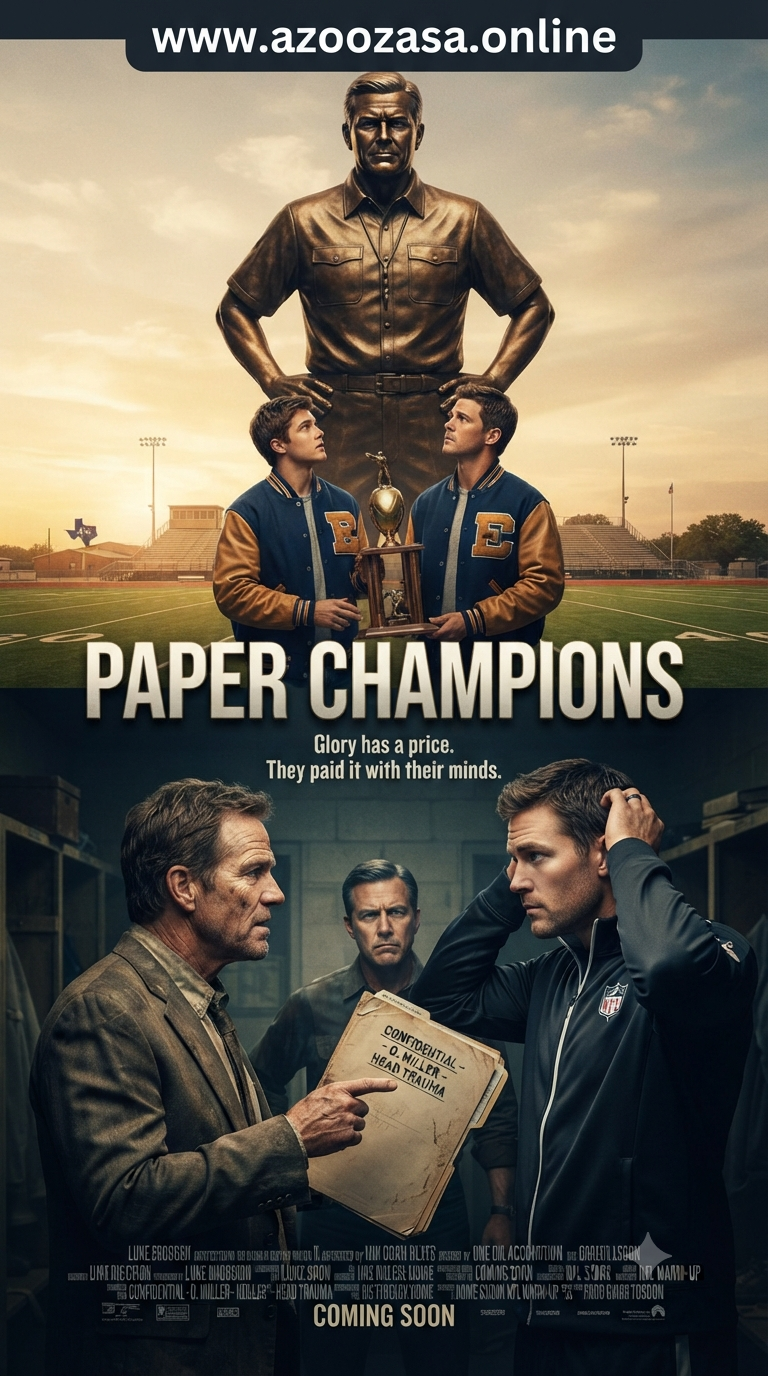
The bronze statue of Coach Jim Vance outside the Panther Stadium gates captured him in eternal bronze glory: clipboard in one hand, jaw set like a granite cliff, eyes fixed forever on a scoreboard that only he could see.
Luke Vance stared up at the monument, the late-afternoon Texas sun baking the asphalt beneath his scuffed loafers. Twenty years ago, under those very Friday night lights, Luke and his older brother Owen had been demigods. They were the twin engines of a machine that had brought three state championships to a town that measured its heartbeat in yard lines.
Today, Luke was just a tired CPA from Austin with a stack of past-due extension forms in his glove compartment. Owen, however, was still a god—or at least a billboard version of one.
A black SUV idled by the curb, and a phalanx of local boosters parted like the Red Sea as Owen stepped out. At thirty-eight, Owen still possessed the imposing, broad-shouldered frame that had made him a first-round NFL draft pick and a three-time Pro Bowl tight end. But as he adjusted his sunglasses and offered a practiced, lopsided grin to the crowd, Luke noticed the slight hitch in his brother’s stride, the way his eyes seemed to briefly lose focus before snapping back to attention.
“Look at him,” a voice murmured beside Luke. It was their father. Jim Vance, now seventy-one and leaning heavily on a carved walnut cane, stepped out from the stadium’s shadow. His hair was stark white, but his eyes retained that terrifying, surgical intensity. “That’s what greatness looks like, Luke. Built in my workshop.”
“He looks tired, Dad,” Luke said quietly.
“Greatness is exhausting,” Jim spat, turning his back to watch the town mayor rush over to shake Owen’s hand. “Don’t mistake fatigue for weakness.”
The evening’s celebration inside the packed high school gymnasium was a masterclass in local mythology. Trophies gleamed under halogen lights; cheerleaders from two decades prior waved faded pompoms; and a slide show projected grainy VHS footage of Owen bulldozing linebackers while Luke threw pinpoint spirals.
When Owen took the podium to accept the town’s Lifetime Achievement award, the applause shook the rafters. He spoke with the smooth cadence of a seasoned athlete turned broadcast analyst, cracking self-deprecating jokes that had the audience roaring.
Yet, sitting three rows back, Luke felt a cold knot tighten in his stomach.
During the speech, Owen lost his train of thought twice. Both times, he glossed over it with a quick laugh, but his hand—clutching the wooden plaque—was trembling with a fine, rhythmic tremor. Luke watched the way Jim Vance beamed from the front row, his chest puffed out like a general reviewing his troops. To his father, Owen wasn’t a son; he was an investment that had finally matured.
Later that night, the noise of the after-party faded as Luke slipped into the damp chill of the old fieldhouse to track down a forgotten bottle of water. The training room door was ajar, spilling a thin line of fluorescent light across the concrete floor.
Luke pushed it open, expecting to find Owen grabbing an ice pack for his knees. Instead, Owen was standing in front of the mirror, staring blankly at his own reflection, his hands pressed against his temples.
“O?” Luke asked, stepping inside.
Owen jumped, spinning around with a defensive flash in his eyes that quickly melted into disorientation. “Oh. Hey, Lukey. Man, this place smells the exact same. Liniment and stale sweat.”
“You okay?” Luke asked, closing the door.
“Yeah, just… a headache. The lights in there are brutal.” Owen rubbed the bridge of his nose, his expression suddenly heavy. “Hey, do you remember the 2004 state semifinal? The game against Westlake?”
Luke frowned. “Vaguely. Why?”
“I couldn’t see the scoreboard for the entire second half,” Owen said, his voice dropping to a harsh whisper. “Everything was flashing white. I thought I was going blind on the field. But Dad told me if I came out of the game, the scouts from Texas would walk away. So I just… guessed where you were throwing.”
A chill washed over Luke. “You never told me that.”
“Dad made me swear not to.” Owen laughed, a hollow, brittle sound. “Crazy, right?”
Owen walked out, muttering something about grabbing a drink, leaving Luke alone in the sterile room.
Resting on the metal examination table was Owen’s worn leather travel bag, unzipped. Protruding from the side pocket was a thick manila envelope labeled *ST. MARY’S NEUROLOGY CLINIC – CONFIDENTIAL*.
Luke stood frozen for a long moment. Ethically, morally, he knew he shouldn’t look. But a visceral dread pulled at his fingers. He reached out, pulled the heavy sheaf of papers from the folder, and began to read.
The words blurred under the harsh fluorescent glare. Magnetic resonance imaging reports. Neuropsychological evaluations. *Early-onset chronic traumatic encephalopathy indicators.* *Significant cognitive impairment consistent with repetitive sub-concussive trauma.*
And then, buried at the bottom of the medical history intake form, was a signed patient disclosure statement from high school clinic records, dated twenty years prior.
*Patient: Owen Vance. Age: 17.*
*Diagnosis: Grade 3 Concussion with retrograde amnesia.*
*Notes: Physician advised immediate cessation of contact sports for a minimum of six months. Accompanied by parent/guardian, Jim Vance, who acknowledged risks and elected to decline protocol to preserve collegiate eligibility timeline.*
Luke’s breath caught in his throat. The paper fluttered back onto the table. It wasn’t just that his father had known. It was that Jim had systematically, ruthlessly traded his oldest son’s brain function for a scholarship, a draft stock, and a legacy written in ink and blood.
The door creaked open. Jim Vance stood in the threshold, his cane tapping rhythmically against the concrete. He didn’t look surprised to see Luke holding the files.
“Snooping never did suit you, Luke,” Jim said smoothly, leaning his weight on the cane. “You always were too sentimental.”
Luke slowly turned around, the paper trembling in his hand. “You knew. When he was seventeen. He had a grade three concussion, and you signed off on it anyway.”
“I secured his future,” Jim fired back, his voice rising, devoid of an ounce of remorse. “Do you think a kid from a dying rust-belt town gets a full ride to Austin and a ten-million-dollar NFL contract by sitting on the bench? I pushed him because he had the gifts to escape this place. Look at him out there! He’s a king! Millions of people know his name!”
“He’s falling apart, Dad!” Luke shouted, his voice cracking with fury and grief. “He’s thirty-eight years old, and he can barely remember what happened an hour ago! You didn’t save him—you sold him!”
“I made sacrifices!” Jim slammed his cane onto the floor, the echo ringing off the tile walls with terrifying authority. “That’s what fathers do! We make the hard choices so our sons don’t have to scrape by like accountants with cheap suits and rented sedans. The price of greatness is pain, Luke. And it was damn well worth it.”
Luke stared at the old man—the man he had feared, admired, and tried to please his entire life. The pedestal shattered completely, leaving nothing behind but a bitter, broken man clinging to a shadow.
Before Luke could answer, a shadow filled the doorway.
Owen stood there, leaning against the doorframe. His face was entirely devoid of color. He had come back for his bag, and in the quiet of the room, he had heard every single word.
For a long, agonizing moment, the only sound in the room was the hum of the fluorescent light. Owen looked from his father’s hard, unblinking glare down to the medical papers clutched in Luke’s hand.
“Is it true?” Owen’s voice was barely a whisper, stripped of all its broadcast polish, sounding suddenly like the terrified seventeen-year-old boy he had once been. “Did you know, Dad? When I couldn’t see… did you know I was broken?”
Jim’s jaw tightened. He didn’t step forward; he didn’t offer a comforting hand. He just looked at Owen with cold, transactional evaluation. “You won the game, Owen. That’s all that mattered.”
Owen closed his eyes. A single tear cut a clean path through the sweat and dust on his cheek.
Luke didn’t hesitate. He crossed the room, stepping past his father as if the old man were a ghost, and placed a gentle hand on his older brother’s broad shoulder.
“O,” Luke said softly, his voice steady and warm. “Look at me.”
Owen opened his eyes, glassy and lost.
“You carried this town on your back for twenty years,” Luke said, his voice thick with emotion. “You don’t have to carry him anymore. The game is over. Let’s go home.”
Owen looked from Luke to their father, standing alone in the center of the sterile room, a king abandoned in an empty kingdom. Slowly, painfully, Owen nodded. He reached out and grabbed his brother’s hand.
Together, the two brothers turned their backs on the fieldhouse, walking out into the cool Texas night, leaving the ghosts of Panther Stadium behind them for good.


0 comments