
### Bitter Harvest
The mist hanging over Finca El Paraíso did not merely blanket the mountains; it felt like a living thing, heavy with the scent of wet loam, crushed coffee cherry, and the sacred history of three generations. For eighty years, the Ramirez family had coaxed the world’s most coveted organic Arabica from the steep, emerald slopes of the Colombian Andes. Their beans commanded staggering prices in Milan, Tokyo, and New York—treasured for notes of dark chocolate, wild jasmine, and a pristine purity born of volcanic soil and absolute non-intervention.
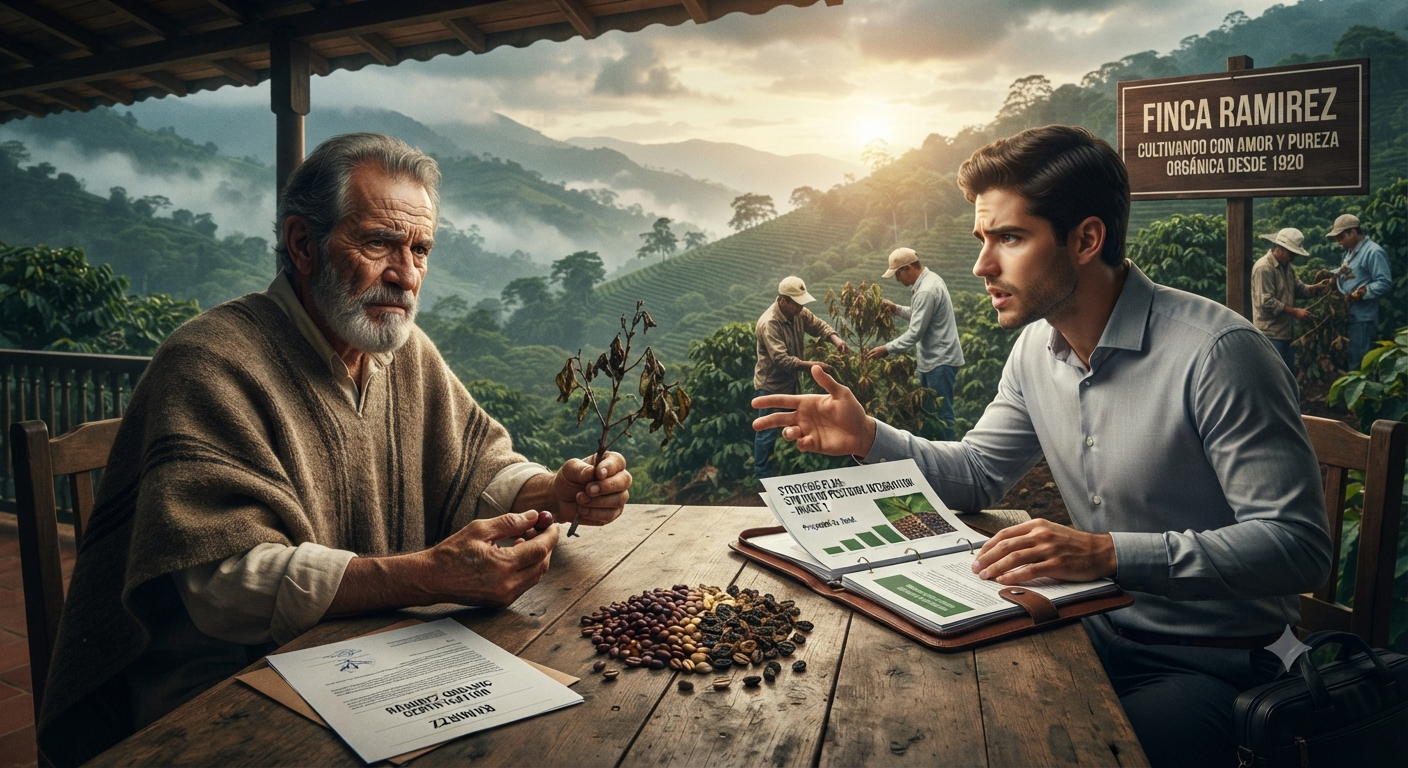
At the center of this ecosystem stood Mateo Ramirez. At seventy-two, his skin was the color of roasted mahogany, etched with the deep lines of a man who measured time not by clocks, but by harvests. He walked the rows every dawn, his hands gently cupping the heavy red fruit as if they were fragile glass. To Mateo, the mountain was a cathedral, and coffee was a prayer whispered upward to the earth.
Then came the return of Santiago.
Santiago, the youngest son, stepped off the LAN flight from Miami wearing a tailored Italian suit that looked absurdly out of place against the red-mud tracks of Huila. He carried an MBA from Wharton, a briefcase full of financial projections, and a worldview entirely divorced from the rhythm of the seasons.
Within forty-eight hours of unpacking, Santiago had set up a makeshift boardroom on the long wooden veranda of the hacienda.
Spread across the table were not family photo albums, but cold, unblinking spreadsheets, market-share analyses, and profit margins.
“Father, look at the numbers,” Santiago urged one evening, jabbing a manicured finger at a projected growth chart. “We are operating at thirty percent capacity compared to the commercial estates across the valley. We lose tons of yield every year to minor insect damage and natural weed competition. It’s romantic, yes, but it’s commercial suicide.”
Mateo slowly poured a stream of boiling water through a cloth filter, his eyes fixed on the dark, aromatic liquid dripping into the clay pot. “We do not chase volume, Santiago. We chase soul. The earth gives what the earth is willing to give. To force it is to rape it.”
“It’s not rape, it’s chemistry,” Santiago replied, his voice rising with the frustration of youth confronting stubborn tradition. He slammed a heavy, brightly labeled container onto the table. It was a synthetic organophosphate pesticide—a broad-spectrum chemical cocktail engineered in American labs to obliterate every living pest within a square mile. “This formula will triple our yield by next season. We can scale our supply chain, automate the washing stations, and secure a multi-million-dollar distribution deal with global coffee chains. We stop being a boutique farm and start becoming an empire.”
Mateo looked at the chemical container as if it were a venomous snake resting on his kitchen table. “If we put that poison into this soil, the mountain will never forgive us. The birds will die, the water table will sour, and the soul of our coffee will turn to ash.”
With a sudden, quiet motion, Mateo picked up the canister, walked to the edge of the veranda, and tossed it deep into the overgrown brush of the ravine below.
The ideological war had begun, and the lines were drawn in blood and red clay.
—
For the next month, Finca El Paraíso was fractured. The older workers, loyal to Mateo and the old ways, cast cold glances at Santiago as he paced the perimeters with digital tablets and soil-testing kits. Santiago, convinced his father was marching the family toward bankruptcy through sheer sentimentality, began holding clandestine meetings with local distributors and bank representatives.
The tension hung thicker than the mountain humidity.
Then, nature delivered its cruel, unyielding verdict.
It began in late July with an unusual, unseasonal heatwave that baked the lower plots. By mid-August, the mist vanished, replaced by an unnatural, suffocating stillness. And then the blight arrived.
It was a mutated strain of coffee leaf rust—*la roya*—coupled with an aggressive infestation of the coffee berry borer beetle. Within a week, the pristine emerald leaves turned a sickly, rusted yellow. The berries, half-formed and sweet with premature sugars, began to drop from the branches in rotting clumps. The hillside looked as though it had been scorched by an underground fire.
By September, forty percent of the harvest was destroyed. By October, the losses approached seventy percent.
The bank called. The seasonal loans were coming due, and without the projected harvest volume, Finca El Paraíso faced immediate foreclosure. The family business, built by Mateo’s father with calloused hands and unwavering devotion, was hurtling toward total annihilation.
The night the foreclosure notice arrived by courier, the hacienda was wrapped in a suffocating silence.
Santiago sat at the veranda table, his head buried in his hands, the spreadsheets now looking like a cruel obituary of his ambitions. Mateo stood quietly beside him, looking out into the pitch-black valley where the twinkling lights of neighboring corporate farms flickered like distant, mocking stars.
“You win, Father,” Santiago whispered, his voice cracking with a defeated bitterness. “Call your friends at the bank. Tell them we’re done. Let the bank take it. At least your hands remain clean.”
Mateo didn’t answer immediately. He walked over, placed a heavy, warm hand on his son’s rigid shoulder, and pointed down toward the lower terrace.
“Look,” Mateo said softly.
Santiago raised his head and looked through the darkness. Down in the fields, dozens of small, flickering lights were moving through the mist. They were lanterns.
Mateo led his son down the wooden steps and into the blighted fields. There, working quietly under the pale moonlight, were the farm workers—men, women, and teenagers from neighboring families whom the Ramirezes had supported for decades. They weren’t using synthetic sprays or corporate machinery. They were carrying pruning shears, organic neem-oil mixtures, and natural biological deterrents. They were meticulously cutting away every infected branch, saving what healthy tissue remained, tree by agonizing tree.
“They aren’t here for money, Santiago,” Mateo said quietly, watching an elderly worker gently tie a protective band around a struggling trunk. “They are here because this land is part of who they are. You cannot buy that loyalty with an MBA, and you cannot replace it with chemicals.”
Santiago stood frozen in the cool night air, watching the quiet army of hands fighting for the farm. A profound, piercing realization washed over him. In his obsession with scaling the mountain, he had forgotten how to climb it. He had looked at the land as an asset sheet, while his father had looked at it as a family.
—
The harvest of that year was the smallest Finca El Paraíso had produced in half a century. The financial toll was brutal; Mateo was forced to sell a portion of their grazing land to clear the immediate debts, and the family tightened their belts to a degree they hadn’t known in decades.
Yet, something miraculous happened.
The surviving trees, purged of the blight through rigorous, back-breaking organic intervention and natural resilience, produced a micro-lot of beans unlike anything the estate had ever grown. The stress of the environment, combined with the pure, unadulterated soil, concentrated the flavors into an intense, wildly complex profile of dark chocolate, blackberry, and deep volcanic earth.
Two years later, Santiago—now wearing flannel shirts and mud-caked boots instead of Italian suits—stood inside a sunlit specialty roastery in Manhattan. Before him sat a panel of the world’s most elite coffee buyers, cupping small porcelain spoons.
At the center of the table was a sleek, minimalist bag stamped with a simple gold seal: *Finca El Paraíso: The Resilience Lot*.
One of the buyers, a legendary European importer, took a slow sip, closed his eyes, and let out a long, reverent breath. The acidity was vibrant, the body rich, the finish utterly haunting.
“My god,” the buyer whispered, looking up at Santiago with absolute awe. “This isn’t just coffee. This has a story. This has a soul. How did you survive the blight of two years ago?”
Santiago smiled, feeling the familiar weight of the mountain soil beneath his fingernails.
“We stopped trying to conquer the earth,” Santiago replied, his voice steady and proud. “And we finally learned how to listen to it.”




0 comments