
### The Last Anchor
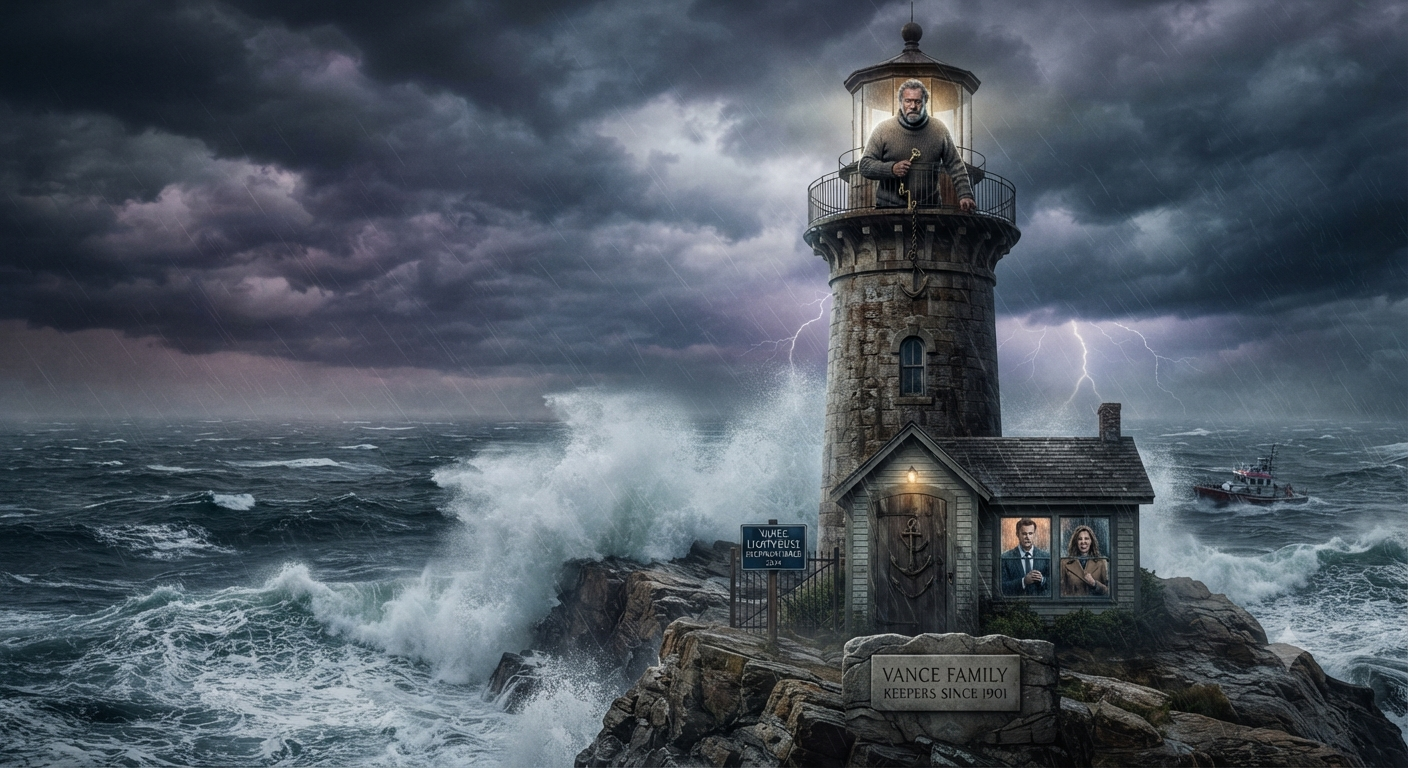
The lens of the Vance Island lighthouse was a three-ton masterpiece of French crystal, ground by hand in the mid-nineteenth century, designed to throw a beam of light twenty-two miles into the treacherous, tooth-and-nail fury of the North Atlantic. For four generations, the Vance family had been the pulse behind that light. They had polished the brass, fed the mercury baths, and listened to the rhythmic, cathedral-like heartbeat of the clockwork mechanism as it turned through winter gales and hurricane-force squalls.
To old Arthur Vance, seventy-eight a
So when the federal maritime automation decree arrived in a crisp, unfeeling manila envelope—stating that the beacon was being converted to solar power and remote telemetry, and that the keeper was officially redundant—Arthur didn’t write a letter of appeal. He walked down to the heavy iron bulkhead door at the base of the tower, stepped inside, locked it from the inside, and swallowed the key.
Two hundred miles away, in the gleaming, glass-and-steel canyons of Boston, his estranged children received the call.
Julian, a high-powered corporate crisis manager whose tailored suits couldn’t hide the exhaustion etched around his eyes, slammed his laptop shut. Maya, a brilliant structural engineer whose life was governed by blueprints and rigid timelines, dropped her pen. They hadn’t spoken to their father—or to each other—in seven years, ever since the winter their mother died and the family fractured under a silent weight of grief and stubborn pride.
Now, the Coast Guard wouldn’t forcefully evict an old warhorse without family intervention, and the federal agency had given Julian and Maya forty-eight hours to get out to Vance Island, drag their father out by his belt loops, and sign the decommissioning papers.
—
The charter boat dropped them off at the rocky slipway of Vance Island just as the afternoon sky turned a bruised, metallic purple.
The wind was already howling, carrying the sharp, stinging taste of brine and ozone. Low-slung clouds raced across the heavens like frightened sheep.
Julian and Maya hiked up the gravel path, their city shoes crunching awkwardly against the shale, dragging heavy overnight bags. When they reached the heavy iron door of the lighthouse, Julian pounded his fist against the metal.
“Dad! Open up! It’s Julian and Maya!”
A metallic screech echoed from the ventilation slit above. Then, Arthur’s voice rasped through the grating, thick with smoke and stubborn defiance.
“The light stays on! You tell Washington I’m not leaving a century of blood and brass for a blinking LED bulb! Go back to your spreadsheets!”
“Dad, don’t be absurd!” Maya shouted, stepping up to the door, her voice sharp with the frustration of a daughter whose logic was always dismissed. “The Coast Guard is sending a marine detachment tomorrow morning if you don’t come out. They will cut the locks and drag you off in handcuffs! Is that how you want your legacy to end?”
Silence hung heavy behind the iron door. Then, with a slow, clanking groan, the deadbolts slid back. The heavy door swung inward.
Arthur Vance stood in the dim, stone-vaulted entryway, leaning heavily on a carved driftwood cane. His flannel shirt was frayed at the cuffs, his silver beard unkempt, but his eyes burned with the fierce, unyielding light of the beacon itself.
“You came back,” Arthur muttered, his gaze sweeping over them. “Not because you missed your home. Because some bureaucrat threatened my pension.”
“We came back because we didn’t want the Coast Guard to arrest you, you old fool,” Julian shot back, stepping past him into the familiar, damp chill of the tower.
Before either of them could say another word, the radio receiver bolted to the stone wall—normally tuned to the maritime channel—hissed to life with an emergency broadcast that chilled the blood in their veins.
*“Warning. Warning. Hurricane Kestrel has unexpectedly upgraded to a Category 5 storm. Eye wall tracking directly over the North Atlantic shelf. Landfall expected in three hours. All coastal residents and maritime personnel must evacuate immediately. Repeat. Evacuate immediately.”*
Julian froze, turning back toward the open doorway. Down at the slipway, the charter boat was already a distant, vanishing speck on the churning horizon, fleeing the oncoming wrath.
Arthur slowly closed the heavy iron door and slid the deadbolts home.
“The boat’s gone,” Arthur said quietly. “And the storm is coming.”
—
Within an hour, the world outside dissolved into a terrifying, apocalyptic whiteout.
Category 5 Hurricane Kestrel didn’t just strike the island; it battered it with the force of a freight train traveling at Mach 1. The wind shrieked against the thick granite walls of the lighthouse with a deafening, bass-heavy roar that made the entire hundred-foot tower vibrate down to its bedrock foundation. Sea spray, hurled a hundred feet into the air by towering rogue waves, slammed against the curved glass of the lantern room like buckshot.
Inside the cramped stone living quarters on the second tier, the family was trapped together in the dim, amber glow of emergency lanterns.
For the first few hours, the tension was thick enough to cut with a knife. The ghosts of the past seven years—the unspoken words, the missed phone calls, the bitter arguments after the funeral—sat heavily in the room.
“We need to check the storm shutters on the third landing,” Maya said abruptly, breaking the silence as a particularly violent gust shook the ceiling masonry.
“I’ll go,” Julian said stiffly.
“No, you’ll slip on the spiral stairs,” Arthur grunted, pushing himself up from his chair. “I know every rusted bolt in this tower. Come with me, Julian. Or are your corporate legs too soft for a few stairs?”
Julian bristled, but stood up without a word and followed his father up the narrow, spiraling iron staircase.
As they worked side-by-side in the semi-darkness, struggling to drop the heavy iron storm bar across the reinforced glass window while the wind battered the exterior, Arthur’s grip slipped on a rusted latch. The heavy bar swung wide, nearly catching Julian across the chest. With a quick, instinctive lunge, Julian grabbed his father’s arm, hauling the old man back against the stone wall just as the wind blew the window inward with a shattering explosion of glass and spray.
For a terrifying thirty seconds, father and son worked in frantic synchronicity, shouting over the roar of the gale, pinning the metal shutter down, and securing the heavy swing-bolts until the room was sealed once more.
Panting, soaked with salt water and sweat, Julian and Arthur stood in the dark corridor.
“You still have fast reflexes, boy,” Arthur said, his voice uncharacteristically soft, lacking its usual defensive edge.
“I learned from the best,” Julian replied quietly, looking away.
Arthur reached out, his calloused, heavy hand coming down to rest on Julian’s shoulder for the first time in a decade. “I’m sorry, Julian. I was a hard man to leave. But I was even harder to come back to.”
Julian swallowed hard, the last twenty years of resentment melting away in the cold draft of the storm. “Me too, Dad.”
—
Downstairs, Maya had managed to fire up the emergency propane stove, boiling water for coffee. When Julian and Arthur descended into the main room, wet and exhausted, Maya looked up from the stove. She didn’t lecture them, and she didn’t bring up the decommissioning papers. She simply handed them two steaming mugs of black coffee.
As the eye of the hurricane passed directly overhead—a terrifying, eerie thirty minutes of dead, eerie silence surrounded by groaning stone—the family sat together around the old wooden table.
They talked. They laughed about old childhood memories they had buried under years of bitterness. They talked about the mother they had all lost, and how they had each tried to cope with the silence in their own separate ways.
When the backside of the hurricane hit with a renewed, secondary wall of wind, the lighthouse didn’t just endure—it sang. The thick granite walls held firm against the tide, and the ancient clockwork mechanism inside the tower, which Arthur had lovingly maintained by hand, ticked on with steady, metronomic precision.
—
Two days later, the storm cleared, leaving behind a brilliant, washed-blue sky and a calm, glittering sea.
A Coast Guard cutter dropped anchor offshore, sending a zodiac inflatable ashore to check on the lighthouse keeper. When the officers climbed the slipway expecting a rescue operation, they found something entirely unexpected.
Julian, Maya, and Arthur stood together on the stone landing outside the heavy iron door, drinking fresh coffee in the morning
sun.
Arthur walked slowly over to the exterior wall, unbolting the federal decommissioning notice that had been slapped there a week prior. He rolled it up neatly, walked over to the metal burn barrel, and tossed it into the ashes.
He didn’t sign the papers. Instead, the federal agency, having witnessed the structural integrity of the Vances’ granite fortress weathering a Cat 5 storm when modern automated stations miles away failed entirely, quietly granted an indefinite operational waiver.
The light would stay.
As the Coast Guard officers saluted and headed back to their boat, Julian and Maya packed their bags into the zodiac, preparing to return to their lives in the city. But as they hugged their father goodbye on the slipway, the embrace lingered longer than it ever had before.
Arthur stood on the shore, watching the boat pull away, carrying his children back toward the modern world. He turned, walked back up the stone path, and unlocked the heavy iron door. The anchor was set, the light was burning, and for the first time in a generation, the Vance family was finally at peace.

0 comments