
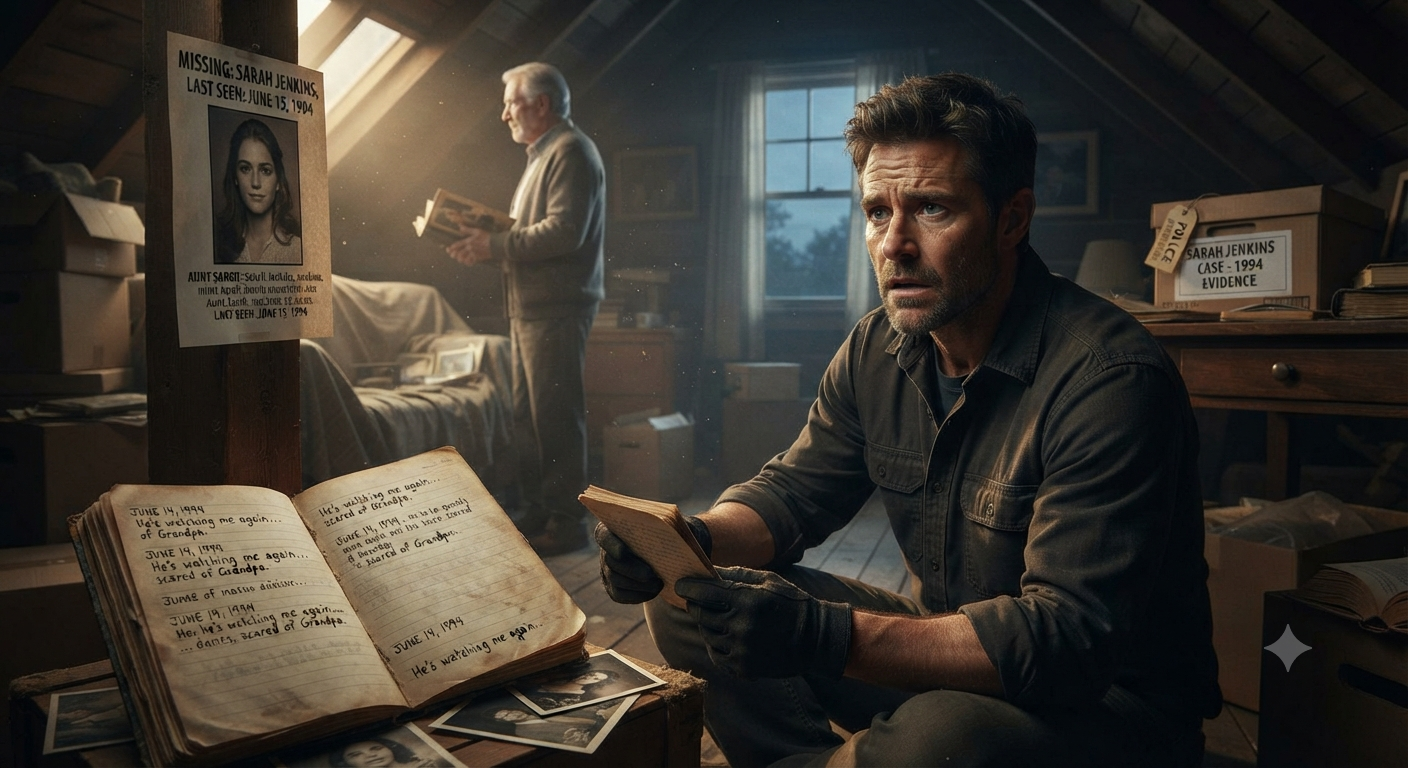
### The Rescued Diary
The dust of old lives always smells the same: a stale blend of dried lavender, yellowed paper, and forgotten ambition. For Marcus, clearing out abandoned estates was just manual labor—heavy lifting, hauling oversized armoires, and sorting through the detritus of people who had vanished or died. But on a rainy Tuesday in October, inside a damp Victorian fixer-upper on the outskirts of Savannah, the debris stopped being anonymous.
Marcus’s crew was emptying the attic when his partner, Leo, kicked aside a warped floorboard near the chimney base.
A small leather-bound volume slid out, its edges gnawed by mice, the dark leather stiff and grey with age.
Marcus picked it up, wiping away a layer of grime. He flipped to the flyleaf, expecting a generic inscription. Instead, written in a hurried, elegant cursive that he recognized instantly from old framed photographs on his mother’s mantel, were three words: *Property of Clara Vance.*
Clara Vance. His mother’s younger sister. The aunt who had supposedly run away to Europe in the summer of 1994, leaving behind a baffled family and a trail that went permanently cold.
“Hey, boss, you good?” Leo asked, noticing Marcus standing frozen in the dim attic light, the diary clutched tightly in his hand. “Found something good?”
“Yeah,” Marcus whispered, his throat suddenly tight. “Yeah, I found my aunt.”
—
Back in his truck, away from the dust and the noise of the crew, Marcus sat in the driver’s seat as the rain drummed a frantic rhythm against the roof.
He pried open the stiff cover. The pages were fragile as autumn leaves, inked in blue ballpoint pen.
He started reading, expecting tales of teenage heartbreak or travel plans. Instead, the entries from May 1994 painted a picture of a terrified young woman living in the shadow of a tyrant.
Clara hadn’t run away to Europe.
> *May 14, 1994:* He found the sketchbook again today. Father was furious. He says my art is a distraction, that I’m wasting my life in this house. But it’s not just the art anymore. He’s been going through my things. I caught him standing in my doorway at midnight, just watching me sleep. I feel like a prisoner here. I’m packing my bag. I’m going to stay with Sarah in Atlanta tomorrow. I can’t take this house anymore.
Marcus’s heart hammered against his ribs. He flipped to the next page, dated May 19, 1994—the day before she was reported missing.
> *May 19, 1994:* He knows I’m leaving. He intercepted my letter to Sarah. He locked me in the cellar tonight. He says nobody leaves this family on their own terms. I can hear him walking around upstairs, checking the bolts. If anything happens to me, look in the fruit cellar behind the old workbench. Please. God help me.
That was the final entry. The remaining pages were blank, torn away or left untouched as a silent monument to a life cut short.
Marcus stared through the rain-streaked windshield toward his grandparents’ house across town. Arthur Vance. A retired carpenter, a gentle, white-haired patriarch known throughout the neighborhood for his woodcarvings, his church attendance, and the grandfatherly warmth he extended to everyone.
Everyone except Clara.
A cold, sickening dread washed over Marcus. The fruit cellar. The workbench. It was still there, sitting in the basement of the house where Marcus had spent his childhood holidays eating apple pie and listening to Arthur tell stories of the old days.
—
The confrontation didn’t happen in a courtroom or under flashing police lights; it happened in the quiet, dust-motes-floating-in-the-sunlight stillness of the Vance family basement.
Marcus drove straight to his grandparents’ house under the pretext of picking up some old tools. His mother was out shopping, leaving only Arthur, puttering around his workbench with a chisel and a block of pine.
“午後, Marcus,” Arthur greeted him warmly, not looking up from his woodcarving, his hands steady despite his eighty-two years. “Working hard today? You look pale, boy. Come, sit down. I just baked some bread.”
Marcus stood at the bottom of the wooden basement stairs, his boots planted on the concrete floor. The diary was heavy in the inside pocket of his jacket, burning against his chest like a live coal.
“I was doing a clearance job today, Grandpa,” Marcus said, his voice terrifyingly steady. “Found an old house. Found an old diary hidden under some floorboards.”
Arthur’s chisel stopped. The silence in the basement suddenly grew deafening, broken only by the hum of the old refrigerator in the corner. Slowly, the old man laid down his tools and turned around. His pale blue eyes, usually crinkled with warmth, were completely flat. Cold.
“Did you now?” Arthur murmured, leaning against the workbench.
“It belonged to Clara,” Marcus continued, taking a step forward. “She didn’t run off to Europe, did she? You locked her in this basement. You took her life because she wanted to leave.”
Arthur didn’t flinch. There was no denial, no feigned shock, no panic. Just a terrifying, resigned acceptance.
“She was weak,” Arthur said, his voice dropping into a raspy whisper that chilled Marcus to the bone. “She wanted to throw everything away for some silly whim. This family has a foundation, Marcus. We built this property, this name, on sacrifice and loyalty. Clara thought she could shatter it. She had to be… contained.”
Marcus felt the room spin. The grandfather he had loved, respected, and looked up to his entire life was a monster wearing a familiar face.
“Where is she, Arthur?” Marcus demanded, his voice cracking with fury and grief. He stepped toward the back wall of the basement, toward the old wooden workbench bolted into the foundation—the exact spot Clara had written about.
Arthur moved with startling speed, grabbing a heavy iron wrench from the bench. “Don’t you dare, boy. Some secrets belong in the dark. If you open that door, you destroy this family. You tear us all apart.”
“The family was already torn apart thirty years ago!” Marcus shouted, lunging past him.
With a surge of adrenaline, Marcus threw his weight against the rotting wooden paneling behind the workbench. With a sharp groan of rusted nails, the hidden door gave way, swinging inward into a pitch-black cavity beneath the earth.
Marcus flicked on his phone flashlight and shone it into the dark.
There, resting against the stone foundation, were a few scattered, rusted metal items—and a small, gold charm bracelet that Clara had worn in every childhood photograph.
—
Three days later, the quiet suburban street was choked with police cruisers, crime scene tape, and flashing red lights.
Arthur Vance sat quietly in the back of a patrol car, staring straight ahead through the glass, his hands cuffed behind his back, looking smaller and older than he ever had before.
The news devastated the family. Marcus’s mother sat on the front lawn, weeping inconsolably as forensic teams carried out sealed evidence boxes from the cellar. The generational secret had burst open into the glaring light of day, exposing a wound that had festered for decades. The illusion of perfection was shattered forever.
Later that evening, after the police had gone and the street had returned to its eerie, quiet stillness, Marcus stood on the porch of the old house.
He held Clara’s recovered diary in his hands. The pages were no longer just a haunting mystery; they were a testimony. He had turned them over to the authorities, ensuring justice, however belated, would finally be served.
Marcus opened the cover one last time. The generational curse of silence had ended with him. He took a deep breath of the cool autumn air, closed the book, and walked down the steps into a future where the truth, at last, was free.


0 comments