
### The Lost Voice
The silence in Evelyn Vance’s apartment was never empty. It was filled with ghosts, sheet music yellowed by time, and the phantom ghost-notes of a soprano voice that had once shaken the rafters of La Scala and the Metropolitan Opera.
Ten years ago, a patch of black ice on a winding upstate highway had stolen everything. It took her husband, David, who had been driving them home after her triumphant debut in *Tosca*. It took the vibrant, soaring timbre of Evelyn’s own throat, crushed by a seatbelt that left her with a permanent, raspy whisper and a doctor’s verdict that she would never sing a single note again.
Ever since, Evelyn lived like a monk in a museum of her own past, pouring her remaining life force into her sixteen-year-old daughter, Clara.
Clara was her mother’s shadow—quiet, observant, and seemingly untouched by the musical gene that had defined the Vance dynasty. Evelyn had deliberately kept Clara away from conservatories, voice coaches, and stages. Music, to Evelyn, was a siren song that lured you to the rocks and left you broken in the dark.
“You’ll study architecture, Clara,” Evelyn would say, coughing softly into her handkerchief as she looked over blueprints at the kitchen table. “Or mathematics. Something safe. Something where the world can’t tear your heart out and throw it away.”
Clara always nodded, kissing her mother’s cheek with a quiet compliance. But compliance is often just the cloak that ambition wears while it waits.
—
The Royal Opera House was staging a rare revival of Puccini’s *La Bohème*, casting for the tragic, fragile role of Mimi.
The auditions were open, anonymous, and fiercely competitive, drawing top-tier talent from across the continent.
For months, while Evelyn thought her daughter was attending after-school drafting classes, Clara was sneaking into an abandoned church basement three blocks away, working with a retired vocal coach who had wept the first time Clara opened her mouth.
Clara didn’t just inherit Evelyn’s vocal cords; she inherited her soul’s geometry.
When Clara stepped onto the darkened stage of the Royal Opera House for the final callbacks, behind a translucent scrim that kept her identity hidden from the judging panel, the air in the auditorium seemed to freeze. She chose *Sì, mi chiamano Mimi*.
The first note floated out into the cavernous, velvet-draped hall, and the rehearsal director dropped his pen. It wasn’t just technically flawless; it was searing, haunting, and agonizingly familiar. It was the exact tone, the exact heartbreaking vibrato that had haunted the opera world for a decade.
By the time the final high note dissolved into the rafters, the auditorium was dead silent. A veteran stage manager in the wings wiped a tear from his eye.
“You have the part, child,” the director whispered through the microphone, his voice shaking. “Opening night is Friday.”
—
Friday evening arrived with the breathless, electric tension peculiar to grand opera houses. The lobby was a glittering sea of diamonds, tuxedos, and flashbulbs.
Evelyn hadn’t planned to attend. She rarely stepped foot in opera houses anymore; the ghosts were too loud. But a last-minute ticket had arrived in her mailbox with no return address—slipped there by a sympathetic stage manager who thought the mother deserved to see the torch passed.
Seated high up in the shadow of the grand tier box, Evelyn clutched her программа, her knuckles white. She looked down at the cast list printed in gold leaf.
*Mimi: Clara Vance.*
The letters swam before her eyes. The blood rushed in her ears, drowning out the murmurs of the crowd. Clara. Her little girl. Throwing herself into the meat grinder. Exposing her throat to the wolves, the critics, the relentless pressure of a world that chewed up artists and spat them out as bones.
Panic, sharp and suffocating, seized Evelyn’s chest. It wasn’t just anger; it was raw, primal terror. The same stage. The same spotlight. The same fragile beauty that invited destruction.
As the orchestra struck up the prelude, Evelyn stood up, her cane clicking sharply against the marble floor, and hurried toward the labyrinthine backstage corridors.
—
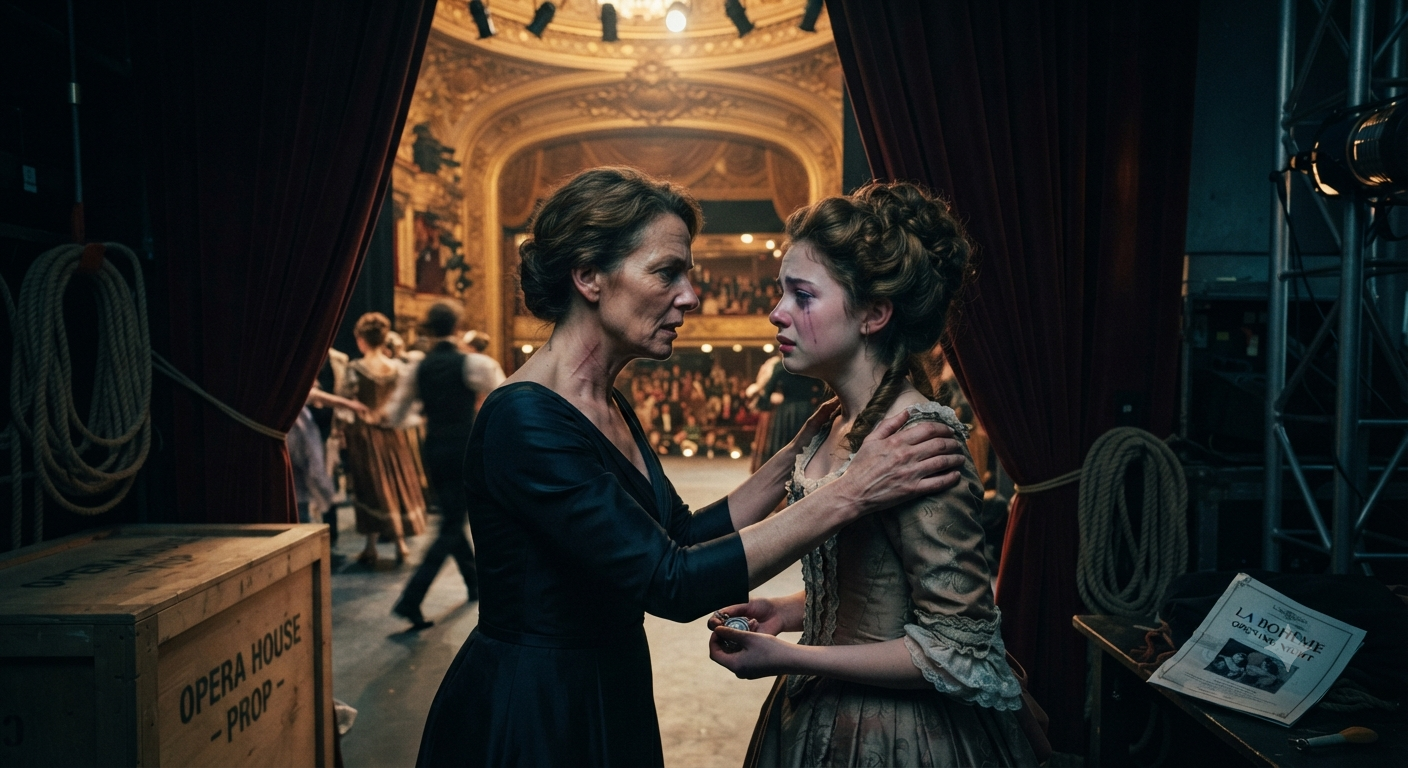
Behind the velvet curtain, chaos reigned. Prop masters rushed past, stagehands hoisted painted flats of Parisian rooftops, and chorus members nervously practiced their scales.
In the wings, standing alone in a simple white linen dress, was Clara. Her hands were trembling slightly as she stared up at the towering proscenium arch.
“Clara!”
The sharp, raspy whisper cut through the backstage noise like a scalpel.
Clara turned, her breath catching in her throat as Evelyn emerged from the shadows of the prop room, her face pale, her eyes burning with an intense, frantic fire.
“Mother? What… what are you doing here?” Clara stammered, stepping back.
“Are you out of your mind?” Evelyn hissed, grabbing Clara’s wrists with a grip that was shockingly fierce. “What is this? An audition? A sick joke? Do you have any idea what this place takes from you? Look at me! Look at what it left behind!”
“I am not you, Mother!” Clara cried out, pulling her hands away, tears stinging her eyes. “Just because your song ended in a wreckage doesn’t mean mine has to! This is who I am. This is inside my blood, whether you lock me in a room or not!”
“It will kill you!” Evelyn’s voice broke, the tough exterior crumbling into a mother’s desperate, agonizing plea. “The critics, the travel, the pressure—they don’t love you, Clara. They love the sound. The moment your voice cracks, they will throw you away. I can’t watch you die the way I did.”
“I’m not dying,” Clara whispered, her chin lifting with a stubborn, magnificent pride that looked so much like a younger Evelyn that it made the older woman’s breath hitch. “I’m finally living.”
Before Evelyn could speak another word, the stage manager’s hand came down on Clara’s shoulder.
“Two minutes, Ms. Vance. Places, please.”
Clara looked at her mother one last time. There was no hesitation left in her eyes—only a fierce, unyielding light. She turned and walked past the heavy velvet drop, stepping out onto the blinding, sunlit set of the Parisian garret.
—
Evelyn stood frozen in the wings, the roar of the audience’s opening applause washing over her like a physical wave. She could run. She could turn around, walk out into the cold night air, and pretend none of this was happening.
Instead, she dragged herself slowly to the prompt corner, gripping the edge of the heavy wooden flat for support.
On stage, Clara took a deep breath. The house lights dimmed to a reverent hush. The orchestra swelled, playing the aching, delicate melody of Puccini’s score.
And then Clara began to sing.
The first note hit the back wall of the theater, pure and crystalline, cutting through the silence with an ethereal grace that defied gra
vity. It was her own voice, yet carried the echoes of a legacy reborn.
As Evelyn listened from the shadows, watching the spotlight catch the silver threads in Clara’s hair and the fierce, beautiful determination on her face, something inside her chest finally shifted. The ten-year winter of her grief didn’t vanish, but it melted, giving way to an overwhelming, incandescent pride.
She realized then that love wasn’t about keeping someone safe inside a cage; it was about having the courage to watch them fly, even when the sky was full of storms.
As Clara sustained the final, soaring note of the aria, the audience erupted into a thunderous, standing ovation that shook the old theater down to its foundations.
In the wings, tears streaming down her weathered face, Evelyn raised her hands and began to clap, smiling into the dark.


0 comments