
The Price of a Lie
The first Sunday of July was always a sweltering affair in the basement of St. Jude’s. The ancient air conditioning units hummed a futile, rattling tune against the crushing humidity of the Southern summer. For the past two decades, my role at the annual church potluck had been identical: standing behind the folding tables, ladling out scoops of baked ziti and green bean casserole, and smiling at the familiar faces of my community.
I was known as a quiet woman, a widow who kept her garden immaculate and her burdens hidden. No one in that basement knew that July held a different, darker significance for me. No one knew that beneath the cheerful yellow gingham of my Sunday dress, my heart was a graveyard.
In July of 1989, I was eighteen years old, terrified, and lying on a stark, rigid bed in a rural women’s clinic two counties over. The doctor had been dismissive; the head nurse, a woman with cold hands and eyes like chipped flint, had been worse. The labor was agonizing, a blur of fluorescent lights and searing pain. But I distinctly remembered the brief, fragile sound of a cry. Then, there was a sudden rush of movement, hushed whispers, and the closing of a heavy door.
When I woke up, the nurse stood at the foot of my bed. Her face was a mask of practiced, professional sorrow. She didn’t survive the night, the nurse had told me, her voice devoid of any real warmth. Her lungs just weren’t ready. We’ve already taken care of the arrangements. It’s better this way, dear. You’re just a child yourself.
In my drug-addled, grief-stricken state, I hadn’t fought her. I hadn’t demanded to see a certificate. I had only taken off the silver bracelet circling my wrist—a heavy, distinctive piece hand-stamped with a pattern of weeping willows and a tiny crescent moon, crafted by my late mother’s own hands—and begged the nurse to bury it with my little girl.
For thirty-seven years, I grieved in total, suffocating silence. I built a life, I married a kind man who passed away too soon, and I aged. But I never stopped calculating how old she would be. Today she would be five. Today she would be graduating high school. Today she would be thirty-seven.
“Excuse me, ma’am? Could I just get a little of the ziti?”
The voice pulled me back to the stifling reality of the church basement. I blinked away the ghosts of 1989, my grip tightening on the stainless steel serving spoon.
“Of course,” I said, forcing my practiced, polite smile as I looked up at the woman standing across the folding table.
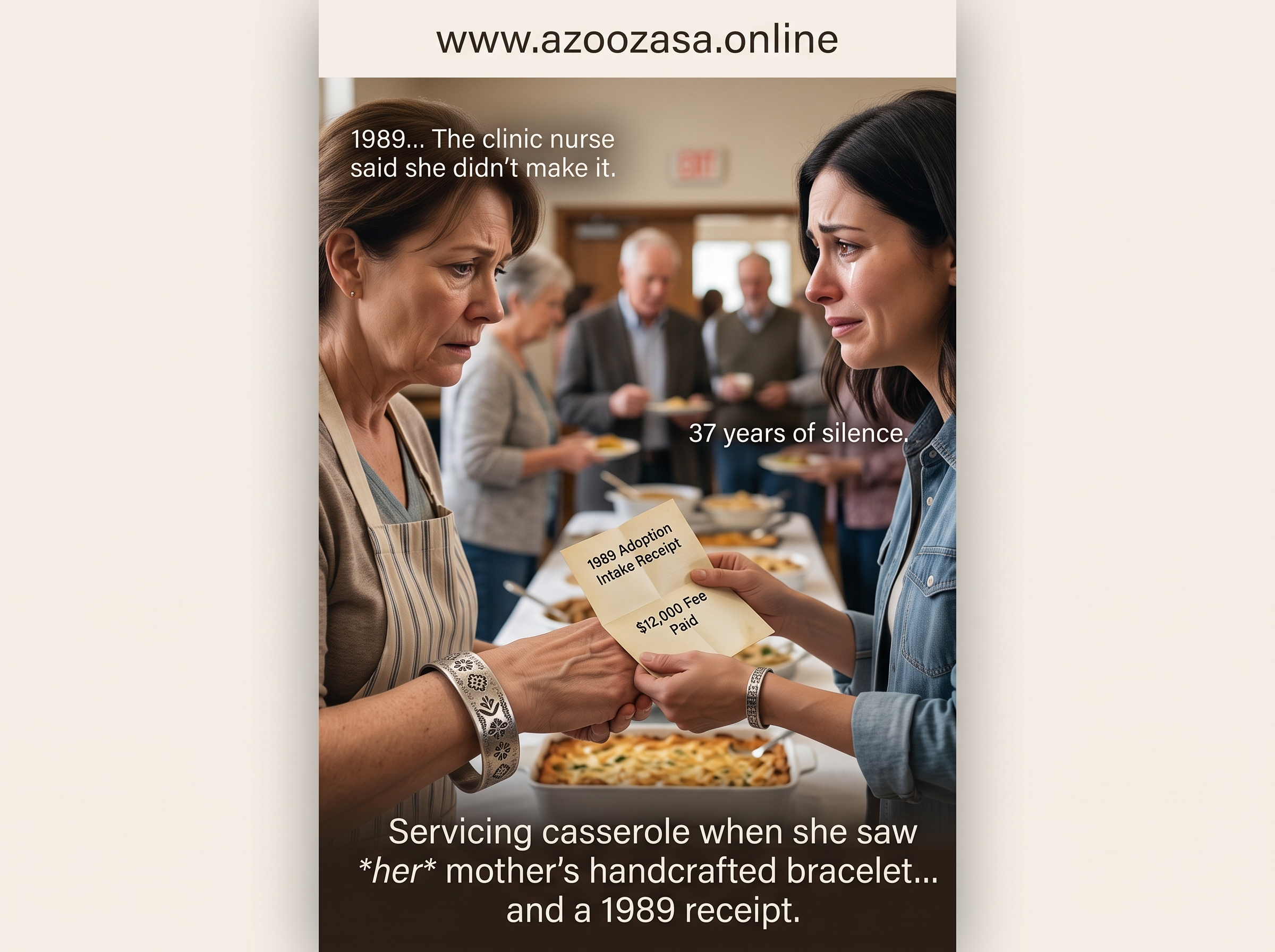
She was beautiful. She had thick, dark hair pulled back in a loose braid, and eyes that were a striking, familiar shade of hazel. But it wasn’t her face that made the breath freeze in my lungs. It was the way she reached out to hand me her paper plate.
Circling her left wrist, catching the harsh fluorescent light of the basement, was a heavy band of silver. It was deeply tarnished in the grooves, but the pattern was unmistakable. Weeping willows. A tiny crescent moon.
The serving spoon slipped from my numb fingers, plunging into the casserole with a heavy, wet thud. The chatter of the crowded room seemed to instantly evaporate, replaced by a high-pitched ringing in my ears.
My mouth went entirely dry. I stared at her wrist, my hands trembling violently, and whispered, “Where did you get that?”
The woman didn’t recoil. She didn’t look confused. Instead, a profound, trembling wave of emotion washed over her face. She set her empty plate down on the table, reached into her leather purse, and pulled out a worn, folded piece of paper. She unfolded it with shaking hands and pressed it flat against the table, right next to the tray of ziti.
It was a yellowed carbon copy of an intake receipt. The letterhead belonged to the very same rural clinic where I had given birth. But it wasn’t a medical bill. It was an unfiled adoption intake receipt, listing a healthy infant girl. At the bottom, stamped in stark red ink, was a payment notation: $12,000 fee paid in full. August 1989.
She looked into my eyes, her voice shaking, and said, “My parents told me they bought this bracelet at an antique shop. They told me my birth mother was a drifter who didn’t want me. But when my father passed away last month, I found this receipt hidden in a lockbox in the attic. Twelve thousand dollars. That wasn’t an adoption fee. That was a transaction.”
I gripped the edge of the folding table, the room spinning violently around me. Thirty-seven years of mourning, thirty-seven years of lighting a solitary candle every July, all built on a monstrous, calculated lie. The nurse hadn’t buried my daughter. She had sold her.
“I didn’t know how to find you,” the woman continued, tears spilling over her lashes and cutting tracks down her cheeks. “The clinic burned down in the nineties. The records were supposedly lost. But I had the bracelet. I started a Facebook page named OneMore, just begging for anyone who recognized the silversmith’s mark. I spent weeks posting pictures of it, tracing regional craft fairs from the eighties. A retired jeweler finally messaged me. He remembered your mother’s work. He remembered her name. And that name led me here.”
“I never gave you away,” I whispered, the words tearing their way out of my throat, raw and ragged. “I never… they told me you died. They told me your lungs failed. I gave them that bracelet to bury with you.”
The woman let out a fractured, agonizing sob. She reached across the aluminum table, knocking over a stack of napkins, and grabbed my hands. Her skin was warm, her pulse frantic against my own.
“My name is Clara,” she cried, gripping my fingers with a desperate, crushing strength. “I’ve spent my entire life feeling like a ghost, feeling like I was thrown away. I drove twelve hours to get here today because I just needed to look you in the eye and ask why.”
“Oh, my sweet girl,” I wept, abandoning the table entirely. I stumbled around the edge of the serving station, heedless of the shocked stares of the congregation beginning to ripple through the basement. I didn’t care about the potluck. I didn’t care about the whispering.
I collided with her, throwing my arms around her shoulders, pulling her against my chest. She was as tall as I was, her frame solid and real. She smelled of vanilla and summer rain, not the sterile antiseptic of a clinic. I buried my face in her dark hair, letting out a wail of grief and terrifying, overwhelming joy that had been trapped inside my ribs for almost four decades.
Clara wrapped her arms around my waist, burying her face in my shoulder, clinging to me with the fierce, undeniable gravity of stolen blood finally returning home.
“I wanted you,” I sobbed into her hair, rocking her back and forth amidst the folding chairs and the scent of fried chicken. “I loved you before you even took your first breath. I would have given my own life for yours. I never gave you away, Clara. I swear it to you.”
“I know,” she wept, her fingers curling tightly into the fabric of my dress. “I know now. I see it.”
We stood there for what felt like hours, two women anchoring each other in the epicenter of a shattered reality. The congregation around us gave us a wide, stunned berth, sensing the monumental weight of the moment unfolding in their humble church basement.
When we finally pulled back, my hands moved instinctively to her face, tracing the line of her jaw, the shape of her eyes—my mother’s eyes. I reached down and touched the heavy silver bracelet resting on her wrist. The weeping willows were tarnished, but the metal was strong. It had survived the lies. It had survived the years. It had survived the men and women who had played God with our lives for twelve thousand dollars.
“They stole my entire life with you,” I said, my voice hardening, a fierce, protective fire igniting in my chest—a fire that had been dormant for thirty-seven years. The quiet, grieving widow was gone. The mother they had tried to erase was fully awake.
Clara wiped her eyes, a matching fire burning in her hazel gaze. She reached down and picked up the yellowed receipt from the table, folding it carefully and slipping it back into her purse.
“My adoptive father was the one who wrote the check,” Clara said softly, her tone laced with a dangerous resolve. “But the nurse who signed it is still alive. I found her address two days ago. She lives in a retirement community just outside of Atlanta.”
I looked at the woman standing before me—my daughter, unbroken, brilliant, and fiercely determined. She wasn’t just a ghost I mourned in the dark; she was a force of nature.
“Let’s go,” I said, untying my apron and letting it fall to the linoleum floor.
I didn’t look back at the serving tables, or the casserole, or the life of quiet resignation I had lived for far too long. I took Clara’s hand, our fingers interlacing perfectly, and together, we walked out of the stifling basement and into the blinding, brilliant heat of the July sun, ready to reclaim every single thing that was ours.

0 comments