
The Proof of the Past
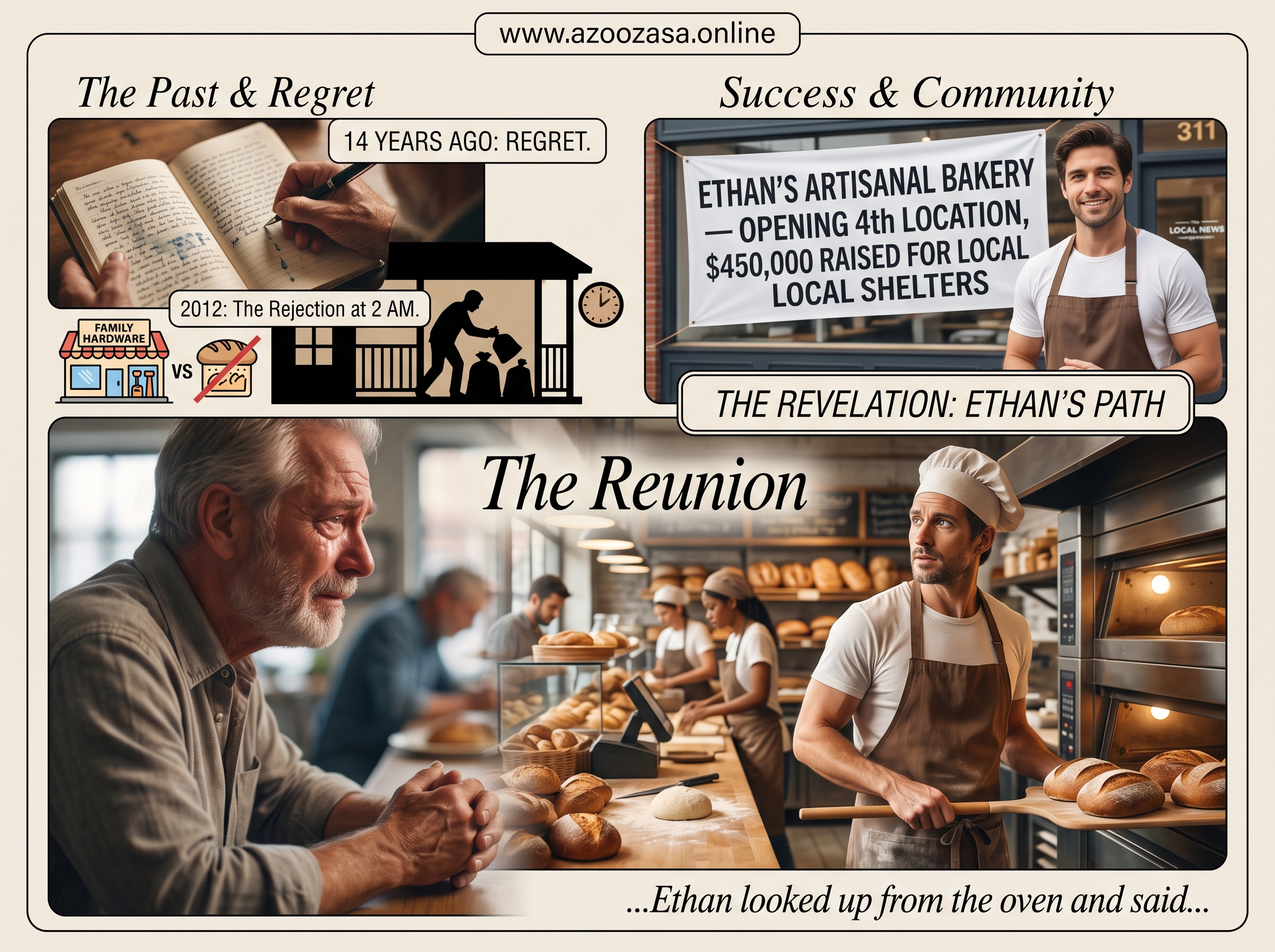
I read my son’s journal fourteen years ago. I still remember the exact date, the chill in the air, and the smell of the cheap, leather-bound notebook, which was quickly masked by the heavy scent of motor oil and sawdust that permanently clung to my clothes. I wish to God I had never opened it.
If I hadn’t read those pages, I might not have been so violently defensive when seventeen-year-old Ethan finally stood up in our cramped, linoleum-floored kitchen and told me he didn’t want the family legacy. The hardware store had been in our name for three generations. To me, it was a cathedral of galvanized nails, PVC pipes, and honest, calloused labor. But in that journal, Ethan hadn’t written about inventory or profit margins. He had written about flour, water, and yeast. He had written about the quiet alchemy of baking, describing the way a perfectly scored loaf of sourdough blooms in the dark heat of an oven with the kind of reverence I reserved only for a well-calibrated table saw.
He wrote that the hardware store felt like a graveyard of rusted metal, and that I was a ghost haunting its endless, gray aisles.
So, when he finally voiced his dream aloud, my bruised pride erupted into a blinding, irrational rage. I didn’t see a young man discovering his passion; I saw an ungrateful child rejecting my entire life’s work. At two in the morning, the argument reached its screaming climax. I dragged his canvas duffel bag down the hall, threw it out onto the freezing concrete porch, and slammed the heavy oak door.
“Don’t come back until you get a real job!” I had roared into the autumn darkness.
He didn’t.
For fourteen years, the silence in my house was absolute. It was a heavy, suffocating quiet that settled into the floorboards and gathered in the corners like dust. I stubbornly kept the hardware store open, watching helplessly as the bright, clinical big-box retailers on the highway slowly bled my customer base dry. I aged a decade in half that time. My hands grew stiffer, my joints aching in the damp weather, and I found myself surrounded by thousands of tools but entirely lacking the one I needed to fix the gaping hole in my chest.
Then came last night.
I was sitting in my worn armchair, eating a frozen dinner that tasted like salted cardboard, watching the ten o’clock local news. The anchor was running a fluff piece on community leaders, and I was half-asleep when the graphic on the screen caught my eye.
Ethan’s Artisanal Bakery — Opening 4th Location.
I froze, the plastic fork slipping from my fingers and clattering loudly onto the hardwood floor.
The camera cut to a ribbon-cutting ceremony. And there he was. Ethan. He was thirty-one now, his shoulders broader, his jawline sharper, a smattering of white flour dusting the dark linen apron tied around his waist. He looked exhausted, yet utterly radiant. The camera panned out to reveal a massive, cheering crowd, and beneath him, a banner hung proudly: $450,000 Raised for Local Shelters.
I gripped the edge of the coffee table, my knuckles turning white, as my vision blurred with a sudden, violent rush of tears. Shelters. He had donated nearly half a million dollars to homeless shelters. The realization hit me with the force of a physical blow to the ribs. He wasn’t just giving back to the community for the sake of good press; he was paying a debt to the places that had kept him from freezing to death after his own father threw him out into the night.
I didn’t sleep a wink. I sat in the dark living room, listening to the hum of the refrigerator, staring at the television long after it had been turned off, haunted by the ghost of the boy I had driven away and the man he had forced himself to become.
By six the next morning, I was sitting in my rusted pickup truck, driving across town to the affluent suburb where his original bakery stood. The drive took forty minutes, every single mile a grueling marathon of regret and terrifying anticipation. I parked a block away and walked toward the address, pulling my collar up against the biting morning chill.
The bakery was a beautiful, welcoming space—a far, magnificent cry from the harsh fluorescent lighting of the hardware store. It had large, floor-to-ceiling windows, exposed brick walls, and the golden, intoxicating scent of baking bread spilling out onto the sidewalk. A line of eager customers already snaked out the front door and down the block.
I joined the end of the line, keeping my head down, my heart hammering violently against my sternum. As the line inched forward, I watched the machinery of his dream in motion. It wasn’t just a bakery; it was a living, breathing symphony. Staff moved with choreographed precision, pulling golden pastries from display cases, pulling espresso shots, and wrapping warm loaves of bread in brown paper.
And behind the glass partition separating the kitchen from the front counter, working the massive stone-deck oven, was my son.
He was using a long wooden peel to extract steaming loaves of bread, moving with a fluid, practiced grace. I watched his hands—the same hands I had tried to violently force around a wrench—handling the delicate, crackling crusts with absolute respect. He was a master of his craft. He was everything he had written about in that journal, and so much more.
The line evaporated entirely too fast. Suddenly, I was standing directly at the register. The young girl at the counter smiled warmly, her uniform spotless. “Good morning! What can I get started for you today?”
I opened my mouth, but no sound came out. My throat was completely paralyzed. I looked past her, right through the glass partition.
As if sensing the sudden, unnatural halt in the rhythm of his shop, Ethan turned around. He wiped his brow with the back of his forearm, his eyes scanning the front counter to see what the delay was. When his gaze locked onto mine, the bustling noise of the bakery seemed to instantly drop into a vacuum.
Fourteen years of silence hung suspended in the warm, flour-dusted air between us.
He didn’t drop the wooden peel. He didn’t run away. He stood perfectly still, his eyes—so much like his mother’s—searching my weathered face. The young girl at the register looked back and forth between us, her cheerful smile faltering as she sensed the sudden, crushing gravity in the room.
Slowly, Ethan walked out from behind the glass partition. He wiped his flour-coated hands on his apron and stepped up to the front counter, coming to a halt directly across from me.
He looked at my graying, thinning hair, the deep lines carved into my face by a decade and a half of regret, and the trembling, calloused hands resting on his pristine marble countertop.
Ethan looked up from the oven, took a slow, deep breath, and said, “I told you I’d get a real job, Dad.”
The words were a direct echo of my greatest sin, but they weren’t delivered with venom, spite, or triumph. They were spoken with a quiet, weary kind of grace.
My knees felt dangerously weak. A tear broke free, tracking a hot path down my cheek, vanishing into the gray stubble on my jaw. “You did, Ethan,” I whispered, my voice cracking, sounding like sandpaper dragging across dry wood. “You did. And I was… I was so blind I couldn’t see it.”
He leaned against the counter, crossing his arms over his chest. The vulnerable boy I had cast out was entirely gone, replaced by a formidable man who had built an empire from the crumbs I had left him. “Why are you here, Dad?”
“To apologize,” I said, the words spilling out in a desperate, breathless rush, terrified he would turn around and walk back to the ovens if I hesitated for a single second. “To tell you that I saw you on the news last night. To tell you that I am so incredibly proud of you. And to tell you that I’ve spent every single day of the last fourteen years wishing I had never opened that front door and thrown your bag onto the porch.”
I looked down at the pastry case, unable to maintain eye contact with the sheer weight of what I had done to him. “I read your journal back then, Ethan. I saw how much you loved this. And I was just… I was terrified. The hardware store was failing, I was failing, and I thought losing you to this was the final nail in the coffin. I tried to force my miserable life onto you because I didn’t know how to survive without it. But seeing that banner… seeing what you did for those shelters…”
I choked on a sob, pressing the heels of my hands into my eyes to stop the flood. “I put you on the street. I did that. And you turned around and spent your life making sure no one else had to feel that cold. You’re a better man than I ever was, Ethan. You’re twice the man I am.”
The bakery around us had gone entirely quiet. The morning rush had slowed to a standstill, the customers instinctively stepping back toward the walls to give us a wide berth.
I felt a sudden, warm weight on my wrist. I lowered my hands to see Ethan reaching across the counter. His grip was firm, his hands dusted with white flour and marked by pale, faded oven burns.
“It was cold,” Ethan said softly, his voice thick with un-shed tears. “It was terrifying, and I hated you for a very long time. I spent my first two years sleeping in a battered van behind a diner, baking overnight on their off-hours just to pay for a tiny, unheated studio apartment. I used that anger to fuel every single hour I spent in the kitchen. But eventually… the anger just burned out. It takes too much energy to stay angry forever, Dad. And I’ve got bread to bake.”
He gently let go of my wrist and reached under the counter, pulling out a small, brown paper bag. He grabbed a fresh, steaming loaf of sourdough from the cooling rack directly behind him—the crust perfectly blistered and dark—and slid it carefully into the bag.
He pushed the paper bag across the marble counter toward me.
“It’s going to take a lot more than one apology,” Ethan said, looking me directly in the eyes. “Fourteen years is a long time. I don’t know who you are anymore, and you definitely don’t know me. But… my shift ends at three today. There’s a park bench across the street. If you want to sit there and eat this, I’ll come find you when I’m done.”
I stared at the brown paper bag, the profound warmth of the bread radiating through the paper, thawing the ice that had encased my heart for over a decade. It wasn’t instant forgiveness. It wasn’t a miraculous erasure of the pain I had caused him. But it was an invitation. It was a doorway I had absolutely no right to expect to find open.
“I’ll be there,” I choked out, pulling the bag toward my chest like a lifeline. “I’ll be right there, Ethan. I promise.”
He nodded once, a small, fragile smile finally touching the corners of his mouth. “Okay, Dad. See you at three.”
He turned back toward the glass partition, tying his apron a little tighter, and walked back to the ovens. I stepped out of the bakery and into the crisp morning air, holding the warm bread against my chest. And for the first time in fourteen years, I finally felt like I was coming home.

0 comments