
The Pulse of a Paper Promise
The steady, mechanical hum of the cardiac monitor in Room 314 felt less like a reassurance and more like a countdown. At seventy-two, the human body transforms from a vessel of endless possibility into a fragile ledger of wear and tear. My ledger was severely overdrawn. The mitral valve in my heart was failing, a tired piece of machinery demanding a high-risk reconstruction that the surgical team had gently, but firmly, warned me I might not survive.
I lay against the sterile, stiff hospital pillows, watching the gray morning light filter through the blinds. It was raining. The relentless, drumming sound against the reinforced glass instantly pulled me backward through the decades, anchoring my mind to another storm, another year, and another life hanging in the balance.
It was November 1996. I was forty-two, living alone in a drafty farmhouse on the outskirts of town. The isolation was usually a comfort, but that night, the weather was violently unforgiving. The wind howled, rattling the single-pane windows, and the rain turned the dirt road into a river of mud. I was standing at the kitchen sink, rinsing a coffee mug, when the motion sensor light on the back porch flickered to life.
Through the water-streaked glass, I saw a shadow huddled against the oak firewood rack.
I didn’t call the police. Something in the fragile geometry of that silhouette told me this wasn’t a threat; it was a tragedy unfolding in real time. I unlocked the deadbolt, pushed the heavy wooden door open against the gale, and found her.
She couldn’t have been more than seventeen. She was entirely soaked, her thin denim jacket clinging to a frame that was starkly malnourished, save for the undeniable, swollen curve of her belly. She was heavily pregnant, shivering so violently her teeth audibly clicked together, her dark hair plastered in muddy strands across a face pale with hypothermia and raw terror.
“Please,” she whispered, her voice barely carrying over the wind. “I don’t have anywhere to go.”
I pulled her inside. I didn’t ask her name right away. I didn’t ask where her parents were, or who the father was, or what terrible sequence of events had led a pregnant child to sleep on a stranger’s freezing porch. The world had already demanded too much of her; I refused to ask for explanations.
Instead, I guided her to the bathroom, handing her a stack of thick, dry towels and my warmest flannel pajamas. While she changed, I moved to the kitchen. I heated a large bowl of leftover vegetable soup on the stovetop, the rich aroma of thyme, carrots, and broth filling the cold air.
When she emerged, she looked even smaller, drowning in the oversized flannel. I sat her at the kitchen table and placed the steaming bowl in front of her. She ate with a desperate, heartbreaking urgency, tears silently mixing with the broth as she swallowed.
“My name is Brenda,” she finally managed, her voice trembling as she set the empty spoon down.
“I’m Clara,” I replied, wrapping my hands around a mug of tea. “You’re safe here, Brenda.”
We didn’t talk much after that. I made a bed for her on the living room sofa, piling it high with every quilt and woolen blanket I owned. Before I turned off the light, I went into my bedroom and opened my purse. I took out a crisp fifty-dollar bill—nearly half of my grocery budget for the week—and laid it on the coffee table beside her. Next to it, I placed my heavy, insulated winter coat.
“For tomorrow,” I told her quietly. “Whatever tomorrow is.”
She looked at the money, then at the coat, and finally up at me. The gratitude in her dark eyes was so profound it felt like a physical weight in the room.
When I woke up the next morning, the house was entirely silent. The storm had broken, leaving behind a crisp, cloudless sky. I walked into the living room, but the sofa was empty. The blankets were neatly folded into a perfect square. The heavy winter coat and the fifty-dollar bill were gone.
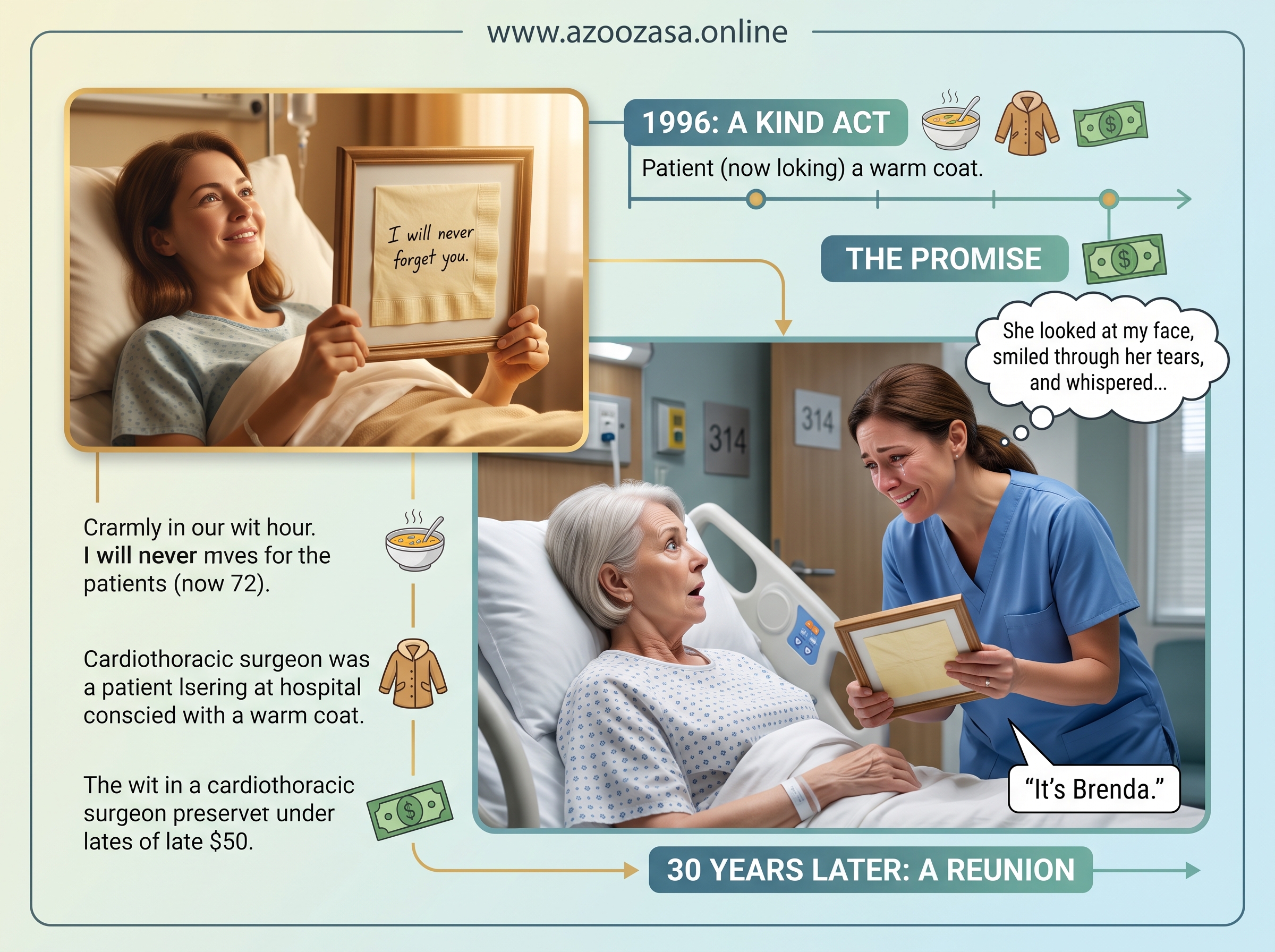
In their place, resting precisely in the center of the coffee table, was a cheap, white paper napkin from my kitchen dispenser. Written on it in blue ink, in a shaky but deliberate script, were six words:
I will never forget you. – B
I kept that napkin. For thirty years, it sat in a small wooden keepsake box on my dresser, migrating with me from the farmhouse to a townhome, and finally to this hospital bed. It was a silent testament to a single night where two lonely lives intersected in the dark. I often wondered if she survived. I wondered if the baby survived. But the world is vast, and people disappear into its currents every day.
A sharp knock on the door of Room 314 snapped me back to the clinical reality of the present.
The surgery was scheduled for 8:00 AM. It was 7:15. My heart hammered a weak, irregular rhythm against my ribs as the door swung open. A team of nurses bustled in, checking the IV lines and adjusting the monitors, their voices a blur of practiced medical efficiency.
“The chief of cardiothoracic surgery is here to go over the final consent forms with you, Clara,” the lead nurse announced, stepping aside.
A woman walked into the room. She was tall, commanding an immediate, undeniable authority. She wore crisp navy-blue scrubs, a pristine white lab coat, and a stethoscope draped around her neck like a medallion of honor. Her dark hair was pulled back into a neat, surgical cap. She was probably in her late forties, exuding the kind of calm, absolute competence that makes you believe, if only for a moment, that death can be negotiated with.
She carried a metal clipboard, but as she approached the foot of my bed, her steps slowed. Her eyes—dark, piercing, and terrifyingly familiar—locked onto my face.
I watched the professional mask slip. The authoritative posture dissolved, replaced by a sudden, jarring stillness. The chief of surgery didn’t look at my chart. She didn’t check the monitors. She just stared at me, the clinical detachment vanishing into a profound, breathless shock.
“Clara?” she breathed, the word slipping out not as a question, but as a prayer.
My breath caught in my throat. The angles of her face had sharpened with age and authority, but the eyes were exactly the same. They were the eyes that had looked up at me from beneath wet, muddy hair on a freezing November night three decades ago.
“Brenda?” I whispered, my voice cracking, fragile as dry parchment.
Tears sprang to her eyes, instantly spilling over her lower lashes and tracking down her cheeks. She ignored the confused glances of the nursing staff. She set the metal clipboard down on the rolling tray table with a sharp clatter. Then, she reached into the deep pocket of her pristine white coat.
Her hands, steady enough to slice into a beating human heart, were trembling slightly as she pulled out a small, flat object.
It was a square, black wooden frame. Behind the glass, perfectly preserved, was a cheap, yellowing paper napkin. The blue ink had faded over the decades, but the shaky handwriting was still undeniably clear.
I will never forget you. – B
The air in Room 314 vanished. I stared at the framed napkin, the edges of my vision blurring with hot, sudden tears. The fifty-dollar bill. The vegetable soup. The heavy winter coat. It had all led to this exact room, to this exact moment.
Brenda walked around the bed, moving past the maze of IV poles, until she was standing directly beside me. She gently placed the framed napkin on my lap. Then, she took my frail, bruised hand in both of hers. Her grip was warm, impossibly strong, and fiercely protective.
“The fifty dollars bought me a bus ticket to a women’s shelter in the city,” Brenda said, her voice thick with emotion, yet ringing with a triumphant clarity. “The coat kept my son warm when I carried him out of the hospital two months later. And the soup…” She let out a wet, genuine laugh. “I still try to make it, but it never tastes quite like yours.”
I couldn’t speak. I could only squeeze her hand, the monitor beside me accelerating its rhythmic beep, capturing the overwhelming swell of my failing heart.
Brenda leaned down, her face inches from mine, her tears dropping onto the stark white hospital blankets. The frightened, shivering girl from the porch was gone, replaced by the brilliant, unstoppable force of a woman who had conquered the world.
She looked at my face, smiled through her tears, and whispered, “Thirty years ago, you saved my heart in the cold. Now, it’s my turn to fix yours.”
She kissed my forehead, a brief, tender seal of an unbreakable promise. When she stood back up, the tears remained on her cheeks, but the steel had returned to her spine. She turned to the bewildered surgical team, her voice echoing with absolute, uncompromising command.
“Prep OR 4,” Dr. Brenda instructed, never letting go of my hand. “We’re going to save her life today. I absolutely guarantee it.”
As the medication finally began to push me toward sleep, the sterile walls of the hospital faded away. The fear that had gripped me all morning dissolved into a profound, unshakeable peace. The last thing I felt before the darkness took me was the warmth of her hand, a lifeline thrown across thirty years, pulling me safely back from the edge of the storm.

0 comments