
The False Prophet of Magnolia Street
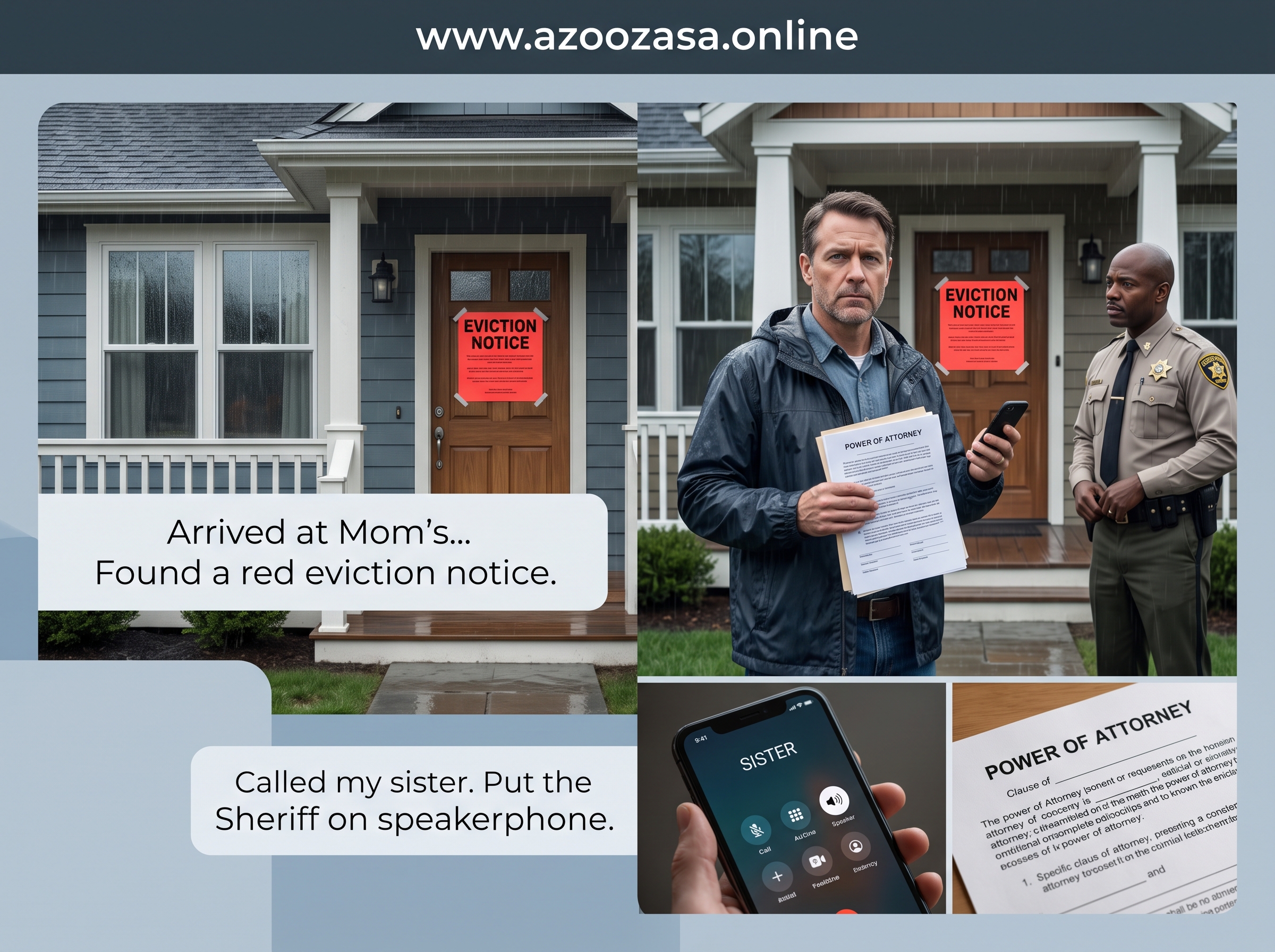
The rain was coming down in thick, unrelenting sheets, turning the familiar front lawn of my childhood home into a bleak, muddy swamp. It lashed against the windshield of my car, blurring the world outside into gray streaks, but it couldn’t obscure the blinding, neon-red square of paper taped to my mother’s front door. It clung to the peeling white paint of the porch like a fresh, bleeding wound.
My sister, Eleanor, was the good daughter. That was the uncontested gospel truth according to everyone in our sprawling, tight-knit church community. She was the woman who directed the children’s choir, the patron saint of casserole deliveries for grieving families, and the one who always prayed the loudest at Sunday service. She wore her virtue like a heavy, glittering crown. I, on the other hand, was the quiet one. The pragmatic sister who moved two states away to work as a financial auditor, missing the Wednesday night Bible studies and the neighborhood block parties. In Eleanor’s carefully curated narrative, she was the selfless martyr burdened with our aging mother, while I was the cold, distant professional who only cared about spreadsheets.
Four years ago, when Mom turned eighty-four, Eleanor executed what she framed as an act of supreme familial devotion. She called me, her voice dripping with manufactured concern, to announce that she had convinced Mom to sign over the deed to her house. It was a modest, three-bedroom craftsman sitting on a quarter-acre lot, but the neighborhood was gentrifying rapidly. The property was suddenly appraised at $290,000.
“It’s just to protect the house from nursing home costs, Sarah,” Eleanor had cooed through the receiver, sounding utterly angelic. “You know how the state can take everything if Mom ever needs long-term care. I’m just putting it in my name to keep our family’s legacy safe. You don’t need to worry about a thing.”
I hadn’t argued. I hadn’t yelled. I had simply said, “Okay, Eleanor,” and hung up the phone. I knew my sister. I knew the hollow, grasping greed that lived beneath her pastel cardigans and pious smiles. But I also knew a secret that Eleanor, in all her arrogant, short-sighted scheming, had completely failed to uncover.
Now, four years later, I stepped out of my car and into the freezing downpour, my boots splashing through the puddles as I marched up the concrete walkway. I ripped the soggy red paper off the door. It was an official Notice of Eviction. The property, currently listed on the market by a cut-rate local real estate agency, was under contract. The current occupant—our eighty-eight-year-old mother—was ordered to vacate the premises by 5:00 PM today.
I pushed through the unlocked front door, the heavy silence of the house instantly suffocating me. The living room looked like the aftermath of a robbery. Cardboard boxes were strewn across the faded floral rug. In the center of the room, sitting on her worn velvet armchair, was my mother. She was clutching a framed photograph of my late father, her shoulders trembling violently as silent tears carved paths down her fragile, wrinkled face. Beside her stood two deputies from the county sheriff’s department, looking uncomfortable but resolute, waiting to enforce the court order Eleanor had ruthlessly pushed through.
“Mom,” I whispered, dropping my wet coat on the floor and rushing to her side. I knelt, taking her cold, trembling hands in mine.
“She said I have to go to the county home,” Mom sobbed, her voice incredibly small, lost in the confusion of early-stage dementia. “She said I don’t own the house anymore. I don’t understand, Sarah. I thought she was keeping it safe.”
The county home. It was a notoriously underfunded, bleak facility on the edge of town, the kind of place you sent people when you wanted the world to forget they existed. Eleanor was throwing our mother into a warehouse for the dying, all to cash out a $290,000 check.
I stood up, my blood running hot with a quiet, lethal calm. I turned to the older of the two deputies, a burly man with a salt-and-pepper mustache whose nametag read Higgins.
“Ma’am, I’m sorry,” Deputy Higgins said, holding up a clipboard. “We’re just here to execute the writ of possession. The legal owner, Eleanor Vance, requested a civil standby to ensure the tenant vacates. We don’t want any trouble.”
“There won’t be any trouble for my mother, Deputy,” I said evenly. I reached into my thick leather tote bag and pulled out a heavy, sealed manila envelope. I didn’t break eye contact as I unspooled the red string and pulled out a thick stack of legal documents, printed on heavy-stock watermarked paper.
“Eight years ago,” I began, my voice echoing clearly in the empty room, “my mother was diagnosed with the very early stages of cognitive decline. Because she knew my sister was notoriously terrible with money, Mom and I quietly visited an estate attorney in the city. She signed a full, durable power of attorney, granting me total legal and financial control over her affairs.”
I handed the first document to Higgins. He frowned, adjusting his utility belt as he started to read the bold legal print.
“But more importantly,” I continued, pulling out the second document, “we placed this property into an Irrevocable Living Trust. I am the sole executor and trustee. My mother hasn’t legally owned this house for eight years. The trust owns it.”
Deputy Higgins’s eyes widened as he flipped to the second page, tracing the embossed notary seal with his thumb.
“Four years ago,” I said, my voice hardening into steel, “my sister brought a fraudulent quitclaim deed to this house and had a cognitively compromised, eighty-four-year-old woman sign away an asset she didn’t even legally possess. Eleanor filed a worthless piece of paper with the county clerk. She has no title. She has no deed. What she does have is a textbook case of felony elder abuse and real estate fraud.”
The younger deputy shifted on his feet, his hand instinctively resting on his radio. Higgins looked up from the paperwork, the bored reluctance in his eyes entirely replaced by the sharp, focused gaze of a law enforcement officer looking at a crime scene.
“Are you telling me the petitioner who requested this eviction is attempting to sell a stolen property?” Higgins asked, his voice low.
“I am,” I replied. “And she is expecting to hear that her mother is safely deposited in a state-run facility so the new buyers can do their final walkthrough tomorrow.”
I pulled my cell phone from my pocket. I found Eleanor’s contact—saved simply as The Golden Child—and hit call. I tapped the speakerphone icon and set the phone down on the wooden coffee table, right next to the eviction notice.
The phone rang twice before she picked up.
“Hello?” Eleanor’s voice chimed through the speaker, breathless and bright. “Deputy? Is it done? Did she leave peacefully? I just felt terrible I couldn’t be there, but I’m setting up the church hall for the charity bake sale and I just couldn’t bear the emotional toll.”
I looked at Higgins. He gave me a slow, grim nod.
“Hello, Eleanor,” I said.
The line went dead silent. The faint background noise of the church hall suddenly vanished, as if the air had been sucked out of the room on her end.
“Sarah?” Eleanor stammered, her angelic tone instantly cracking. “What… what are you doing there? I told Mom I had this handled.”
I didn’t yell. I didn’t need to. The truth was a much heavier weapon than volume.
“I called you, put the sheriff on speakerphone, and I want to tell you a story,” I said, my voice dangerously soft. “I’m standing here with Deputy Higgins. He’s just finished reviewing the Irrevocable Trust Mom and I set up eight years ago, the one that legally owns this house. He’s also looking at my durable power of attorney and Mom’s official dementia diagnosis from Dr. Aris. It turns out, Eleanor, that the quitclaim deed you coerced Mom into signing four years ago isn’t just worthless—it’s felony elder fraud.”
I paused, letting the absolute terror of the moment bleed through the digital connection. All I could hear on the other end was the frantic, shallow rhythm of my sister’s breathing.
“So,” I continued, “you have two choices. You can get in your car, drive down here right now, and explain to these deputies exactly how you tried to evict our mother from a house you don’t own to line your own pockets. Or, Deputy Higgins can drive over to the First Methodist Church right now and arrest you for felony fraud in front of the entire congregation. Which works better for your schedule?”
“Sarah, please,” Eleanor whispered, her voice finally stripped of all its holy pretenses, raw with genuine panic. “Please, you don’t understand. I needed the money. Mark’s business is failing, the credit cards are maxed out—I was going to make sure Mom was okay!”
“By dumping her in a county ward?” I asked coldly. “Save it for the judge.”
“Sarah, please! Don’t do this to me! My reputation—”
“Your reputation,” I interrupted, “is exactly what you deserve it to be.”
I tapped the screen, ending the call. The silence in the living room returned, but this time, it wasn’t heavy with despair. It was the clear, crisp silence of a storm finally breaking.
Deputy Higgins sighed, handing the paperwork back to me. He unclipped his radio from his shoulder. “Dispatch, this is Unit 4. Cancel the civil standby at the Magnolia Street residence. Requesting a detective from the financial crimes division to meet me at the First Methodist Church. We have a felony warrant to initiate.”
He turned to my mother, his expression softening into profound gentleness. “You aren’t going anywhere, ma’am. This is your home.”
My mother looked up, the confusion in her eyes slowly clearing, replaced by a profound, exhaustion-laced relief. She reached out, her frail hand gripping my wrist with surprising strength.
I sat down on the arm of her chair and wrapped my arm around her shoulders, listening to the wail of police sirens sparking to life in the distance, cutting fiercely through the relentless rain. The good daughter was finally getting exactly what she had earned, and the paper house she had built on a foundation of lies was crashing down for good.


0 comments