
The Foundation of Bone and Brass
My father locked the storm cellar door in the suffocatingly humid summer of 1982, looping a heavy, forged-iron padlock through the iron hasp with a terrifying, absolute finality. He threaded the only key onto a braided brass chain, and for forty-four years, that chain never left his neck. Not when he slept, not when he bathed, and certainly not when he took his last, rattling breath in the hospice ward last month. He always told us, with a dead-eyed, unblinking stare that brokered no argument from me or my mother, “If anyone opens those doors, the whole town will fall apart.”
We thought it was the onset of early dementia, or perhaps some deeply rooted paranoid trauma from a devastating twister he’d narrowly survived in his youth. The cellar became a forbidden zone, a silent monument to an old man’s decaying mind. But yesterday, a severe July microburst proved us all absolute fools. The wind howled like a wounded, cornered animal, snapping ancient Georgia pines like toothpicks and ripping the rotting wooden cellar frame clean off the concrete foundation. After the sky cleared, I stood in the muddy, debris-strewn grass, the brass key burning a phantom ring against my palm, realizing I didn’t need it anymore. The earth was exposed, and the dark mouth of the cellar gaped open, exhaling a breath of stagnant, forty-year-old air.
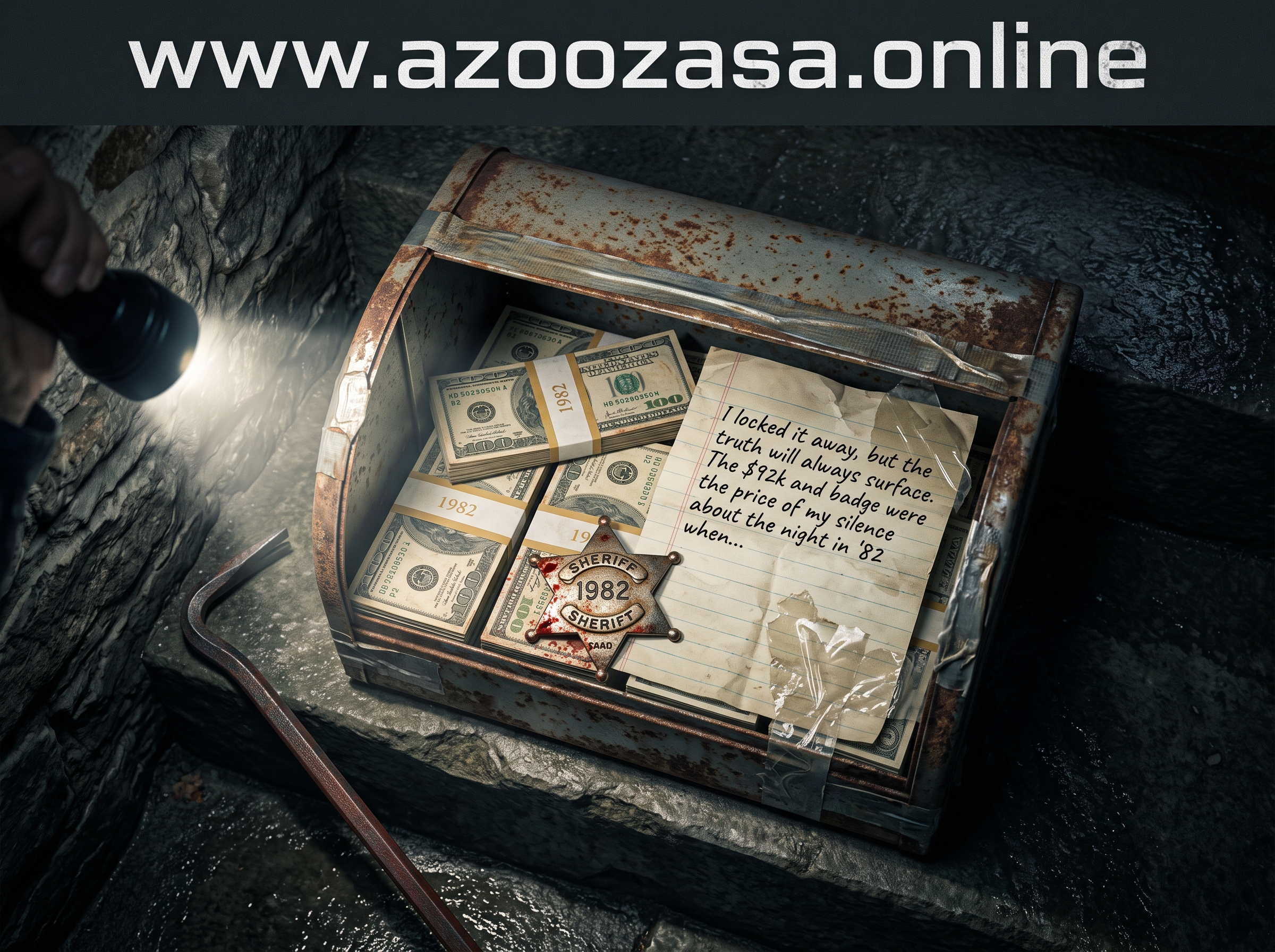
I retrieved a heavy, rubber-gripped flashlight from the garage and walked down the damp, uneven stone steps for the first time in over four decades. The air down there was impossibly thick, smelling intensely of wet concrete, decaying leaves, and an ancient, undisturbed silence that made the hair on my arms stand at attention. Water dripped from the exposed roots above, echoing rhythmically in the pitch blackness. Sweeping the harsh white beam across the small, subterranean room, my eyes landed on it immediately. In the far corner, half-buried under a rotting, mildewed canvas tarp, sat a heavy, rusted metal breadbox sealed with thick layers of hardened, yellowed duct tape.
My heart hammered against my ribs like a trapped bird desperately seeking escape. I found a rusted crowbar leaning against the weeping limestone wall, wedged the hooked iron end under the breadbox lid, and pushed with all my body weight. The metal shrieked in protest, the old, fossilized tape snapping like brittle bones, until the lid flew back and hit the stone floor with a hollow, ringing clang.
Inside lay the terrifying relics of my father’s lifelong paranoia.
First was the money. Thick, dense stacks of fifty and hundred-dollar bills, bound in cracking, fossilized rubber bands that disintegrated the moment I touched them. A quick, trembling count revealed exactly ninety-two thousand dollars in banded cash. It smelled of mint ink, mildew, and age. Beneath the heavy stacks of green lay something metallic and dark. I reached in, my fingers brushing against cold, heavy brass. I pulled it into the beam of the flashlight. It was a 1982 county sheriff’s badge, the intricate star dulled by time and heavily stained with deep, rust-colored smears of oxidized blood.
Sheriff Elias Vance. The man who vanished without a trace the night of the great flash flood in ’82. The town legend, repeated in every diner and barbershop, claimed he was swept away by the raging river while trying to save a stranded family in a station wagon.
And resting beneath the bloody badge was a single, standard-issue audio cassette tape. A piece of white masking tape was stuck to the plastic housing, bearing a single word written in my father’s unmistakable, jagged handwriting: Confess.
My hands shook violently as I gathered the items, shoving them deep into the pockets of my canvas jacket. The storm outside was beginning to surge again, but the distant roll of thunder was absolutely nothing compared to the roaring in my ears. I scrambled up the slick stone steps, burst into the humid summer air, and ran blindly back into the safety of my kitchen. I locked the deadbolt, though I didn’t know what I was locking out.
I tore through the dusty boxes in the attic for over an hour before I finally found my old Walkman buried beneath high school yearbooks and deflated footballs. I shoved two fresh AA batteries into the back compartment, slid the dusty cassette into the mechanical deck, and pressed my old, foam-padded headphones over my ears. I took a deep, shuddering breath, and hit play.
For a long, agonizing moment, there was only the hissing wash of magnetic tape and the rhythmic, popping static of time. Then, my father’s voice filled my head. He sounded younger, more vibrant, yet his voice was trembling, thick with a raw terror I had never heard from the stoic, unbreakable man who raised me.
“If you are listening to this, it means I am dead, and the doors have been opened. I pray to God it was the earth that gave way, and not my own flesh and blood prying where they shouldn’t.”
He paused, and I could hear him taking a ragged, wet breath, followed by the clink of glass against a bottle. He was drinking.
“They told you Elias Vance drowned. He didn’t drown. He was murdered in the basement records room of the municipal building. And I am the one who pulled the trigger.”
I squeezed my eyes shut, gripping the edge of the kitchen counter so hard my knuckles turned a stark, bloodless white. The bloodstained badge resting on the Formica suddenly looked like an unpinned grenade.
“It was November of 1982. The town of Oakhaven was completely bankrupt. The lumber mills were closing, the banks were foreclosing on half the county, and we were staring down the barrel of becoming a ghost town. Mayor Higgins, Judge Lawson, and myself… we found a way out. The federal government was offering massive disaster relief grants for the new reservoir project. Millions of dollars. We didn’t build a reservoir. We falsified the topographical reports, bribed the state inspectors, and funneled ninety-two thousand dollars to every man on the town council to keep their mouths shut. We used the rest of the federal money to buy up the dying businesses, completely rebrand the town, and build the tourist economy you see today. Oakhaven was saved.”
The tape cracked with static. I could hear him weeping, a sound that made my stomach aggressively churn.
“But Sheriff Vance figured it out. He was too smart, and he cared too much. He found the altered blueprints hidden in the clerk’s office. He came to my office that night during the storm. He was a good man, Thomas. He was a righteous man. He stood in my doorway, soaking wet, and said he was arresting us all. He said a town couldn’t be built on a foundation of theft and lies. He didn’t understand that without that money, three thousand innocent people would starve in the winter. I tried to reason with him. I begged him on my knees. But when he reached for his cuffs… I panicked. I took the heavy service revolver out of my desk drawer.”
A raw, guttural sob broke through the audio. My father, the man of iron and stone, was completely broken.
“I shot him square in the chest. Higgins and Lawson heard the gunshot and ran down. They helped me roll him in a carpet and move the body. We wrapped him in heavy logging chains and dropped him deep into the limestone quarry before it filled with rainwater. It was supposed to be a secret that died with the three of us. But Higgins and Lawson are dead now. Cancer and a heart attack. And I am the only one left holding the blood on my hands.”
The static returned for a few seconds, accompanied by a heavy sigh.
“The money in this box is my share. I never spent a single, cursed dime of it. The badge… I kept it to punish myself. To remind me every single day of the good man I slaughtered so this town could survive. I locked the cellar because I couldn’t bear to look at it, but I wore the key because I couldn’t bear to let it go. Thomas, listen to me very carefully. If you expose this, the federal government will ruthlessly audit Oakhaven. The deeds, the businesses, the grants—they will take it all back. The town will be dismantled brick by brick. Your friends, your neighbors, they will lose their homes, their livelihoods, everything. The lie is the only thing holding the concrete together.”
The recording clicked off with a harsh snap, leaving me in a deafening, ringing silence broken only by the rain lashing violently against the kitchen window.
I stared intently at the rusted breadbox on the table. My father’s warning wasn’t a superstitious, senile curse. It was a literal, undeniable fact. If anyone opens those doors, the whole town will fall apart. The quaint boutiques downtown, the thriving, newly built elementary school, the beautiful municipal parks—all of it was deeply nourished by the blood of Elias Vance.
Suddenly, a heavy, rhythmic pounding echoed violently through the house.
I flinched, tearing the foam headphones off my ears. Someone was at the front door.
I crept silently down the hallway, pressing my eye against the cold glass of the peephole. Standing on the porch, completely drenched in rain and illuminated by a sweeping, flashing yellow light from his cruiser, was the current Chief of Police—Daniel Higgins. The son of the former mayor.
He pounded again, his heavy knuckles rapping loudly against the frosted glass. “Thomas! It’s Chief Higgins! I saw the storm tore up your yard pretty bad. Wanted to make sure you were alright in there! Saw your cellar door was blown wide open!”
My blood ran absolute ice cold. How much did Daniel know? Did his father leave him a tape, too? Or was he simply a good, honest cop doing a routine welfare check, completely ignorant of the terrible, bloody sins his father and mine committed in the dark?
I looked back at the kitchen. The ninety-two thousand dollars. The bloody silver star. The tape.
I could put it all in a heavy black trash bag. I could bury the box deep in the woods behind the property line. I could walk out to the porch, shake Daniel Higgins’ hand, offer him a warm cup of coffee, and thank him for his concern. I could keep the brass key permanently buried with my father, and let Oakhaven continue its peaceful, prosperous existence, utterly undisturbed by the chained ghosts rotting at the bottom of the quarry.
Or I could hand him the badge. I could hand him the tape, and watch the entire world burn to the ground.
The pounding on the door grew significantly louder, far more insistent. “Thomas? You in there, buddy?”
I walked back into the kitchen, picked up the cold, rusted breadbox, and felt the immense, suffocating weight of my father’s legacy settle onto my own shoulders. He had carried this immense burden for forty-four years, letting it hollow him out from the inside until there was absolutely nothing left but a frail, terrified man clinging to a brass chain. I realized then that the rot wasn’t just hidden in the cellar; it was in the floorboards of the town hall, in the walls of the bank, in the very air we all breathed.
I scooped the banded cash back into the tin, followed by the cassette tape, and finally, the tarnished, bloody silver star. I didn’t bother locking the breadbox. The long, exhausting era of secrets was finally over.
I walked purposefully down the hallway, the metal tin incredibly heavy in my hands, and firmly unlocked the deadbolt. The front door swung open, revealing the pouring, relentless rain and the expectant, friendly face of Chief Higgins.
“Everything okay, Thomas?” he asked, wiping rain from his brow and eyeing the rusted metal box in my grip.
“No, Daniel,” I said, my voice steady as I stepped out onto the porch, right into the teeth of the storm. “It’s really not. Let’s take a ride down to the station. We have a lot of history to talk about.”


0 comments