
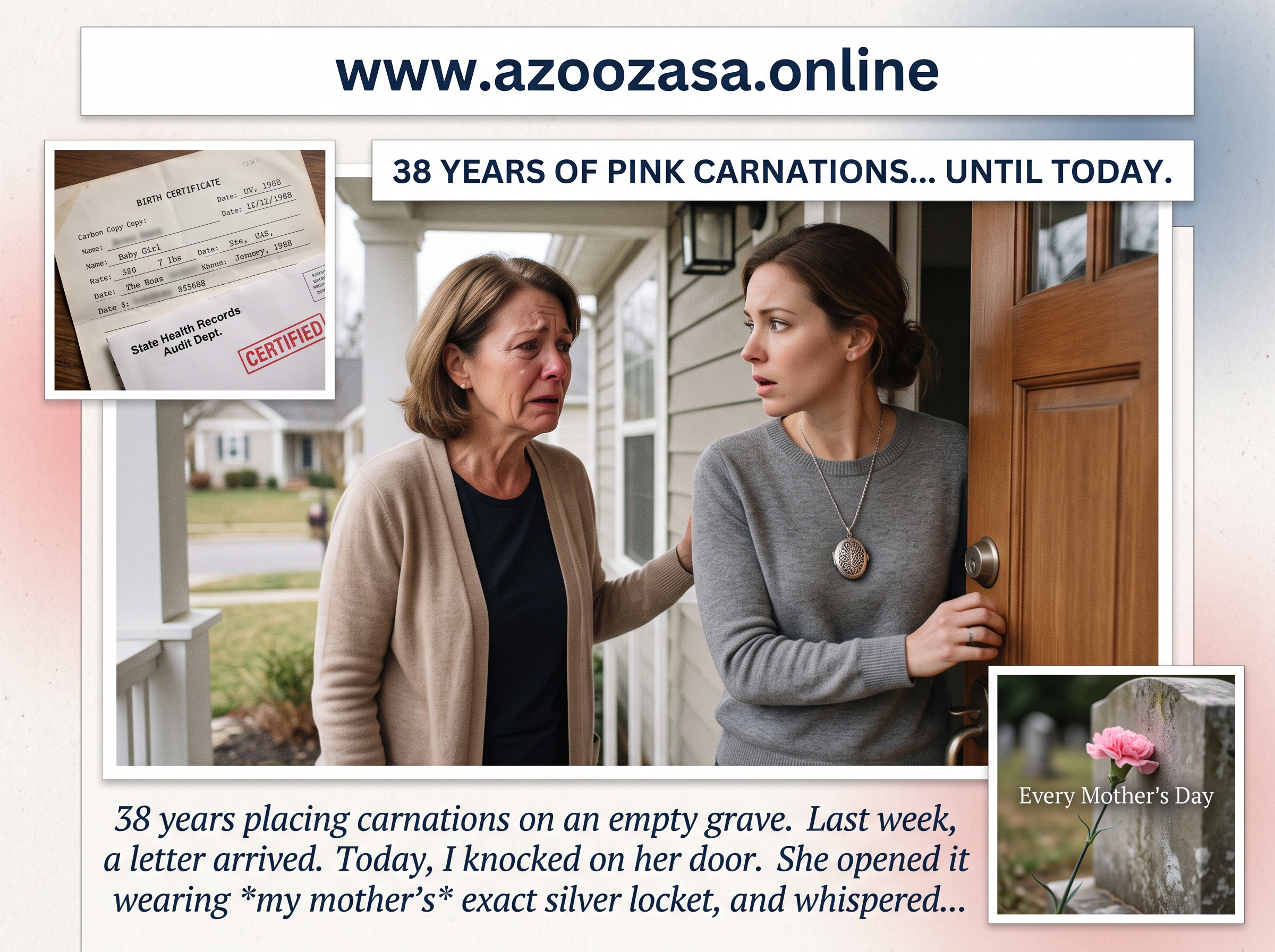
Thirty-Eight Pink Carnations
The sterile, suffocating smell of iodine and floor wax will forever belong to September of 1988. I was nineteen, terrified, and completely alone in a dimly lit clinic on the edge of the county line. The twilight sleep they had given me was heavy, but not heavy enough to erase the memory of the clinic nurse’s face. She possessed a cold, practiced kind of sympathy when she stood at the foot of my recovery bed, folded her arms, and delivered the words that stopped my heart.
“Your baby girl didn’t make it. I am so terribly sorry.”
There was no funeral. There was no tiny casket. They told me the state would handle the remains, wrapping my grief in a veil of bureaucratic efficiency. For thirty-eight years, I was a ghost inhabiting my own life. Every Mother’s Day, while the rest of the world celebrated with Sunday brunch and handmade cards, I drove to the municipal cemetery. I would find a quiet patch of grass beneath a sprawling weeping willow—a placeholder for the grave I was never allowed to have—and I would lay a single pink carnation on the earth. Thirty-eight years. Thirty-eight carnations slowly turning brown under the spring sun, marking the passage of a life that was stolen from me before it ever truly began.
Then came last Tuesday.
It was an ordinary afternoon, the kind of quiet suburban Tuesday where the loudest sound is the distant hum of a lawnmower. The mail carrier, a friendly man named Davis, asked for my signature on a thick, brown envelope. It was sent via certified mail, stamped with the imposing seal of the State Health Records Audit Department. I didn’t think much of it at first. I assumed it was a notice about my pension or a bureaucratic mix-up regarding my own birth records.
I took the envelope into the kitchen, the afternoon light spilling across the granite countertops, and used a paring knife to carefully slice through the heavy adhesive seal.
A stack of photocopied documents slid out, accompanied by a formal letter on official state letterhead. The cover letter detailed a recently unsealed investigation into a disgraced former county judge and a network of black-market adoptions operating out of rural clinics in the late 1980s. The words blurred together, a dizzying soup of legal jargon, until my eyes caught my own maiden name highlighted in stark, fluorescent yellow.
Beneath the letter was a carbon copy of a birth certificate.
My hands, weathered by time and decades of quiet mourning, began to tremble so violently that the paper rattled against the counter. The document was dated September 14, 1988. Time of birth: 4:12 AM. Weight: 7 pounds, 2 ounces. APGAR score: 9.
Status: Healthy.
A second page, a deeply redacted ledger recovered from the clinic’s archives, showed a transaction date three days later. A private adoption. The fee was listed in cold, hard, typewritten numbers: $15,000.
I grabbed the edge of the kitchen island to keep my legs from giving out. The air in the room felt impossibly thin. My baby hadn’t died. She hadn’t been swallowed by the earth or claimed by a tragic twist of fate. She had been boxed up, priced out, and sold to the highest bidder by the very people who were supposed to care for us. The betrayal was a physical blow, a heavy, suffocating weight that crashed down on my chest, threatening to crush my lungs.
But it was the final sheet of paper that broke the dam entirely. It was a yellow adhesive note, affixed by the state auditor, containing a name and a current address cross-referenced from recent tax records.
The address was exactly three miles away.
For thirty-eight years, she had been breathing the same air, watching the same thunderstorms roll in, and shopping at the same grocery stores. The phantom child I had mourned for nearly four decades was living ten minutes from my front door.
I didn’t think. I didn’t plan. I didn’t stop to consider the psychological earthquake I was about to trigger. I grabbed my car keys, my purse, and the heavy brown envelope, and I walked out the door.
The three-mile drive was a blur of familiar suburban sprawl that suddenly looked entirely alien. Every stoplight felt like an eternity; every passing car felt like a physical obstacle keeping me from the missing piece of my soul. My mind raced with terrifying questions. Would she hate me? Did she know she was adopted? Had they told her that her mother threw her away? I gripped the steering wheel until my knuckles turned white, silently praying to a universe I had given up on in 1988.
I pulled onto Elmwood Drive, a quiet, tree-lined street with manicured lawns and children’s bicycles resting in driveways. The address belonged to a modest, beautiful craftsman home painted in a soft slate gray. Potted ferns hung from the wrap-around porch, swaying gently in the afternoon breeze.
I parked at the curb and turned off the ignition. The silence in the car was deafening. I looked at the rearview mirror. Staring back at me was a fifty-seven-year-old woman with silvering hair and eyes swollen from sudden, violent tears. I took a ragged, desperate breath, opened the car door, and stepped out into the blinding afternoon sun.
My legs felt like lead as I walked up the concrete path. Each step carried the weight of a missed birthday, a lost first day of school, a graduation I never attended. I reached the wooden porch, my heart hammering against my ribs like a trapped bird. I raised my hand, my fingers shaking uncontrollably, and knocked three times on the heavy oak door.
The wait was agonizing. Muffled footsteps echoed from deep inside the house. The lock clicked, the brass handle turned, and the door swung open.
The air caught in my throat, choking off the introduction I had desperately tried to prepare.
Standing in the doorway was a thirty-eight-year-old woman. But I didn’t just see a stranger. I saw the ghost of my own youth staring back at me. She had the exact same hazel eyes, the same stubborn, slight curve of the jawline, and the same unruly, dark waves of hair that I had spent my twenties trying to tame. It was like looking into a temporal mirror, watching the timeline I was denied playing out in vivid color right in front of me.
But it was what rested against her collarbone that sent a shockwave of pure electricity down my spine.
When I went into labor in 1988, I had been clutching my grandmother’s silver locket—a heavy, intricate piece of antique filigree that I had intended to pass down to my daughter. When the twilight sleep pulled me under, it was in my palm. When I woke up to the news of her death, the locket was gone. The clinic staff told me it must have been lost in the laundry during the chaos of the delivery.
Now, thirty-eight years later, that exact silver locket rested against my daughter’s chest.
She looked at me, a polite, questioning smile forming on her lips. “Can I help you?”
I tried to speak, but my voice failed completely. Tears spilled over my eyelashes, cutting warm tracks down my cheeks. I raised a trembling hand and pointed, almost unconsciously, to the silver locket.
Her smile faltered. Her brow furrowed as she looked closely at my face. She took in the shape of my eyes, the slope of my nose, the way my chin trembled. The polite confusion in her expression slowly gave way to a profound, dawning shock. She stepped closer, the screen door completely forgotten, her eyes widening as the impossible truth began to settle between us.
She reached up and wrapped her hand around the silver filigree of the locket. Her breathing turned shallow and rapid. She looked at the necklace, then back up at my face.
“My parents…” she started, her voice barely more than a breath. “They told me the woman who gave birth to me died in the clinic. They said this locket was the only thing she left behind.”
A sob ripped from my throat, a ragged, ugly sound born of thirty-eight years of stolen grief. “They lied to me, too,” I wept, unable to hold back the torrent of emotion any longer. “They told me you didn’t make it. I thought you were gone. I’ve mourned you every single day of my life.”
The space between us vanished. The years, the lies, the forged documents, and the corrupt men who had orchestrated our tragedy simply melted away on that quiet suburban porch. She didn’t hesitate. She didn’t pull back. She stepped forward, tears spilling from her own hazel eyes, and closed the gap.
“I knew it,” she whispered, her voice breaking as she wrapped her arms around my shoulders, burying her face into my neck. Her embrace was desperate, a primal recognition of blood and bone. “I always looked in the mirror and knew I was waiting for someone. I knew you were out there.”
I held her. I wrapped my arms around the daughter I had kissed only in my darkest dreams for nearly four decades. I felt the warmth of her skin, the solid, undeniable reality of her existence. The scent of her hair was real. The heartbeat drumming against my chest was real. The silver locket pressed between us, a tangible bridge across the chasm of time, had finally returned to where it belonged.
“I’m here,” I cried, rocking her gently, anchoring myself to the beautiful, living truth in my arms. “I’m right here, my sweet girl. And I am never, ever letting you go.”
Somewhere across town, the municipal cemetery sat quiet and undisturbed. The grass beneath the weeping willow would continue to grow, but it would no longer serve as an altar for my grief. I had placed my last pink carnation on that empty earth. My daughter was alive, she was in my arms, and for the first time in thirty-eight years, I was finally awake.

0 comments