
The Lilies of Room 4B
The silence in the house was a physical weight, pressing against my chest every time I walked past Gene’s empty recliner. It had been three months since a sudden heart attack took my husband of forty years, but the quiet had not grown any less deafening. Gene had been a man of immense presence—a booming laugh, heavy work boots that scuffed the linoleum, and a comforting predictability that anchored my life.
His routine was sacred, none more so than his Wednesday afternoons. For twelve years, without fail, Gene would come home from the hardware store, wash his hands, kiss my cheek, and withdraw exactly ninety dollars in cash from the mason jar we kept in the kitchen cupboard. He would grab his battered, navy-blue Brunswick bowling bag and tell me he was heading to the lanes for league night. He always came home late, smelling faintly of institutional soap rather than stale beer and floor wax, but I never questioned it. Gene was a good man, and the bowling league was his designated slice of freedom.
Or so I believed, until a rainy Tuesday afternoon when the doorbell abruptly shattered the silence.
I opened the front door to find Clara, the owner of the local Main Street floral boutique, standing on my porch. She was clutching a thick, leather-bound ledger against her chest to shield it from the drizzle. Clara and I weren’t particularly close, though Gene had always insisted on buying my anniversary roses exclusively from her shop.
“Pearl, I am so deeply sorry to disturb you,” Clara said softly, her eyes rimmed with red. She stepped out of the rain and into the foyer, gently placing the heavy ledger on the entryway table. “Gene made me promise to bring this to you after he passed. I wanted to give you some time, but I couldn’t hold onto it any longer.”
My brow furrowed in confusion. “A ledger? Clara, Gene didn’t keep our books. What is this?”
She offered a sad, knowing smile, touched my arm lightly, and quietly let herself out the front door without another word.
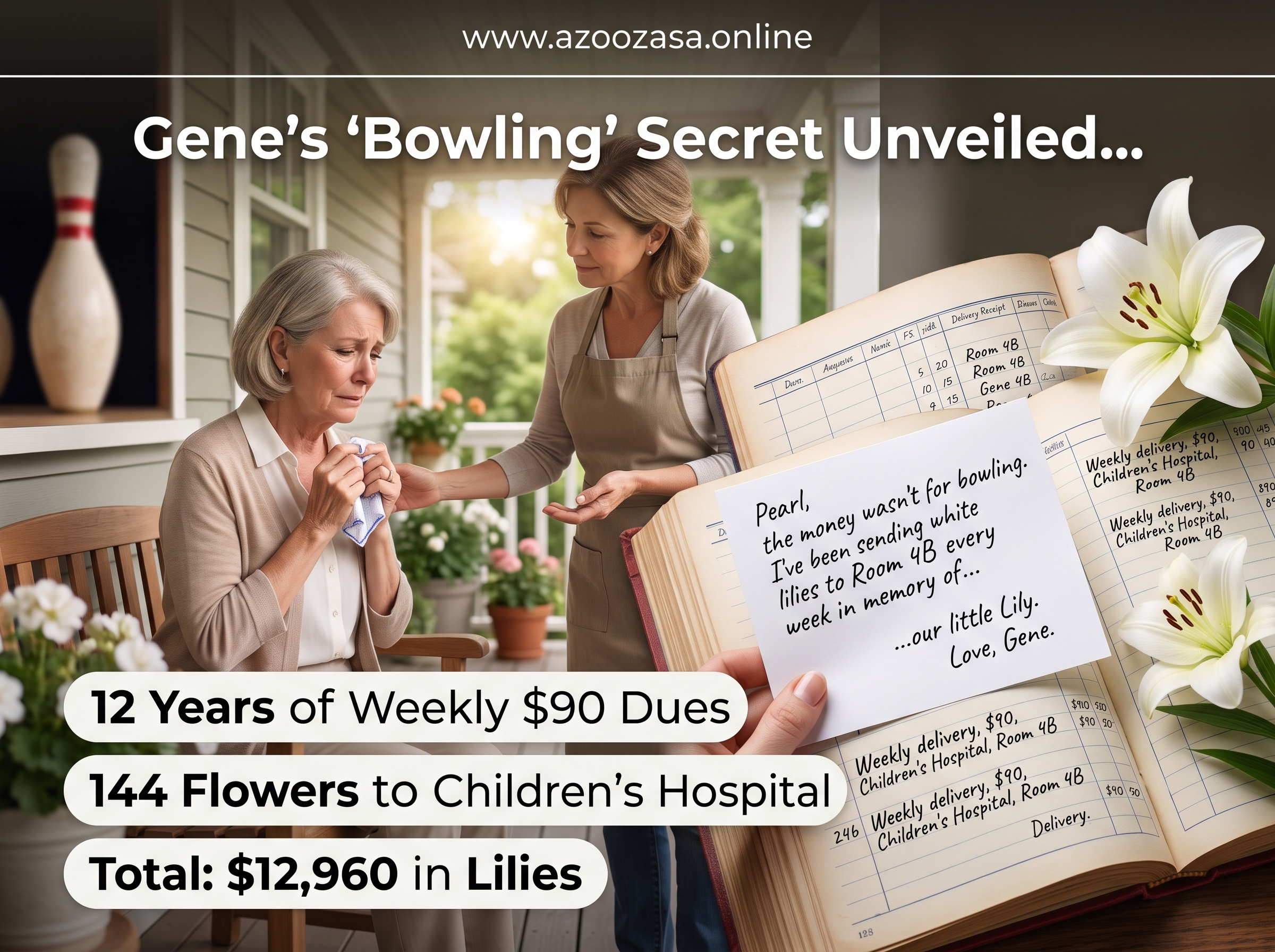
Trembling, I approached the table. The leather cover was worn, the corners softened by years of handling. I opened the heavy book. Inside the current volume were row after row of meticulously kept delivery receipts—144 in this book alone. I ran my finger down the column of totals. They added up to $12,960. Every single receipt was for a fresh, lavish arrangement of white lilies. Every single receipt was marked with a Wednesday delivery date. And every single destination was listed identically: County Children’s Hospital, Pediatric Wing, Room 4B. Anonymous.
Tucked neatly into the back cover was a piece of lined notebook paper folded in half. I recognized Gene’s slanted, hurried handwriting immediately. The ink was slightly smudged, as if he had written it in a rush, or perhaps with a shaky hand. My breath caught in my throat as I unfolded the paper and began to read.
Pearl,
If you are reading this, I am gone, and I owe you the deepest apology a husband can give. The money wasn’t for bowling. I haven’t thrown a bowling ball in twelve years. I’ve been sending white lilies to Room 4B every week in memory of our sweet Madeline.
I dropped the paper onto the table, my hand flying to my mouth to stifle a sudden, tearing sob.
Madeline.
We hadn’t spoken her name out loud in twelve years. She was our bright, fiercely independent seven-year-old granddaughter. When our daughter Sarah lost her battle with addiction, Gene and I had taken Madeline in, raising her as our own. For three years, she was the absolute center of our universe. Then came the leukemia. It was aggressive, merciless, and terrifyingly fast. We spent six months practically living in Room 4B at the county hospital. When Madeline passed away on a rainy Wednesday afternoon, the loss fundamentally broke something inside our home.
I had coped by shutting down entirely. I packed away her toys, boxed up her clothes, and stripped the house of her photographs. I demanded we move forward, building a sterile fortress of denial to survive the suffocating grief. Gene had quietly agreed. He held me while I cried, helped me paint over her pink bedroom, and never pushed back. I thought we had moved on together.
I picked the letter back up, my vision blurring with hot tears.
When we lost Maddie in that room, you begged me to help you move on. You needed the house quiet, and you needed the past packed away so you could breathe again. I loved you too much to deny you that peace, Pearl. I watched you fighting just to get out of bed, and I swore I wouldn’t drag you backward into the pain.
But I couldn’t stop being her grandfather. I couldn’t let her memory disappear into the silence. I found out the hospital rotates the sickest children into Room 4B. Families who are terrified, exhausted, and living the exact nightmare we lived. So, every Wednesday, instead of going to the lanes, I went to Clara’s. I bought the biggest arrangement of white lilies—Maddie’s favorite—and I took them to the pediatric wing. I sat in the hospital chapel for a few hours, prayed for the child sleeping in Maddie’s old room, and made sure their parents knew they weren’t entirely alone.
I kept the secret to protect your heart, Pearl. Please forgive an old man for needing a place to put his grief.
The letter slipped from my fingers. I slumped into the hallway chair, burying my face in my hands as twelve years of misplaced assumptions crashed down around me. Gene’s Wednesday nights. The ninety dollars. The faint smell of institutional antiseptic on his jacket. He hadn’t been escaping me, or our life—he had been carrying the unbearable weight of our shared tragedy entirely on his own shoulders, so I wouldn’t have to. He had spent over fifty thousand dollars over a decade, anonymously pouring his broken heart into the laps of terrified strangers, just to keep our little girl’s memory alive in the dark.
I looked at the grandfather clock ticking faithfully in the corner of the living room. It was 3:15 PM.
It was Wednesday.
A sudden, fierce surge of adrenaline cut through my sorrow. I wiped my face, grabbed my purse and car keys, and marched out the front door. The rain was coming down harder now, a cold, driving sheet that mirrored the weather of that terrible day twelve years ago, but I didn’t care.
I drove straight to Clara’s floral boutique. When I pushed the glass door open, the bell chimed brightly overhead. Clara looked up from the counter, her eyes widening in surprise.
“Pearl,” she said, quickly wiping her hands on her apron. “Are you alright?”
“Ninety dollars,” I said, my voice remarkably steady as I pulled a crisp hundred-dollar bill from my wallet and laid it flat on the glass counter. “I need ninety dollars’ worth of white lilies. The freshest, most beautiful ones you have.”
Clara’s hand trembled as she reached for the money, a tear finally escaping and tracking down her cheek. “Of course, Pearl. I’ve had them set aside all day. I… I just didn’t know if I should put them together.”
Ten minutes later, I was walking back to my car, cradling a massive, fragrant explosion of pristine white lilies wrapped in simple brown paper. The scent was intoxicating, a sharp, sweet contrast to the damp smell of the asphalt.
The drive to the county hospital was a blur of memory and anticipation. I hadn’t stepped foot on this campus in over a decade. When I walked through the sliding glass doors, the familiar smell of clinical sanitizer hit me like a physical blow. It was exactly the scent I had smelled on Gene’s coat every Wednesday night.
I took the elevator to the fourth floor. The pediatric wing was painted in the same cheerful, forced pastels I remembered. Nurses in brightly patterned scrubs moved quietly but urgently down the halls. I walked slowly, my heart pounding in my ears, until I reached the heavy wooden door marked with a brushed steel plaque: 4B.
The door was cracked open. I peeked inside. The room was dim, illuminated only by the rhythmic, blinking lights of several monitors. In the small hospital bed lay a little boy, no older than five, his head completely bald, fast asleep. Sitting in the vinyl chair beside the bed was a young woman. She looked exhausted, her hair pulled back into a messy bun, her shoulders slumped under the terrible gravity of a mother’s worst fear.
On the windowsill, sitting in a cheap plastic hospital pitcher, was a single, wilted white lily from the week before.
I tapped gently on the wooden doorframe. The young woman jumped slightly, turning to look at me with wide, bloodshot eyes.
“I’m sorry to intrude,” I whispered, stepping softly into the room. I held out the massive bouquet of fresh lilies. “My husband… my husband used to bring these. He passed away recently, and he couldn’t make it today. But he wanted to make sure you had them.”
The young mother stared at the flowers, then up at me, her eyes filling with sudden, overwhelming emotion. She stood up, covering her mouth with her hands.
“The Flower Man,” she breathed, her voice cracking. “Are you… are you the Flower Man’s wife?”
I nodded, my throat tightening so painfully I could barely swallow.
“We’ve been in this room for three weeks,” she whispered, stepping forward to take the flowers. “Those lilies… they are the only beautiful thing in this entire room. He never left a name. We asked the nurses, and they just said a grandfather brings them every Wednesday. When they didn’t come this morning, I… I thought we had been forgotten.”
“You weren’t forgotten,” I said, my vision swimming as I looked past her to the sleeping boy, seeing for just a fleeting second the ghost of a bright-eyed little girl in his place. “You were never forgotten.”
The mother stepped forward and wrapped her arms tightly around my neck, pulling me into a fierce, desperate hug. She smelled like exhaustion and fear, but beneath it, there was a profound, lingering gratitude. I closed my eyes and hugged her back, finally letting go of the heavy, suffocating armor I had worn for twelve long years. I cried with her—for the little boy in the bed, for the terrified mother, for my sweet Madeline, and for my beautiful, selfless Gene, who had possessed the courage to love loudly in the darkest of places.
When I finally walked out of the hospital and back into the rainy afternoon, the air felt lighter. I got into my car, the passenger seat now empty, but my heart fuller than it had been in a decade. I started the engine, put the car in drive, and made a silent promise to the man who had loved me enough to carry my pain.
I would be back next Wednesday. And every Wednesday after that.



0 comments