
The Ledger of Booth Four
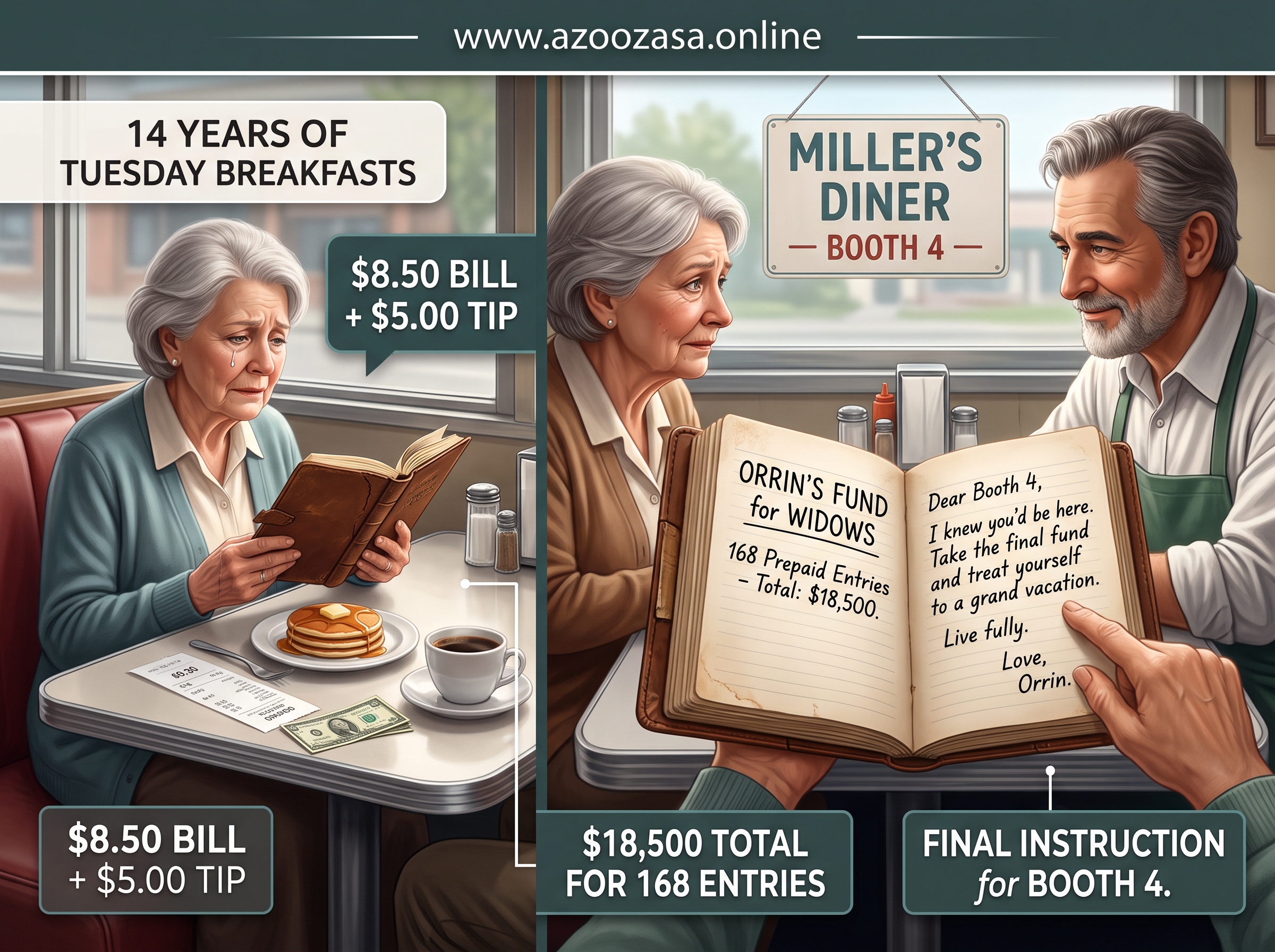
The bell above the glass door of Miller’s Diner chimed, a familiar, slightly out-of-tune metallic clatter that had anchored my Tuesday mornings for exactly fourteen years. I shook the autumn chill from my wool coat, offered a quiet nod to the regulars nursing their black coffees at the counter, and slid into the cracked red vinyl of booth four. It was the same booth, the same morning light filtering through the dusty blinds, and the same hollow ache in my chest that had settled there the day my husband, Orrin, passed away.
For over five thousand days, I had lived in the shadow of his absence. Orrin had been a man of quiet, sturdy presence—a retired structural engineer who spoke softly but loved fiercely. When a sudden, massive stroke took him from me, it felt as though the foundation of my own world had been permanently shattered. I survived by clinging to routine. Every Tuesday morning, I came to Miller’s. I ordered two over-easy eggs, dry wheat toast, and black coffee. My bill was always $8.50, and I always left a crisp $5 tip under the ceramic mug. It was a small, rigid ritual that kept me tethered to the earth when grief threatened to pull me under entirely.
Gabe, the owner of the diner, knew my order before I even sat down. A towering, gentle man with a permanent dusting of flour on his apron, Gabe had watched my hair turn from peppered gray to solid silver over the years. He never offered empty platitudes. He just kept my coffee cup full and offered a warm, silent smile.
But last month, on a quiet, rain-slicked Tuesday, the routine abruptly broke.
Gabe didn’t just drop off the heavy ceramic mug and retreat behind the counter. He carried two cups of coffee. He set one down in front of me, placed the other on the opposite side of the table, and slid into the booth across from me. He looked older today, the deep lines around his eyes heavily pronounced.
From the deep pocket of his apron, Gabe pulled out a thick, mended leather notebook. The spine was secured with a strip of black electrical tape, and the edges of the pages were soft and dog-eared from years of constant handling. He laid it flat on the Formica table between us, resting his large, calloused hands on top of it.
“Orrin came in two weeks before he died,” Gabe said softly, his voice barely rising above the low hum of the diner’s old refrigerator.
I froze. My hands hovered over my coffee cup. I hadn’t heard anyone speak Orrin’s name aloud in years. The sudden invocation of his memory felt like a physical shock.
Gabe gently opened the cover of the worn leather notebook. “He knew his heart was failing, Martha. He knew the doctors had given him a timeline he wasn’t sharing with you, because he didn’t want you spending your last days together drowning in panic.”
I stared at the pages. They were filled with columns of neat, meticulously kept dates and numbers.
“He brought me a cashier’s check that morning,” Gabe continued, his voice thick with unspent emotion. “Inside this book are one hundred and sixty-eight prepaid entries totaling eighteen thousand, five hundred dollars.”
I couldn’t process the number. Orrin and I had lived comfortably, but modestly. We had a solid savings account, a paid-off mortgage, and a life insurance policy that had kept me safe since his passing. But $18,500 in cash?
“For what, Gabe?” I whispered, my voice trembling. “What did he pay for?”
“For fourteen years,” Gabe said, his eyes shining with unshed tears, “Orrin has secretly paid for every meal eaten by low-income widows in this town. He knew the women who had lost their pensions. He knew the ones whose husbands left them with nothing but medical debt. He told me that when you lose the person who built your life with you, the absolute last thing you should have to worry about is the cost of a hot meal in a warm room.”
My breath caught in my chest. A profound, overwhelming silence descended over the table. I looked down at the ledger. Next to the dates were small initials. M.K. – $7.40. E.R. – $9.15. S.J. – $6.50. Every single entry was zeroed out. Paid in full. Over a decade of quiet, invisible grace, funded by the man I had loved and mourned. I thought back over the years, visualizing the older, solitary women I had seen sitting in the booths around me—women who lingered over their tea, reading paperbacks, finding a safe haven from their empty, quiet houses. Orrin had fed them all. He had been gone for fourteen years, and yet, he had been right here in Miller’s Diner every single day, taking care of his community from the grave.
Tears spilled over my eyelashes, cutting hot tracks down my cheeks. The sheer magnitude of his love—his boundless, selfless character—was blinding.
Gabe slowly turned to the very last page of the ledger. The paper was thicker here, slightly yellowed with age. Pinned to the center of the page was a single piece of lined notepad paper. I recognized the sharp, slanted strokes of the blue ink instantly. It was Orrin’s handwriting.
“The fund officially ran out last Thursday,” Gabe said gently. He tapped his thick finger on the handwritten note. “But he left one final instruction for the woman sitting in booth four, which says…”
Gabe slid the notebook across the table. My hands shook violently as I pulled the book closer. The ink was slightly faded, but the message was agonizingly clear.
Gabe,
If you are reading this, the money has run its course, and roughly fourteen years have passed. My Martha is a creature of habit. I know she is still sitting in booth four every Tuesday, ordering two eggs and black coffee. I know her bill is $8.50, and because she is the most generous woman alive, she leaves you a $5 tip.
But Martha’s meals were never supposed to come out of the widows’ fund. Her meals were always on me. I’ve left a separate envelope in the back of this book. Every time she pays her $8.50, and every time she leaves you a $5 tip, I want you to put that money into the envelope. Keep it completely hidden from her until the ledger is entirely empty.
Gabe reached under the table. He pulled out a heavy, polished wooden cigar box—the one Orrin used to keep on his workbench—and set it gently on the table. He flipped the brass latch. Inside, bound in thick rubber bands, were stacks of perfectly preserved cash. Five-dollar bills, singles, and quarters. Fourteen years of my own money, quietly intercepted, matched, and saved by the owner of the diner on my husband’s final orders.
I choked back a sob, pressing my hand over my mouth. I looked back down at the note, reading Orrin’s final words through a blurry, watery haze.
Martha, my brave, beautiful girl.
If Gabe has given you the box, it means you have spent over five thousand days mourning me in this booth. You have survived the worst of it. But survival is not the same thing as living. In that box is just under ten thousand dollars. It is your money, saved by your own stubborn loyalty.
I have spent the last fourteen years making sure you had a place to sit, a routine to hold onto, and a quiet way to help take care of the women in this town alongside me. But our work here is finally done. The ledger is closed. Your tab is fully paid.
Stop looking for my ghost at the bottom of a coffee cup. I am not in booth four anymore. I am in the ocean we promised we would go see. I am in the redwood forests we always talked about driving through. Take this money. Buy a ticket, rent a car, and go out into the beautiful, wide-open world. It is time to leave the diner, Martha. I will meet you out there.
Forever yours,
Orrin.
I sat there in the quiet diner, the hum of the refrigerator suddenly drowned out by the thunderous, undeniable beating of my own heart. The crushing, suffocating weight I had carried into the diner every Tuesday for fourteen years had vanished, entirely replaced by a brilliant, soaring lightness. Orrin hadn’t just left me with a life insurance policy; he had left me with a meticulously engineered map back to my own life, perfectly timed for the exact moment he knew I would finally be strong enough to follow it.
I closed the heavy leather ledger. I reached out and rested my hand on Gabe’s thick forearm. “Thank you,” I whispered, my voice thick but remarkably steady. “Thank you for keeping his secret. Thank you for taking care of us.”
Gabe smiled, a brilliant, watery smile. “It was the honor of a lifetime, Martha. Where are you going to go first?”
I looked out the diner window. The rain had stopped, and the early morning sun was just beginning to break through the heavy gray clouds, casting a warm, golden light across the wet pavement.
“The ocean,” I said, pulling the wooden cigar box into my lap. I slid out of booth four, standing taller than I had in a decade and a half. “I’m going to see the ocean.”
I didn’t leave a tip on the table that morning. I didn’t need to. I pushed open the glass door of Miller’s Diner, the little bell chiming one last, triumphant time behind me, and I walked out into the morning sun, finally ready to live.



0 comments