
The Secret in the Oak: A Codicil of Dust and Gold
The funeral soil hadn’t even settled over Dad’s grave when my older brother, Royce, decided to carve up the kingdom. We were standing in the dim, dusty light of our childhood living room, the air still thick with the scent of lilies and stale coffee. Royce didn’t even have the decency to wear a black tie. He was leaning against the fireplace mantle, popping open a can of soda with a sharp hiss that felt entirely too loud for a house in mourning.
“Dad wanted me to have the land and the accounts,” Royce said, taking a long sip. He didn’t look at me. He just stared out the window at the sprawling, two-hundred-acre property we had grown up on—a property known locally as the OneMore Farm, named for Dad’s stubborn habit of always planting one more row of corn, fixing one more fence post, or working one more hour before the sun went down.
The estate was worth roughly $310,000, between the acreage, the tractors, and Dad’s modest bank accounts. According to the document Royce casually slid across the kitchen table—a hastily drafted will notarized by one of Royce’s drinking buddies—Dad had left everything to his “firstborn and namesake.”
“What about me?” I asked, my voice dangerously quiet.
Royce shrugged, a casual, infuriating lift of his shoulders. “You can take whatever you want from the attic. But be out by the end of the week. I’m bringing in a crew to gut the kitchen.”
I could have fought it. I could have dragged him through probate court, challenged the sketchy notary, and spent years draining whatever money was left in a bitter legal feud. But the grief was too heavy, and Royce had always been a master of wearing people down to the bone. I walked upstairs to the stifling heat of the attic, intending to leave with nothing but my pride. But sitting in the corner, covered in a thick layer of dust and draped in a moth-eaten quilt, was Dad’s old recipe cabinet.
It was a beast of a thing—heavy, solid oak, chipped at the edges from years of use, with dozens of tiny drawers that used to hold index cards of fertilizer ratios and my grandmother’s pie recipes. It wasn’t worth a dime, but it was the only thing in the house that actually smelled like him. I hauled it down the stairs, loaded it into the back of my car without saying a single word to my brother, and drove away from OneMore Farm.
For eight long years, that chipped oak cabinet sat in the narrow hallway of my cramped apartment. It became a piece of the background, a silent, stubborn monument to the life I had been cheated out of. Royce, meanwhile, lived exactly as I expected him to. He treated the farm like a personal ATM, selling off the timber, neglecting the soil, and parading around town in lifted trucks he couldn’t afford. Rumors trickled down through the family grapevine that he had leveraged the property to the hilt, drowning in debt and desperate for cash. I ignored it all. I built a quiet, disciplined life, passing that heavy oak cabinet every single day.
Then came yesterday.
I was re-arranging the apartment, trying to make room for a new bookshelf, and I had to move the cabinet. I gripped it by the sides, underestimating how top-heavy the solid oak made it. My foot caught the edge of the hallway rug. I stumbled, my grip slipped, and the cabinet crashed hard onto the hardwood floor with a deafening, splintering thud.
I cursed, dropping to my knees. The impact had completely split the bottom right side panel, snapping the ancient wooden dowels and peeling the thick oak veneer away from the frame. But as I reached out to press the wood back into place, my fingers brushed against something cold and distinctly unnatural.
The side panel wasn’t solid wood. It was hollow.
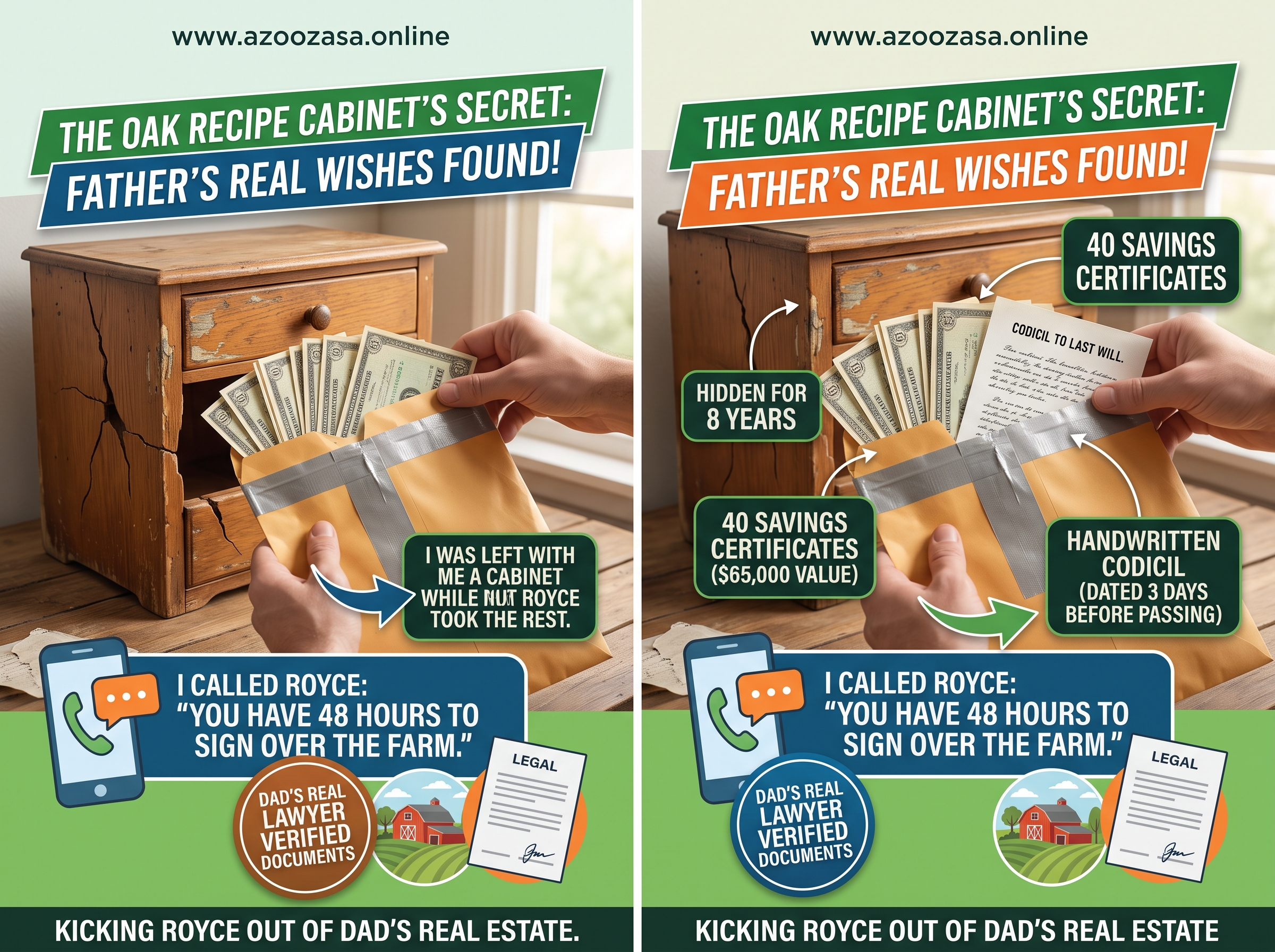
My heart skipped a sudden, frantic beat. I grabbed a flathead screwdriver from the kitchen drawer and wedged it into the splintered crack, prying the damaged panel completely off. Hidden in the secret, two-inch cavity between the exterior wall and the bottom drawers was a thick, Manila envelope, heavily wrapped in silver duct tape.
My hands began to shake as I pulled it free. The tape was ancient and brittle, peeling away with a dry, ripping sound. I opened the flap and dumped the contents onto the floor.
Dozens of crisp, heavily embossed papers fluttered onto the rug. I picked one up, my breath catching in my throat. They were municipal savings certificates. Forty of them, to be exact. I quickly calculated the denominations, my mind racing. Sixty-five thousand dollars. They were unregistered, completely mature, and entirely untraceable.
But it was what lay at the bottom of the envelope that made the blood freeze in my veins.
Folded neatly inside a plastic sleeve was a piece of personalized stationary. It was Dad’s handwriting—the sharp, unmistakable cursive I would know anywhere. At the top right corner was a date: October 14th. Exactly three days before his sudden, fatal heart attack.
To my youngest, the letter began.
If you are reading this, I am gone, and you were smart enough to take the one piece of furniture I explicitly asked Royce to leave in the attic. Your brother is a fool, but he is a dangerous fool. A week ago, he cornered me when I was medicated and weak, threatening to put me in a state home if I didn’t sign a will giving him the farm. I signed it just to get him out of my house.
But Royce forgot that I am a stubborn old man.
Attached to this letter is my final, legally binding codicil. I took a cab into town yesterday and sat down with Arthur Sterling, my actual attorney. Arthur has the original, but this copy bears his notary seal. This document completely revokes the fraudulent will Royce bullied me into signing. The savings certificates are for you—a little cushion to help you get the land back on its feet. The OneMore Farm belongs entirely to you. Take it back.
I sat on the floor of my hallway for a long time, the cool paper of the codicil trembling in my hands. The betrayal was staggering, but the vindication was an absolute, blinding rush of adrenaline. Dad had known. He had seen Royce exactly for what he was, and he had planted a time bomb in the one place he knew Royce’s arrogance would never let him look.
I didn’t sleep that night. At 8:00 AM sharp, I was sitting in the polished mahogany office of Arthur Sterling, a formidable, sharp-eyed estate lawyer who had been practicing law longer than I had been alive. Arthur took one look at the codicil, matched the notary stamp to his private ledger from eight years ago, and smiled a cold, terrifying smile.
“Your brother,” Arthur said, adjusting his glasses, “has committed a severe case of probate fraud. He forced a superseded will through the courts. Legally speaking, he doesn’t own a single blade of grass on that farm, and he never did.”
By noon, the legal machinery was fully in motion. Arthur filed the emergency injunctions, freezing every asset attached to the property and pulling the deed out from under Royce’s feet faster than he could blink.
At 2:00 PM, I parked my car at the edge of my apartment complex, the heavy envelope of savings certificates locked safely in my glovebox. I pulled out my phone and dialed the number I hadn’t called in nearly a decade.
It rang four times before Royce picked up.
“What do you want?” he answered, his voice rough and irritated. I could hear the roar of a tractor engine in the background. “I told you eight years ago, I’m not giving you any handouts.”
I leaned back against my car, looking up at the clear blue sky, feeling a profound, overwhelming sense of peace settle over my shoulders.
“I don’t want a handout, Royce,” I said, my voice steady, carrying the quiet, undeniable authority of a ghost coming to collect. “I’m calling to give you a timeline. You have 48 hours to sign over the farm, because Dad’s real lawyer just verified that the will you pushed through probate was legally revoked three days before he died.”
The tractor engine in the background suddenly cut off. The silence on the line was absolute, thick with a sudden, suffocating panic.
“What?” Royce finally choked out. “That’s impossible. I have the deed. I have the papers.”
“You have a piece of paper Dad signed under duress,” I corrected smoothly. “I have the final, notarized codicil. Arthur Sterling filed the injunction an hour ago. You’re entirely frozen out of the accounts, Royce. You don’t own the house. You don’t own the tractors. You have been squatting on my property for eight years.”
“You’re lying!” he shouted, his voice cracking with a frantic, desperate fear. “Where did you even get this? You’ve had nothing for eight years!”
“Dad left it for me,” I replied. “In the junk you told me to take from the attic.”
I didn’t wait for him to respond. The sound of his frantic breathing was enough. I ended the call, letting the dial tone serve as the final punctuation to an eight-year sentence.
Two days later, Royce was gone. Faced with the undeniable proof of the codicil and the looming threat of felony fraud charges, he packed his lifted truck and abandoned the property before the sheriff even had to serve the eviction notice.
I drove back out to the OneMore Farm on a crisp, bright Sunday morning. The fields were overgrown, and the fences needed mending, but as I stood on the front porch and looked out over the two hundred acres of sprawling land, it didn’t look like a ruin. It looked like a beginning.
I walked inside the old house. The air was stale, but the light was warm. Later that afternoon, my friends would help me move my things in, but the very first item I carried through the front door was a heavy, solid oak recipe cabinet with a broken side panel. I set it carefully in the hallway, right where it belonged. It was, without a doubt, the most valuable piece of furniture I would ever own.



0 comments