
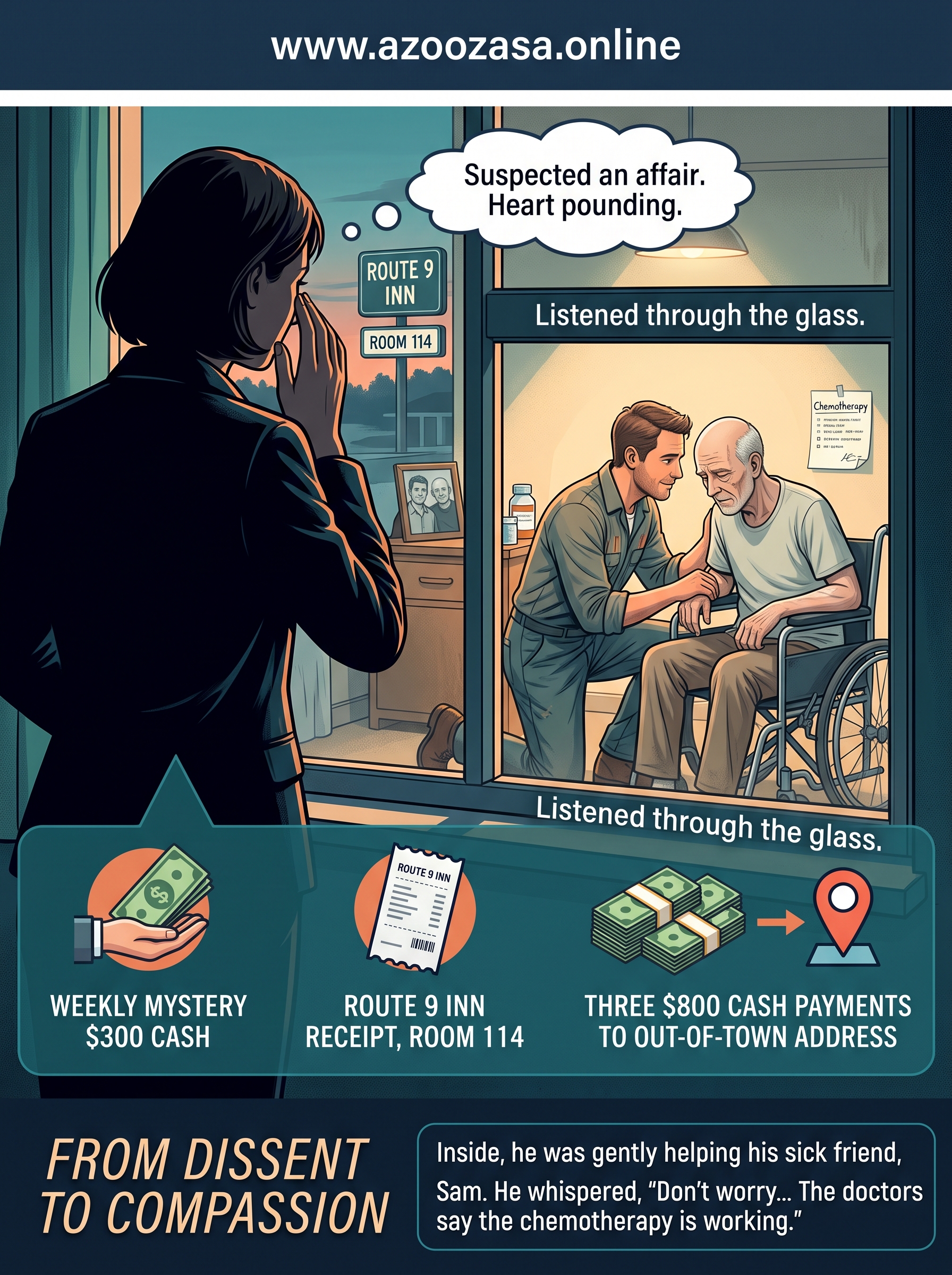
The Friday Penance: What Waited in Room 114
The slow death of a marriage rarely begins with a shouting match; it usually begins with the quiet, undeniable arithmetic of missing money.
For two months, exactly three hundred dollars vanished from our joint checking account every Friday afternoon. The withdrawal was always made at the same ATM on the edge of town, right around the time my husband, Douglas, clocked out from his shift at the lumber yard. When I first noticed the discrepancy, I asked him about it over a casual Tuesday dinner, trying to keep my voice light and untroubled. Douglas didn’t meet my eyes. He rubbed the thick stubble on his jawline—a nervous tic he had carried since his twenties—and claimed he was helping his buddy Mike patch up a collapsing garage roof. The cash, he said, was for off-the-books building materials.
I wanted to believe him. I had loved this man for eight years, building a quiet, comfortable life on a foundation of absolute trust. But doubt is a relentless weed. It takes root in the darkest corners of your mind and chokes out everything else.
My doubt blossomed into terrifying certainty on a rainy Thursday evening while I was sorting the laundry. Douglas had left his heavy canvas work jacket draped over the mudroom bench. As I picked it up to toss it into the wash, I checked the pockets. My fingers brushed against a crumpled wad of thermal paper. I pulled it out, smoothing the receipts flat against the top of the washing machine.
My stomach violently twisted into cold, heavy knots.
The first was a receipt for the Route 9 Inn, a notoriously bleak, neon-lit motel on the crumbling outskirts of the county line. Tucked directly behind it were three carbon copies of money orders. Each was made out for eight hundred dollars, sent to a P.O. box in an out-of-town medical district two counties over.
There were no lumber receipts. There was no garage roof. There was only a cheap motel and thousands of dollars being funneled to a mystery address.
The air in the laundry room suddenly felt entirely devoid of oxygen. The classic, humiliating narrative played out in my mind with agonizing clarity. He was keeping a second life. A mistress in a cheap motel. Perhaps a secret child in another town, requiring child support under the table. The betrayal felt like a physical blow, leaving me dizzy and gasping for breath. I didn’t confront him that night. I couldn’t. I needed to see the wreck of my life with my own two eyes before I burned it all to the ground.
The next day, Friday, I left my office an hour early. I parked my sedan two blocks down from the lumber yard and waited. At exactly 3:15 PM, Douglas’s silver Silverado pulled out of the gravel lot. My hands were slick with sweat against the steering wheel as I slipped into the traffic three cars behind him, my heart hammering a frantic, terrifying rhythm against my ribs.
He didn’t drive toward Mike’s house. He drove straight out to the county line, his truck kicking up sprays of gray water as the afternoon drizzle turned into a steady, freezing rain.
The Route 9 Inn looked even more desolate in person. The pink neon sign sputtered, missing half its letters. Douglas pulled into a spot near the back of the single-story complex. I parked across the street behind a rusted diner, watching through the rhythmic sweeping of my windshield wipers. He stepped out of his truck, pulling a plastic grocery bag and a small cooler from the passenger seat, and walked purposefully toward Room 114.
He didn’t knock. He simply pulled a brass key from his pocket, unlocked the peeling blue door, and stepped inside.
For ten minutes, I sat in my car, paralyzed by the sheer weight of what I was about to do. I imagined the woman inside. I imagined her young, vibrant, and everything I feared I was losing as the years ticked by. Finally, a surge of adrenaline masked my terror. I opened my car door, stepped out into the freezing rain, and marched across the cracked asphalt.
I approached Room 114, my breath pluming in the damp air. The heavy blackout curtains were drawn shut, but a small, two-inch gap remained where the fabric had caught on the window frame. I pressed my back against the damp brick wall, closed my eyes for one brief, agonizing second, and then leaned over to look through the glass.
I braced myself for the sight of tangled sheets and whispered betrayals. Instead, the scene before me completely shattered my reality.
The dim, yellow light of the motel lamp illuminated a small, sterile room smelling faintly of antiseptic and stale carpet. Douglas wasn’t undressing. He was kneeling on the floor, his massive, calloused hands moving with excruciating gentleness as he adjusted the footrests of a steel wheelchair.
Sitting on the edge of the sagging mattress, struggling to breathe, was a skeletal, frail man.
He was incredibly thin, his skin a translucent, sickly gray. He was entirely bald, his head covered in faint, dark bruises from intravenous lines. Douglas stood up, wrapping his strong arms around the fragile man’s waist, and lifted him with agonizing care, lowering him securely into the wheelchair.
Douglas knelt back down, pulling a thick, woolen blanket from the bed and draping it over the man’s trembling knees. He smoothed the fabric, his shoulders slumping with a profound, unspoken exhaustion.
Through the thin, uninsulated glass of the motel window, I heard my husband’s voice crack as he whispered, “Don’t worry, Sam. The doctors say the chemotherapy is working. The money orders cleared for the clinic. We’re going to beat this.”
The man in the chair was Sam, the older brother Douglas had told me died in a drunk driving accident a decade before we even met.
My hand flew to my mouth to stifle a gasp. The rain soaked through my coat, but I couldn’t feel the cold. I could only feel the massive, tectonic shift of my entire world realigning.
When Douglas and I had first started dating, he told me his older brother had died in a fiery crash when they were teenagers. He told me it was a tragic, senseless loss that tore his family apart, and he had explicitly asked me never to bring it up because the pain was simply too deep. I had respected that boundary for eight years.
But Sam wasn’t dead. He was right here, clinging to life in a roadside motel.
I didn’t think. I just acted. I stepped away from the window, walked to the peeling blue door, and knocked three times.
The rustling inside stopped instantly. A tense, suffocating silence fell over the room. The deadbolt clicked, the handle turned, and the door opened a few inches.
Douglas stared at me through the gap, his face draining of all color. His eyes widened in absolute, unadulterated terror. He looked like a man who had just been sentenced to the gallows.
“Sarah,” he choked out, his voice barely a breath. “What… what are you doing here?”
I pushed the door open, forcing him to step back. The stale, medicinal air of the room washed over me. I looked past my terrified husband and met the sunken, exhausted eyes of the man in the wheelchair.
Up close, the family resemblance was undeniable. Sam had the same strong brow line, the same deep-set hazel eyes as my husband. But where Douglas was vital and strong, Sam had been entirely hollowed out by disease.
“You told me he was dead,” I said, my voice shaking not with anger, but with a profound, aching sorrow.
Douglas collapsed into the single armchair by the window, burying his face in his large, rough hands. A ragged, terrible sob tore from his chest. “I’m sorry,” he wept, the sound ripping my heart completely in two. “Sarah, I am so deeply sorry.”
Sam wheeled himself forward slightly, his bony fingers gripping the metal rims of his wheels. “Don’t be angry with him, ma’am,” Sam’s voice was a raspy, papery whisper. “This is my fault. All of it.”
I walked further into the room, closing the door against the cold rain. “Someone needs to tell me the truth. Right now.”
Douglas looked up, his eyes bloodshot and overflowing with years of repressed, toxic guilt.
“He didn’t die in that crash, Sarah,” Douglas whispered, his voice trembling. “I was the one driving.”
The truth spilled out of him in a desperate, broken flood. When Douglas was eighteen, he had gotten drunk at a graduation party and wrapped his father’s truck around a telephone pole. Sam, who was twenty-one and stone-sober, had arrived on the scene minutes before the police. Knowing that Douglas had a full scholarship to a state university and a pristine record, Sam had dragged his younger brother to the passenger seat and sat behind the wheel.
Sam took the fall. He took the felony charge. He went to county jail for a year, destroying his own prospects while Douglas went off to college to build a perfect, unblemished life. Their strict, unforgiving parents disowned Sam entirely, forbidding his name to ever be spoken in their house again.
“I let him do it,” Douglas wept, staring at the stained carpet. “I was a coward. I let him ruin his life to save mine. When I met you… you were so good, Sarah. You came from this wonderful, honest family. I was so terrified that if you knew what a coward I was, what I had done to my own blood, you would walk away.”
Sam had struggled for years, drifting from town to town, unable to secure decent work with a felony record. Six months ago, a free clinic diagnosed him with late-stage lymphoma. With nowhere else to turn, he had finally called the brother whose life he had saved.
“The three hundred dollars…” I started, the pieces rapidly locking into place.
“For his food, his motel rent, his pain meds,” Douglas said, wiping his face. “The money orders are paying off his treatments at the oncology center. I’ve been working double shifts at the yard and hiding the cash. I just… I couldn’t let him die alone, Sarah. Not after what he gave up for me.”
I looked at the three of us in that dim, tragic little room. I looked at my husband, a man who had carried the crushing weight of another man’s life on his shoulders for a decade, too paralyzed by shame to ask his own wife for help.
I didn’t scream. I didn’t yell about the lies or the missing money.
I took off my wet coat, draping it over the back of a wooden chair. I walked across the room and knelt down on the stained carpet right in front of Sam’s wheelchair. I reached out and gently took his cold, fragile hands in mine.
“You must be Sam,” I said softly, forcing a warm, steady smile through my own tears. “I’ve heard absolutely nothing about you.”
Sam let out a weak, raspy breath that might have been a laugh, a tear escaping his hollowed eye and rolling down his gray cheek.
I stood up, walked over to my husband, and pulled his shaking body into my arms. I held him tightly, letting him weep into my shoulder as the dam he had built for ten years finally shattered.
“We’re checking him out of this awful place right now,” I whispered into Douglas’s ear, stroking the back of his neck. “We have a guest room. It has a beautiful window that looks out on the garden. He’s coming home with us.”
Douglas pulled back, his eyes wide with disbelief. “Sarah, you don’t have to—”
“He’s your brother, Douglas,” I interrupted, my voice leaving no room for argument. “Which means he is my brother, too. And you are never, ever going to carry this alone again.”
The rain continued to batter the cheap glass of Room 114, but inside, the suffocating, heavy air had finally cleared. The money was gone, the secrets were entirely laid bare, and for the first time in his life, my husband was finally free.


0 comments