
The Echoes of Room 204
“Your blood type doesn’t match either of your parents,” the clinic doctor said quietly, his brow furrowed as he looked over the rim of his glasses at the tablet in his hands.
I’m 54 years old. I had gone in for a routine checkup, a standard metabolic panel to address some lingering fatigue, only to discover in one sterile, fluorescent-lit moment that I couldn’t biologically belong to the couple who had raised me. The man who had taught me how to ride a bicycle and the woman who had painstakingly sewn all my childhood Halloween costumes shared O-negative and A-negative blood. I was AB-positive. It was a genetic impossibility.
My ears started ringing, a high, thin whine that entirely drowned out whatever medical reassurances the doctor was trying to offer. I drove back to my childhood home—the house I had inherited after my mother passed away three years ago—in a state of complete, suffocating paralysis. The trees lining my familiar street looked foreign; the front door I had walked through ten thousand times suddenly felt like the entrance to a stranger’s life.
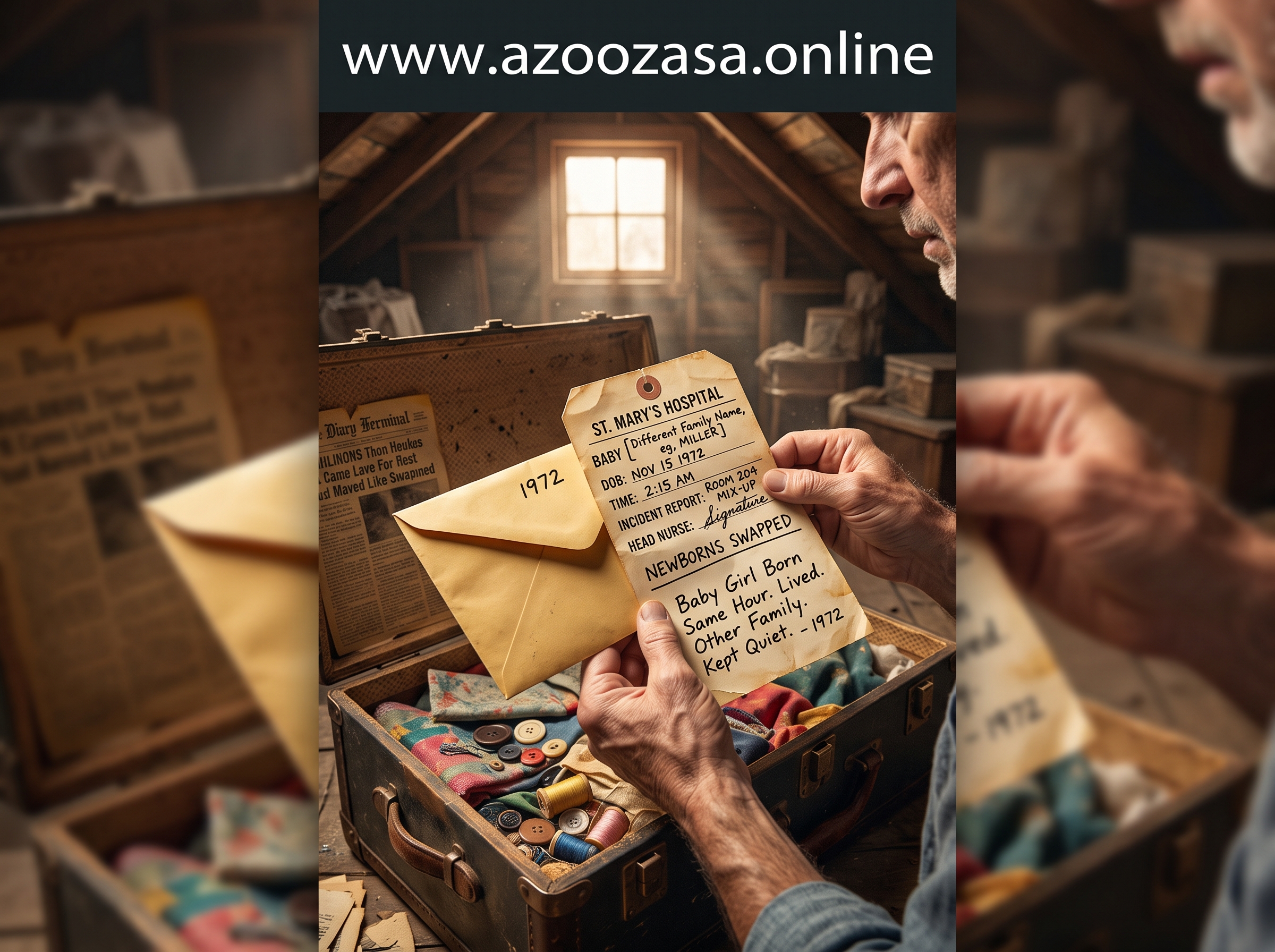
That evening, driven by a frantic need for an anchor, I climbed the creaking pull-down stairs into the attic. I searched my late mother’s old cedar sewing trunk, a heavy, brass-latched box she had guarded with a quiet reverence her entire life. Tucked at the very bottom, hidden beneath layers of vintage floral fabric and spools of heavy-duty thread, was a faded yellow envelope postmarked October 1972.
Inside was an unfiled hospital intake tag bearing my exact birth date, tied with a brittle piece of string. Beside it rested a handwritten note on official hospital letterhead from a head nurse named Margaret Higgins. The intake tag listed a completely different family name: Gallagher. Folded behind the tag was an internal, clearly suppressed incident report detailing a catastrophic newborn mix-up in room 204. The nurses had bathed two infants born minutes apart and returned them to the wrong bassinets. By the time the error was privately flagged by a night orderly, both families had already been discharged.
And then, I found the final piece of paper. Attached by a rusted paperclip was a newspaper clipping from 1990 of a baby girl born the same hour who lived just four miles across town.
The clipping was a high school graduation announcement from the local gazette. The girl’s name was Sarah Gallagher. I stared at the grainy black-and-white photograph, my breath catching painfully in my throat. She had my father’s unmistakable, slightly crooked jawline. She had my mother’s heavy-lidded, expressive eyes. She was the biological daughter my parents had brought into the world, and I was the imposter they had carried out the hospital doors.
The weight of the betrayal was crushing, but as I read Nurse Higgins’s attached note, the narrative shifted from institutional negligence to a mother’s agonizing choice.
“Margaret,” the note read, addressed to my mother. “I am risking my pension sending you this, but you demanded the truth when you noticed her eye color changing. The hospital administrator has buried the report to avoid a lawsuit. The Gallagher family remains completely unaware. You must decide if you want to shatter two families to reclaim the blood you birthed, or keep the child you have already loved for eight months. God forgive us all.”
My mother had known. For fifty-three years, she had carried the knowledge that the child sleeping in the room down the hall was not hers, while her biological daughter grew up a mere four miles away. She had kept the clipping. She had watched from the shadows.
The next morning, I did not go to work. I sat at the kitchen table, armed with a laptop and a desperate, burning need for resolution. Tracking down Sarah Gallagher took less than two hours. She still lived in the same state, working as a pediatric physical therapist in a neighboring county. I found her professional contact page, staring at her current, full-color headshot. The resemblance to my late parents was no longer deniable; it was blinding. She was the ghost of my mother, aged and living a life I had unknowingly usurped.
My hands shook so violently I could barely punch the digits into my phone. When the receptionist transferred me to Sarah’s office, a warm, bright voice answered.
“This is Sarah.”
“My name is Clara,” I said, my voice cracking on the first syllable. I forced myself to swallow, to find the steel required to drop a bomb into a stranger’s reality. “You don’t know me. But I believe we were both born at St. Jude’s Hospital on October 12th, 1972. I need to meet you. I have something that belongs to you.”
The silence on the line stretched out, heavy and thick. “What is this regarding?” Sarah asked, the professional warmth fading into cautious confusion.
“It’s regarding room 204,” I whispered.
We met two days later at a quiet, sunlit diner halfway between our respective towns. I arrived early, clutching the faded yellow envelope to my chest like a shield. When the bell above the door chimed, I looked up. My heart stopped.
Sarah walked in, pausing to scan the booths. Seeing her in person was a visceral shock. She moved with the same hurried, purposeful stride my father always had. She carried her shoulders with my mother’s distinct posture. We were two women in our fifties, standing on either side of a mirrored reflection that belonged to completely different people.
I stood up. She saw me. As she approached the table, her eyes darted over my features, searching for familiarity and finding none. She slid into the booth opposite me, her gaze dropping to the yellow envelope in my hands.
“I don’t understand,” Sarah said, her voice tight. “My parents… the Gallaghers… they passed away a decade ago. I was their only child. Who are you?”
I didn’t try to soften the blow. There is no gentle way to tell someone their entire foundation is built on a clerical error. I opened the envelope and slid the unfiled intake tag, the incident report, and Nurse Higgins’s letter across the laminate table. Finally, I laid down the newspaper clipping of her graduation.
“I am the child your parents brought home from the hospital,” I said quietly, tears finally spilling over my eyelashes. “And you are the child mine gave birth to.”
Sarah didn’t speak. She picked up the hospital tag, her thumb tracing the faded ink of her own birth name. She read the incident report, her eyes scanning the clinical description of the swap. Then, she picked up Nurse Higgins’s letter. As she read the words detailing my mother’s agonizing choice, a profound, shuddering sob tore from her throat.
“She knew,” Sarah whispered, a tear dropping onto the vintage paper. “Your mother knew about me.”
“She was your mother, too,” I said, my voice breaking. “And she was terrified. She was terrified of losing the baby she had already bonded with, and terrified of tearing you away from the only parents you knew. She chose to bear the weight of it alone so that we wouldn’t have to.”
We sat in that diner for four hours. The coffee grew cold, the afternoon light shifted into dusk, and we laid out the pieces of our stolen lives. Sarah told me about the Gallaghers—a warm, boisterous Irish-Catholic family who had filled her life with laughter and loud, chaotic holidays. I told her about the quiet, fiercely loyal couple who had raised me, the way my father loved to build birdhouses, the way my mother baked bread every Sunday morning.
We realized, with a strange, melancholic grace, that we had both been profoundly loved. The hospital’s mistake had rewritten our destinies, but it had not robbed us of a family. It had simply handed us different ones.
Before we left the diner, I reached into my purse and pulled out a small, velvet box. I slid it across the table toward her.
“When my mother died, she left me this,” I explained. “It was her grandmother’s cameo necklace. It’s been passed down through her bloodline for four generations. I wore it because I thought it was my history. But it belongs to you.”
Sarah opened the box. She stared at the delicate, hand-carved cameo, her hazel eyes—my mother’s eyes—brimming with fresh tears. She reached across the table, bypassing the necklace, and grabbed my hand, gripping it with a fierce, grounding strength.
“It’s our history, Clara,” Sarah said softly, her voice thick with emotion. “Biology gave me her face. But you spent fifty years being her daughter. You were the one who held her hand when she died. You earned that necklace.”
I drove home that night with the cameo still safely tucked in my purse. The house was quiet when I unlocked the front door, but it no longer felt like a stranger’s domain. The walls held the echoes of the woman who had loved me enough to keep me, and the attic held the truth she had left behind for me to find.
Sarah and I didn’t become instant sisters; the gap of fifty-four years is too wide to bridge overnight. But we began to talk. We met for coffee. We visited the cemetery where our intertwined parents were buried, standing side by side in the cool autumn air. I had lost the absolute certainty of my bloodline, but in the ashes of that revelation, I found something equally profound.
Blood can dictate the shape of your jaw or the color of your eyes. But a mother is the woman who sews the pieces together, even when the thread is terrified of breaking.


0 comments