
The Architecture of a Lie
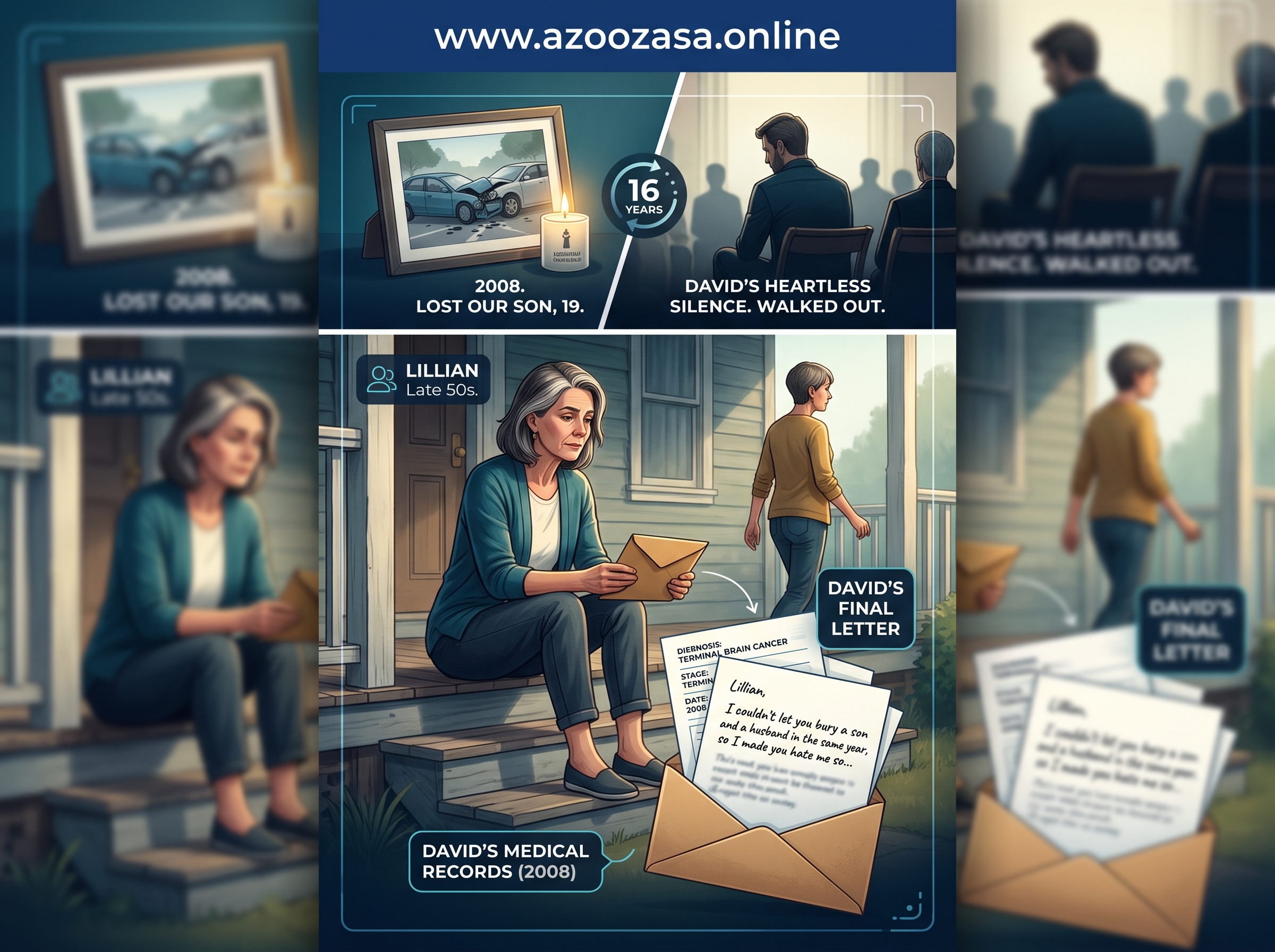
That was 2008. I still set his place at Christmas dinner, a hollow, agonizing tradition for a boy frozen forever at nineteen. When our son, Ethan, died in a crumpled mess of steel and shattered glass on a rain-slicked highway, my husband, David, never shed a single tear.
I remember the funeral with a vivid, sickening clarity. The sky was the color of bruised iron, weeping a relentless drizzle over the cemetery. I was a fractured shell of a woman, leaning so heavily against my sister that I felt I might dissolve into the wet earth. But David stood beside the grave like a statue carved from granite. His jaw was locked, his hands buried deep in the pockets of his black wool coat, his eyes fixed on the mahogany casket with a chilling, detached emptiness. While I wailed for our only child, David simply stared.
The silence that followed us home became a living, breathing entity in our house. He stopped touching me. He stopped speaking unless it was strictly necessary. Then, exactly six months after we buried our boy, I came downstairs to find a leather suitcase sitting by the front door. David was shrugging on his coat. He didn’t offer a preamble, a tear, or an apology. He simply looked at me with those cold, empty eyes, packed his bags, and walked out without a word. The heavy oak door clicked shut behind him, severing a twenty-two-year marriage in the span of a single heartbeat.
For sixteen years, I hated him for being so heartless.
That hatred became my life raft. In the agonizing months that followed his departure, when the grief of losing Ethan threatened to pull me under the black water of severe depression, the burning fury I felt toward David kept me kicking. I hated him when I packed away Ethan’s baseball trophies. I hated him when I signed the divorce papers sent by a faceless lawyer. I hated him to survive. Over the years, I rebuilt my life around that anger. I started a community garden, I volunteered, I learned to laugh again, all while wearing the armor of a woman who had survived the ultimate abandonment.
David passed away last week.
I received the news through a brief, sterile phone call from an estate attorney. I felt no profound sorrow, only a distant, hollow echo in my chest. He had been dead to me for a decade and a half.
But yesterday, the fragile reality I had constructed for sixteen years was completely dismantled.
I was watering the ferns on my front porch when a silver sedan pulled into my driveway. The car door opened, and his sister, Celia, stepped out. I hadn’t seen her since the divorce. She had aged beautifully, though her face was currently drawn and pale, her eyes rimmed with angry red circles. She walked up the brick pathway clutching a thick, manila envelope against her chest like a shield.
“Hello, Lillian,” she said quietly, her voice trembling.
I didn’t invite her inside. The lingering loyalty to my anger wouldn’t allow it. “Celia. I’m sorry for your loss, but if this is about his estate, the attorney already—”
“It’s not about the estate,” Celia interrupted, her voice cracking. She stopped at the bottom of the stairs, looking up at me with a devastating mixture of profound pity and desperate sorrow. “He made me swear on my life I wouldn’t come to you until he was gone. He made me promise.”
My knees suddenly felt entirely unable to support my weight. I sat down right there on the porch steps, the damp wood seeping through my jeans, as she handed me the sealed envelope. It felt impossibly heavy.
I tore the flap open. Inside were clinical, heavily stamped medical records from Massachusetts General Hospital. The dates jumped off the page: October 14, 2008. Exactly three days after Ethan’s car crash. I scanned the dense medical jargon, my breath catching in my throat as the words Glioblastoma Multiforme and Stage IV burned themselves into my retinas.
They were records showing David had terminal brain cancer.
“They gave him six to eight months,” Celia whispered, sitting down on the step beside me, her shoulder pressing against mine. “The tumor was inoperable. It was aggressive. He went to the clinic to get his headaches checked out while you were at the funeral home picking out Ethan’s casket.”
The world tilted on its axis. The ringing in my ears drowned out the sound of the neighborhood birds. I dug deeper into the envelope, pulling out a folded piece of heavy, cream-colored stationary. It was dated November 2008. The handwriting was David’s—sharp, deliberate, and fiercely steady.
I unfolded the paper with trembling fingers, my vision blurring with tears I hadn’t shed for this man in over a decade.
Lillian,
If you are reading this, it means my body has finally done what it promised to do, and Celia has kept her word. By now, you have seen the medical files. You know.
I am writing this sitting in the dark in my new apartment, watching the snow fall outside the window. I want to come home so badly it feels like my ribs are cracking. But I cannot.
Three days after we lost Ethan, Dr. Evans sat me down in a sterile white room and handed me a death sentence. An inoperable tumor. Six months, maybe eight if I was lucky. I walked out of that hospital and drove to the cemetery. I sat by our son’s fresh grave for hours in the freezing rain, trying to figure out how I was going to go home and tell a woman who was already drowning in grief that she was going to lose her husband, too.
I realized I couldn’t. I couldn’t let you bury a son and a husband in the same year, so I made you hate me.
I know you, Lillian. I know your strength, and I know your heart. Despair is a heavy, sinking thing. It is ice. If I had come home and told you I was dying, the sheer weight of that double tragedy would have pulled you under the water forever. You would have withered away in that house, nursing a dying man while mourning a dead boy. I refused to let my final months be the anchor that drowned you.
But anger… anger is fire. Anger is a survival mechanism. It gives you a reason to get out of bed in the morning, even if only to curse my name. So, I sat through our boy’s funeral and forced myself to turn into stone. I bit the inside of my cheek until it bled to keep from crying. I packed my bags, I looked into the eyes of the only woman I have ever loved, and I became the villain you needed me to be.
I gave you a target for your pain. I made myself the monster so you could survive the nightmare.
The great irony of my plan is that the doctors were wrong. My body, out of some cruel, stubborn refusal to quit, didn’t give out in six months. I underwent an experimental trial in Switzerland that halted the growth but left me permanently compromised. I have spent the last sixteen years in a care facility in upstate New York. I lost the use of my left arm, and eventually my ability to walk. But I kept my mind, and I kept my distance.
Celia brought me updates. I know about the community garden. I know you started painting again. I know you survived. Every time Celia told me you cursed my name, I thanked God, because it meant my shield was still working.
I don’t ask for your forgiveness, my sweet Lillian. I only ask that, now that the fire of your anger has burned its course, you allow yourself to know how entirely, devastatingly, and fiercely you were loved. I never left you. I was simply protecting you from the shadows.
Love always,
David.
The letter slipped from my fingers, fluttering onto the porch floorboards like a broken wing.
The silence of the summer afternoon was shattered by a sound I hadn’t made since 2008—a guttural, agonizing wail that tore itself from the very bottom of my soul. It was the sound of sixteen years of armor violently cracking apart. Celia wrapped her arms tightly around my shaking shoulders, pulling my head onto her chest as I wept. I wept for the man who had stood like a stone at our son’s grave because he was busy constructing a fortress to keep me alive. I wept for the years he spent trapped in a clinical room, watching my life unfold through second-hand whispers, dying by inches entirely alone.
He had taken my grief, swallowed it whole, and handed me the rage I needed to survive. It was an act of such monumental, staggering sacrifice that my mind could barely comprehend the sheer architecture of his lie.
I don’t know how long I sat on the porch, crying until my lungs burned and my eyes swelled shut. When the tears finally subsided, replaced by a profound, echoing exhaustion, I picked up the cream-colored letter and pressed it gently against my chest, right over my heart.
That evening, the house felt different. The ghosts of the past sixteen years—the bitterness, the resentment, the cold betrayal—had been swept clean, replaced by the heavy, beautiful weight of a love that had defied death itself.
I walked into the dining room. The house was quiet, save for the gentle ticking of the grandfather clock in the hall. I opened the antique oak china cabinet and reached for the plates.
For sixteen years, I had set two places at Christmas. One for me, and one for the boy who never came home.
I walked over to the long mahogany table, the wood gleaming in the dim light of the chandelier. I carefully laid down Ethan’s plate at his usual spot. Then, I pulled out the heavy wooden chair at the head of the table. With hands that no longer trembled with anger, but with absolute reverence, I set a third place.
I smoothed the linen napkin, aligned the silver cutlery, and stepped back. The house wasn’t empty anymore. It was filled to the brim with a love that had outlasted the anger, outlasted the cancer, and outlasted the silence. I looked at the head of the table, smiling through a fresh blur of tears.
“Welcome home, David,” I whispered to the empty room.


0 comments