
📋 Table of Contents
The Crayon Padlock: What Hid Behind a $16,000 Smile
The fellowship hall of St. Jude’s smelled of warm casseroles, stale coffee, and the cloying scent of floor wax. It was our monthly church potluck, a chaotic symphony of scraping chairs and overlapping conversations. I was seated across from my daughter, Sarah, her new husband, Richard, and my seven-year-old grandson, Liam.
Liam was usually a vibrant boy, full of loud laughter and scraped knees, but lately, he had become a ghost of himself. He sat rigidly in his metal folding chair, his small hands gripping his utensils like weapons.
Suddenly, the stainless-steel fork slipped from his fingers, clattering loudly against the ceramic plate before bouncing onto the linoleum floor.
The noise wasn’t remarkably loud, but Liam flinched as if a firecracker had gone off. His shoulders hiked up to his ears, and he squeezed his eyes shut.
Richard didn’t miss a beat. He leaned over Liam’s chair, his large hand clamping down on the boy’s narrow shoulder. I watched Richard’s knuckles whiten. He flashed a brilliant, perfectly practiced smile to the couple sitting next to us.
“He’s just clumsy tonight, folks,” Richard said smoothly, his voice a rich, comforting baritone.
The couple chuckled and returned to their potato salad. But I had known that smile for two years.
The $16,000 Illusion
Sarah had met Richard when she was at her most vulnerable, fresh out of a messy divorce and struggling to make ends meet. Richard was a regional manager for a logistics firm—charming, financially secure, and completely obsessed with presenting a flawless image to the world.
Their wedding, just two years ago, was a sixteen-thousand-dollar spectacle that Richard had insisted on paying for entirely. There were ice sculptures, a string quartet, and a designer gown that made my daughter look like a porcelain doll. But even as I watched them cut the five-tier cake, something deep within my maternal instincts had recoiled. Richard didn’t look at Sarah with love; he looked at her with the smug satisfaction of a collector who had just acquired a rare antique.
Over the past twenty-four months, that feeling had only calcified. Sarah had grown quieter, her wardrobe shifting to muted colors, her opinions always deferring to his. And Liam, once a whirlwind of joyful energy, had learned to tiptoe through his own life.
While the men excused themselves to the parking lot to discuss college football, I saw my window. I stood up, walked over to Liam, and gently took his hand.
“Let’s go look at your coloring books in the nursery room, sweetheart,” I said.
Sarah looked up, a flash of panic in her eyes. “Mom, Richard wants us to leave right after dessert…”
“We’ll just be a minute,” I replied firmly, leading Liam down the quiet, carpeted hallway away from the crowded hall.
The Drawing in the Dark
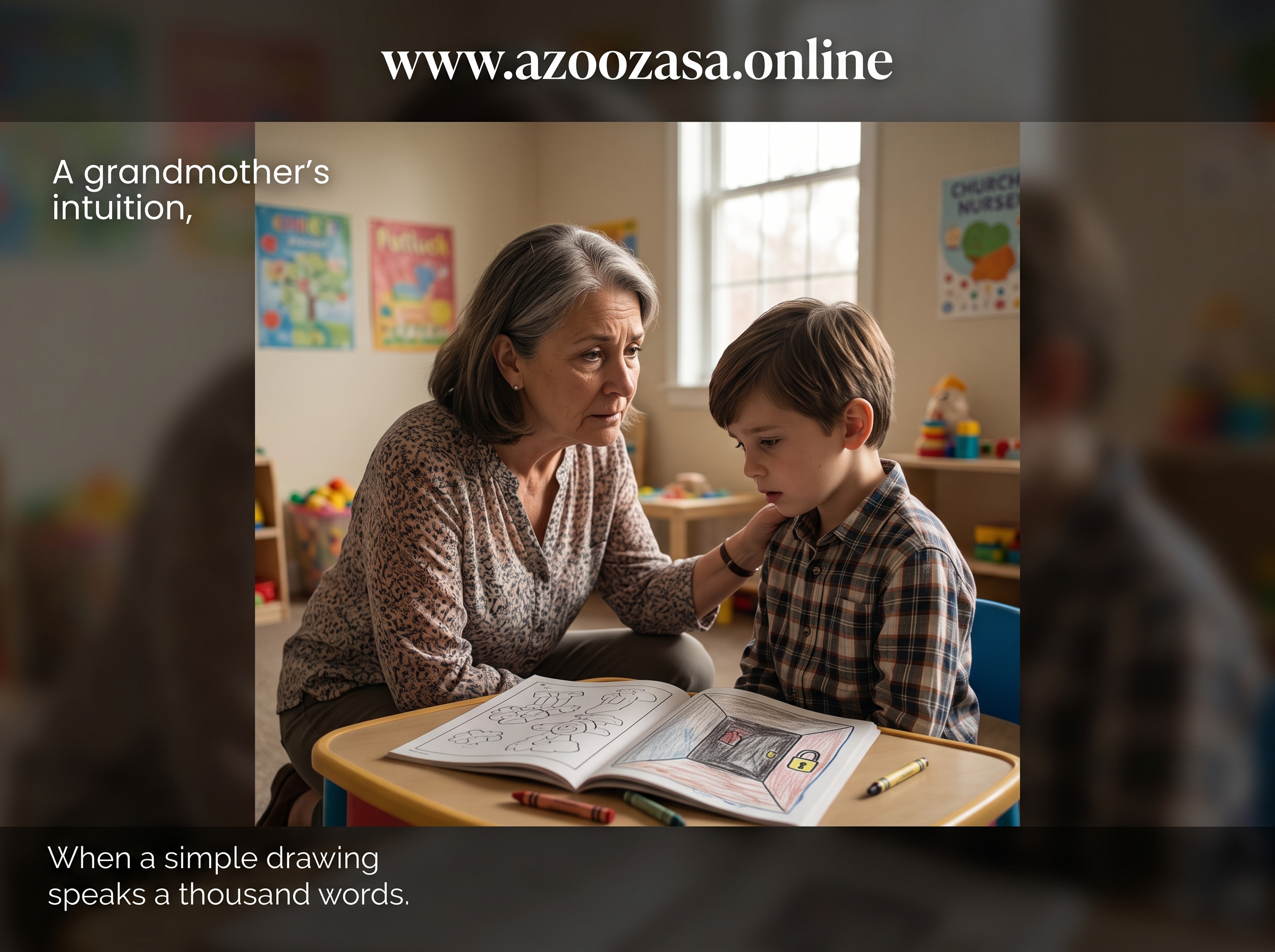
The church nursery was empty, bathed in the soft, yellow light of a single desk lamp. I hoisted Liam into a small plastic chair and opened his backpack, pulling out his favorite superhero coloring book.
As I flipped it open, a loose sheet of construction paper slipped out and fluttered to the floor.
I picked it up, expecting a drawing of a dinosaur or a racecar. Instead, a wave of cold dread washed over me.
It was a drawing of a room. The walls were colored with aggressive, heavy strokes of black crayon, pressed so hard into the paper that the wax had clumped and the paper had nearly torn. In the center of the dark expanse was a thick brown door. But it was the detail on the door that made my chest squeeze so tight I could barely draw breath.
Drawn in precise, deliberate silver crayon was a heavy padlock, mounted on the outside handle.
I knelt beside his chair, my joints aching against the thin carpet. I touched his shoulder gently, making sure my grip was nothing like Richard’s.
“Liam, honey,” I asked, keeping my voice as steady and soft as a summer breeze. “What is this padlocked room?”
Liam looked toward the open doorway, checking the hallway for Richard’s shadow. His bottom lip trembled. He leaned forward, lowered his head so our foreheads were almost touching, and whispered, “That’s the mistake room, Nana. It’s in our basement.”
The blood roared in my ears. “The mistake room?”
A tear spilled over his eyelashes, cutting a clean track down his dusty cheek. “When I drop things. Or when I laugh too loud. Richard says bad boys need to learn the dark. He locks it from the outside. Sometimes… sometimes for a whole day. And Mommy cries upstairs, but she says we have to listen.”
The Shift in the Wind
In my sixty-four years, I have never considered myself a violent woman. I was a retired schoolteacher who baked peach cobblers and knitted scarves. But in that small, fluorescent-lit nursery, an ancient, feral rage erupted in my chest.
Richard wasn’t just controlling my daughter; he was torturing my grandson to break him, to mold him into a terrified, compliant accessory for his perfect life.
I didn’t panic. I didn’t cry. My mind went completely still, calculating the immediate future with terrifying clarity. If I confronted Richard here, he would charm the room, gaslight Sarah, and bundle them into his car. He would lock the doors, drive away, and I would never see Liam again. Child Protective Services would investigate, but Richard was smart. He would hide the evidence before they ever knocked on his pristine front door.
I needed proof, and I needed it right now.
I zipped the drawing back into Liam’s backpack and stood up. “Liam, I want you to stay right here with Mrs. Higgins,” I said, waving over the elderly nursery volunteer who was wiping down a chalkboard. “Nana has to go run a quick errand. Do not leave this room with anyone but me or your mother. Do you understand?”
Liam nodded, his eyes wide.
I walked back into the fellowship hall. Richard had just returned, dusting invisible lint off his tailored slacks. He was smiling at the pastor.
I walked straight to Sarah, grabbing my purse from the table. “Sarah, I left my medication on my kitchen counter. My heart is racing, and I need it. I’m going to take your car keys—you’re blocked in anyway. I’ll be back in twenty minutes.”
Before she could process the lie, I slid my hand into her open purse, grabbed her key ring, and walked out the double doors. Richard called out my name, his tone holding a sharp edge of warning, but I didn’t look back.
Unlocking the Truth
I didn’t drive to my house. I drove ten miles over the speed limit straight to Richard and Sarah’s sprawling, immaculate suburban home.
The house was dark, sitting quietly at the end of a cul-de-sac. I used Sarah’s keys to unlock the front door. The house smelled of expensive vanilla diffusers and money. It made me sick.
I bypassed the pristine living room and headed straight for the basement door. I flicked the light switch, descending the wooden stairs into the unfinished half of the basement. The air grew damp and chilly.
Tucked behind the furnace and the water heater, perfectly hidden from casual view, was a heavy, solid-core wooden door.
And there it was. A heavy-duty steel padlock bracket had been aggressively screwed into the doorframe. The padlock itself was hanging open, left unsecured while the family was out.
I pulled my smartphone from my purse and started recording video. I filmed the heavy screws, the padlock, the reinforced hinges.
Then, my hands shaking violently, I pushed the door open.
The room was no larger than a walk-in closet. There were no windows. The walls were bare concrete. In the center of the floor lay a thin, stained camping mat and a single, threadbare blanket. In the corner sat a plastic bucket.
But what broke me—what finally forced a ragged sob from my throat—were the scratches on the back of the door. Dozens of frantic, tiny gouge marks where a terrified seven-year-old boy had tried to claw his way out of the suffocating dark.
I took photos of every inch of the room. I took close-ups of the scratch marks. I sent the entire file, immediately, to my brother-in-law, who was a detective in the next county over. I typed a single text message: Send a squad car to this address right now. Do not call me back.
The Facade Crumbles
I was halfway up the basement stairs when I heard the heavy thud of the front door opening.
“Martha?” Richard’s voice echoed through the dark house. It wasn’t smooth anymore. It was tight, laced with a dangerous, barely contained fury. He must have realized I took Sarah’s house keys instead of my own and followed me.
I stepped up into the kitchen, my phone gripped tightly in my hand.
Richard stood in the hallway, his chest heaving. The charming mask had completely dissolved. His eyes were cold, flat, and predatory.
“What are you doing in my house?” he demanded, taking a slow step toward me.
“Looking for my medication,” I lied smoothly, staring him dead in the eyes. “I couldn’t find it.”
Richard’s gaze flicked to the open basement door behind me. His jaw clenched. He knew.
“You have no right to be here,” Richard hissed, dropping the polite pretense entirely. He took another step, his large frame blocking the exit to the front door. “You’re trespassing. You are an old, hysterical woman poking her nose where it doesn’t belong. I could have you arrested.”
“You could,” I agreed, my voice eerily calm. “But I think the police will be far more interested in the mistake room, Richard.”
His face paled, just slightly, but his arrogance quickly smothered his fear. “It’s a discipline tactic. Sarah agreed to it. It’s perfectly legal to give a child a timeout.”
“A bucket in a windowless room with a padlock on the outside isn’t a timeout, Richard. It’s a prison cell,” I said, taking a step toward him, refusing to yield an inch of ground. “And Sarah only agreed because you’ve spent two years tearing her mind apart, convincing her that you are the only thing keeping this family afloat.”
Richard lunged forward, grabbing my wrist with a crushing grip. “Give me the phone, Martha.”
“Too late,” I whispered, wincing against the pain but smiling fiercely. “I already sent the photos to Detective Miller.”
Through the front windows, the flashing red and blue lights of two patrol cars swept across the manicured lawn. The heavy, authoritative knock on the front door shattered the silence of the house.
Richard froze. His grip on my wrist loosened as he stared out the window, watching his sixteen-thousand-dollar facade burn to the ground in the reflection of the police cruiser lights.
The Aftermath
The next few months were a blur of legal proceedings, restraining orders, and intense therapy.
When the police opened the basement door, Richard didn’t say a word. He was arrested on the spot for felony child abuse and unlawful imprisonment. Sarah broke down in the driveway, finally seeing the monster she had married stripped of his designer suits and smooth excuses.
We moved them both into my house that very night.
Today, the smell of church potluck casseroles still makes me slightly nauseous, but the sight of my grandson makes up for it. Liam is slowly finding his laugh again. He colors with bright blues and vibrant yellows, and the door to his bedroom at my house stays wide open all night long, letting the warm hallway light spill across his bed.
He knows, without a shadow of a doubt, that he will never sit in the dark again.



0 comments