
Title: The Prepaid Promise of Table Four
The brass bell above the heavy glass door of Miller’s Diner didn’t just ring; it chimed with a battered, familiar warmth. For nine years, that chime was the anchor of my week. Every Tuesday morning at exactly 7:30 AM, I would walk through that door, shake the rain or snow from my coat, and slide into the red vinyl booth at Table Four.
My order never changed: a Denver omelet, hash browns crisped on the flattop, two slices of rye toast, and black coffee. The total was always exactly $14.50. And every Tuesday for nine years, when I walked up to the register with my worn leather purse, the server—whether it was young Sarah with her bright pink braces, or seasoned Betty with her tired smile—would gently push my hand away.
“It’s taken care of, Martha,” they would say.
For the first few years, I assumed it was the local congregation at St. Jude’s. My husband, Chester, had been a fixture in the community, the kind of man who fixed neighbors’ lawnmowers for free and shoveled driveways before the snow plows even arrived. When pancreatic cancer took him at the age of sixty-two, the town wrapped its arms around me. Casseroles arrived on my porch, anonymous envelopes of cash were slipped into my mailbox, and my diner tab was miraculously cleared.
I figured it was a quiet charity they refused to let go of. I never fought it too hard, mostly because that Tuesday breakfast was the only thing pulling me out of the crushing, suffocating silence of my empty house. Without the obligation of that $14.50 breakfast, I would have easily let the world slip away, resigning myself to a life lived entirely behind drawn curtains. The diner forced me to brush my hair, put on real clothes, and remember how to speak to people.
But last week, the brass bell stopped chiming.
A stark white piece of poster board appeared in the window of Miller’s Diner: Closing our doors after 42 years. Thank you for the memories.
I stood on the sidewalk on a Tuesday morning, staring at the sign, feeling profoundly untethered. The diner was gone, and with it, the last remaining string that tied me to a routine Chester and I used to share. I drove back home in a daze, made a pot of weak coffee in my kitchen, and sat at my table, feeling older and lonelier than I had in a decade.
Two days later, the doorbell rang.
I opened the front door to find Elias Miller, the owner of the diner, standing on my porch. He looked entirely out of his element without his flour-dusted apron and paper cap. He wore a heavy wool sweater, his silver hair neatly combed, holding a thick, worn leather notebook against his chest.
“Morning, Martha,” Elias said softly, shifting his weight from one foot to the other.
“Elias. I was so sorry to see the sign,” I said, wiping my hands on a dish towel. “Forty-two years. The town won’t be the same without you.”
“My knees finally made the decision for me,” he chuckled, though his eyes looked incredibly sad. “Do you mind if I sit for a minute?”
I gestured to the wooden porch swing. We sat together in the crisp autumn air, watching the oak leaves drift onto the damp lawn. Elias didn’t speak right away. He ran a calloused thumb over the frayed edge of the leather notebook in his lap.
“I’ve been going through the books,” Elias finally said, his voice thick with unexpressed emotion. “Closing out accounts. Settling debts. And I realized I had one last piece of business to take care of. With you.”
“With me?” I frowned, confused. “Elias, I haven’t paid for a meal in your diner for nine years. If anything, I owe you a fortune. I always thought it was the church…”
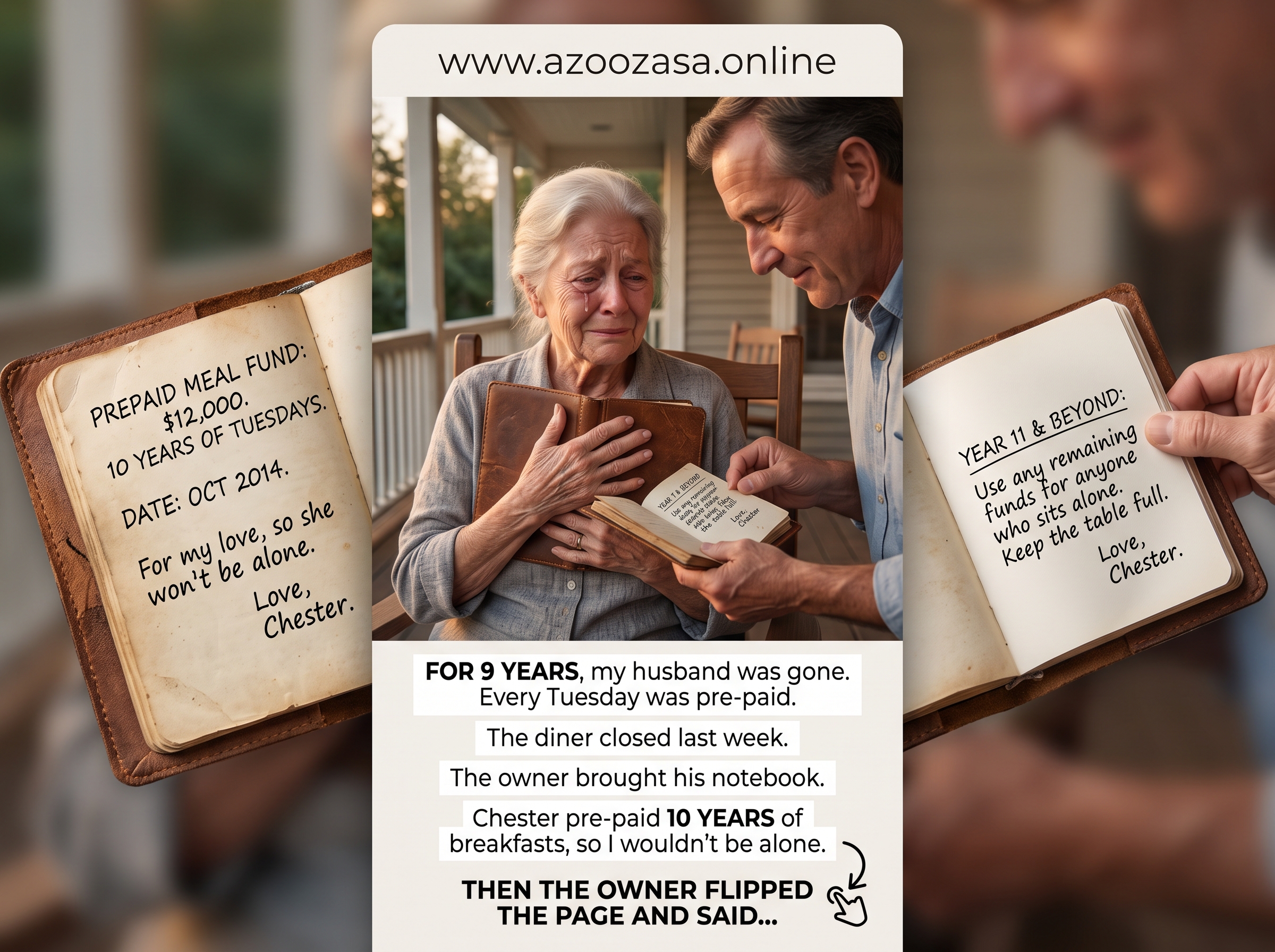
“It wasn’t the church, Martha,” Elias interrupted gently. He opened the heavy notebook, the pages yellowed and curling at the corners. He flipped toward the back, scanning the handwritten columns of numbers until he found what he was looking for.
He turned the book toward me. There, written in Elias’s blocky handwriting, was a ledger entry dated October 14th, 2017—exactly two weeks before Chester passed away.
Chester Vance. Prepaid Account Balance: $12,000.00.
My breath hitched in my throat. The numbers blurred as my eyes instantly filled with tears.
“Chester came in on a Tuesday afternoon,” Elias said, his voice dropping to a reverent whisper. “It was the day after the oncologist gave him the final timeline. He looked terrible, Martha. Pale, thin, practically transparent. But he walked right up to the counter, pulled a cashier’s check out of his jacket, and laid it next to the register.”
I closed my eyes, the image of my dying husband walking into the diner snapping into vivid, agonizing reality.
“He told me, ‘Elias, my Martha is going to want to hide when I’m gone,'” the diner owner continued, quoting Chester with painful accuracy. “‘She’s going to lock the doors, close the blinds, and try to disappear into the upholstery. I can’t let her do that. I need you to charge this account every Tuesday for her Denver omelet. If she doesn’t show up, you call her. You make sure she leaves that house, Elias. You make sure she doesn’t sit at home alone.'”
Elias swallowed hard. “He prepaid for ten years of breakfasts, Martha. Just to ensure you had a reason to get dressed and face the world once a week.”
A sob tore its way out of my throat, raw and unrestrained. The sheer magnitude of Chester’s love—a love so fiercely practical and far-reaching that it had successfully engineered my survival for nearly a decade—was overwhelming. I took the worn leather notebook from Elias’s hands and pressed it tight against my ribs, right over my breaking heart. The leather felt warm, as if Chester himself were finally pulling me into a hug I had been craving for nine years.
We sat in silence for a long time, the only sound the rhythmic creaking of the porch swing and my own ragged breathing.
Then, Elias reached over and gently touched the edge of the notebook. He flipped the page.
“He didn’t just leave the money, Martha,” Elias said softly, pointing to a smaller, secondary note written beneath the ledger. “He left instructions for the final year.”
I wiped my eyes with the back of my sleeve and leaned in to read the ink.
Elias traced the words with his finger. “Chester told me, ‘If she makes it to year ten, it means she survived the worst of it. It means she remembered how to live.'” Elias looked up at me, his eyes shining. “He said, ‘Starting on the tenth year, Elias, charge the account for two breakfasts. Tell Martha that nine years is long enough to eat alone. Tell her it’s time to invite someone new to the table.'”
The world seemed to stop spinning. The wind died down in the oak trees.
Chester hadn’t just bought me a lifeline; he had drawn me a map. He knew the intricate architecture of my grief better than I did. He knew I needed time to mourn him, to sit alone in the diner booth and converse with his ghost. But he also knew that eventually, the ghost wouldn’t be enough. He loved me enough to let me go, and he had orchestrated this exact moment to give me his blessing.
“Because the diner is closing, we didn’t quite make it to year ten,” Elias said, reaching into his heavy sweater pocket. He pulled out a thick white envelope and placed it on top of the notebook. “There’s about fourteen hundred dollars left in the account. That’s yours.”
I stared at the envelope, then at Elias.
Chester’s final wish wasn’t bound by the physical walls of Miller’s Diner. It was about breaking the seal on my isolation. It was about pulling out the chair across from me and offering it to the world.
I took a deep, shuddering breath, feeling the air fill my lungs differently than it had in a decade. It felt lighter.
“Elias,” I said, my voice finally steadying. “What are you and Betty doing next Tuesday morning?”
Elias blinked in surprise. “Well… I suppose we’ll be figuring out what to do with ourselves. It’ll be our first Tuesday off in forty years.”
I picked up the white envelope and handed it right back to him.
“I don’t want the money,” I said, offering him the first genuine, unburdened smile I had managed since 2017. “But I do want to fulfill my husband’s tab. Next Tuesday, I’m cooking. A Denver omelet, hash browns, and black coffee. I expect you and Betty here at seven-thirty sharp.”
Elias looked at the envelope in his hand, then back up at me. A slow, beautiful smile spread across his weathered face.
“We wouldn’t miss it, Martha,” he said quietly.
He stood up, patted my shoulder, and walked down the porch steps. I sat on the swing for a long time after his truck disappeared down the street, my hands resting on the leather notebook in my lap. I looked out at the empty driveway, feeling the warmth of the morning sun on my face.
For the first time in nine years, I didn’t feel alone. I felt ready.

0 comments