
The Ghost in the Ledger: A Thirty-Eight-Year Lie
A certified envelope from the county historical society arrived on a humid Tuesday in mid-August. The air hung thick and heavy, pressing like a wet blanket against the screen door of my porch, but a sudden, violent chill seized my bones the moment I saw the return address. The thick manila package felt unnaturally heavy in my trembling hands, carrying a weight that defied gravity.
In the winter of 1988, the hospital staff had told me my newborn son had passed away. I can still close my eyes and perfectly recall the blinding, stark fluorescent lighting of St. Jude’s Maternity Ward. I remember the sharp, antiseptic smell of iodine and floor wax. But mostly, I remember the oppressive silence. There was no tiny, triumphant cry. There was only the vacant, overly practiced expression of the attending nurse who wouldn’t meet my eyes as she muttered, “There is no baby record. I am so sorry, but the infant was stillborn.”
They wouldn’t let me hold him. They told me it was better for my mental state not to see the remains. I spent thirty-eight years carrying that quiet, corrosive grief. It was a heavy, invisible stone I wore around my neck, an ache that flared every time I saw a little boy learning to ride a bike, a teenager heading to prom, or a young man graduating from college. I had spent nearly four decades mourning a phantom, lighting a candle every November 14th for a child I had never been allowed to meet.
But the past rarely stays buried forever.
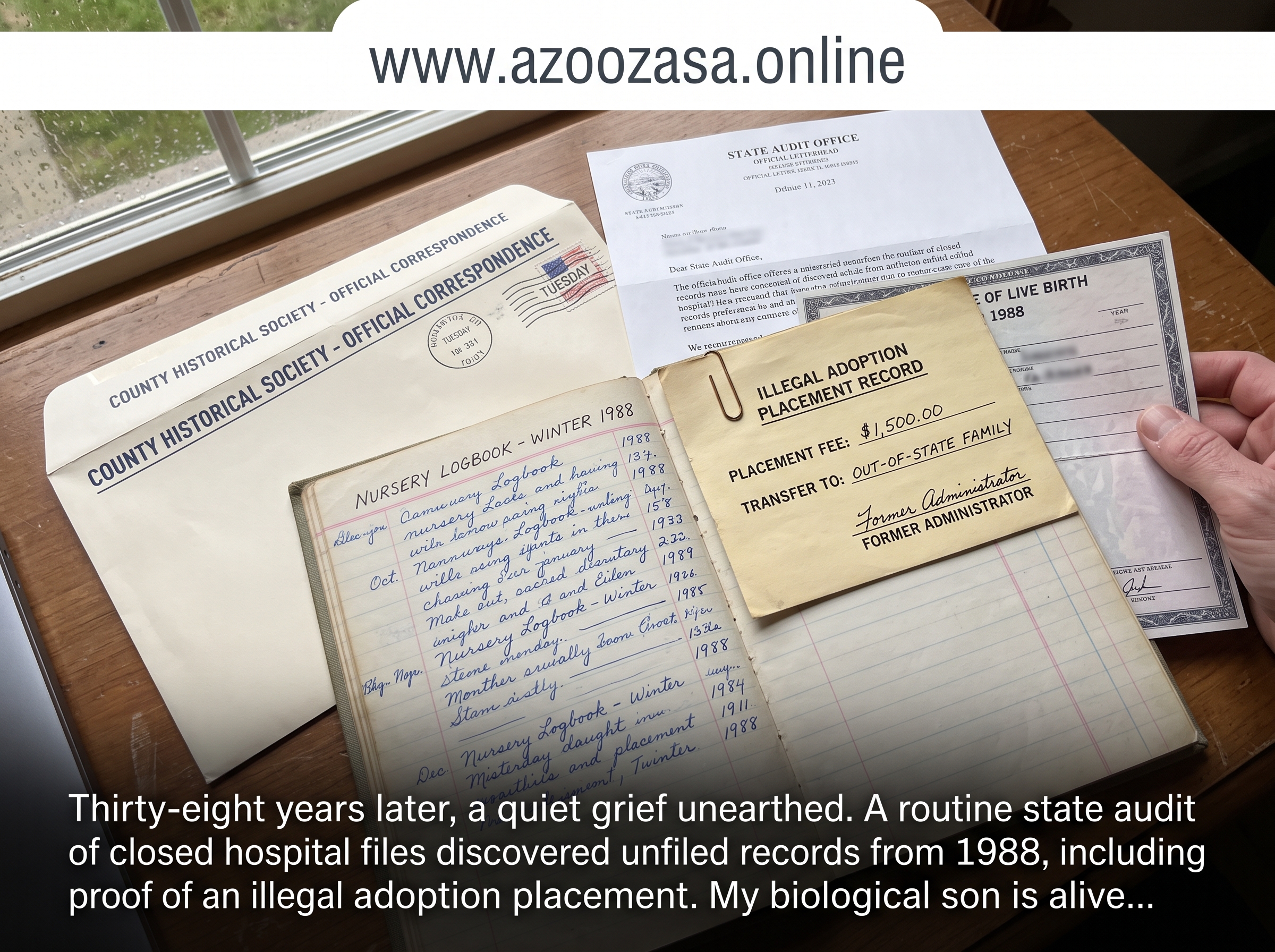
A massive state audit of closed hospital files, spurred by recent allegations of historical malpractice, had forcefully pried open the sealed vaults of St. Jude’s. The historical society had been tasked with locating next-of-kin for unresolved medical anomalies. They uncovered unfiled nursery logbooks from that terrible winter—ledgers that had been deliberately stuffed behind a false filing cabinet wall.
Tucked inside those dusty pages was an illegal adoption placement record, bearing the distinct, jagged signature of Dr. Aris Thorne, a former hospital administrator. Next to his signature was a carbon copy of a bank deposit slip.
$1,500.
That was it. That was the price tag placed on my flesh and blood. My legs went completely numb right where I stood on the porch, my knees buckling as I sank into the wicker chair behind me. The world narrowed to the crisp, yellowed paper trembling in my hands. It was a bribe. Dr. Thorne had received a mere fifteen hundred dollars to falsify a stillbirth and transfer my perfectly healthy baby boy to an out-of-state family in Massachusetts. They hadn’t just stolen my child; they had stolen my entire life as a mother.
With a heart hammering so hard I could hear it in my ears, I unfolded the original birth certificate clipped behind the ledger page. It was a document that proved my son had drawn breath, cried, and lived. The historical society had attached a modern, post-investigation addendum tracking his current whereabouts—a standard, albeit devastating, procedure for living victims of the St. Jude’s trafficking ring.
I scanned the addendum, and the breath vanished from my lungs. My biological son was currently living as Elias Vance.
Elias Vance. The name echoed in the silent, humid air of my porch. It wasn’t just a random name to me. Elias Vance was the lead investigative journalist for the New England Chronicle.
For the past six months, I had been religiously reading his serialized exposé on corrupt adoption rings in the Northeast. It was Elias’s relentless journalism that had publicly pressured the governor into launching the state audit of St. Jude’s in the first place. He had been digging into the hospital’s dark past, tearing down their walls of deception brick by brick. He was hunting for the truth of his own existence, driven by a ghost he couldn’t name, and neither of us knew we were digging from opposite sides of the exact same buried wall.
The hours that followed were a blur of frantic, desperate internet searches. I pulled up his author bio. I watched videos of him speaking at press conferences. He was thirty-eight, with my distinct, piercing hazel eyes and his father’s strong, stubborn jaw. I watched a clip of him adjusting his glasses on a news segment, a nervous tic that perfectly mirrored my own when I was lost in thought. The grief of thirty-eight lost years collided violently with a surreal, blinding joy. He wasn’t a ghost in a pauper’s grave. He was a force of nature, a man who had built a brilliant career out of exposing the very monsters who had sold him in the dark.
I didn’t call a lawyer. I didn’t call the police. I found the contact number for the Chronicle’s direct tip line.
“I have information for Mr. Vance,” I told the weary-sounding receptionist, my voice remarkably steady despite the earthquake in my chest. “Regarding the St. Jude’s audit. Tell him… tell him the mother from Room 204 has his original birth certificate.”
It took less than five minutes for my phone to ring.
“This is Elias Vance,” a deep, authoritative voice said.
The sound of it sent a fresh wave of electricity down my arms. My son. My baby. Speaking to me through the crackle of a cellular line, separated by hundreds of miles but finally, impossibly, connected.
“Mr. Vance,” I breathed, fighting to keep my voice from shattering into a million pieces. “My name is Claire. In November of 1988, they told me my son died.”
There was a sharp intake of breath on the other end of the line. The heavy silence stretched for five seconds, then ten. When he finally spoke, the polished journalistic professionalism had melted away into a raw, vulnerable whisper.
“Claire,” he said, his voice cracking. “I’ve been looking for you my entire life.”
We agreed to meet two days later at a quiet, unpretentious diner halfway between my home in Pennsylvania and his office in Boston. The suffocating humidity of the week had finally broken, giving way to a cleansing summer rain that washed the dust from the highway signs.
When I walked through the glass doors of the diner, the bell jingling above my head, I didn’t need to look for a specific table number or ask a waitress for help. I knew him instantly.
He stood up from a corner booth. He was tall, dressed in a casual button-down shirt, holding a thick manila folder that undoubtedly contained the same devastating proof I had received in the mail. We stood there for a long moment, an ocean of stolen time and unmade memories stretching out between us. The diner around us faded away—the clinking of coffee cups, the murmur of other patrons, the rain lashing against the windows all went entirely silent.
“You really do have my eyes,” I whispered, the first tears breaking free and spilling down my cheeks.
Elias closed the distance between us, stepping forward and wrapping his arms around me. The embrace felt like pieces of a broken compass finally finding true north. I buried my face in his shoulder, breathing in the scent of rain and coffee, feeling the solid, undeniable reality of his heartbeat against my chest. He was real. He was here.
“I have your stubbornness, too, from what I’ve read in your file,” he said, a wet, breathless laugh escaping his chest as he pulled back to look at me. “I never stopped digging. I just always knew there was a piece missing.”
We sat in that corner booth for eight hours. We drank lukewarm coffee and traded thirty-eight years of stories. He told me about his adoptive parents—good, loving people who had been entirely lied to, who believed they were paying a “legal facilitation fee” for an orphaned child with no living relatives. He told me about his childhood, his passions, and the unshakeable feeling of displacement that ultimately drove him to journalism.
I told him about the life I had lived in his shadow, setting a place for him in my heart every single day. I told him about the day he was born, how much I had loved him before I even saw his face.
The anger at Dr. Thorne and the corrupt administration of St. Jude’s would come later. The class-action lawsuits, the fiery testimonies, the national media storm—all of that was waiting for us just outside the diner doors. Elias and I would see to it that the people responsible paid for what they did.
But in that moment, under the flickering neon sign of a roadside diner, there was no room for vengeance. There was only the breathtaking miracle of restoration.
The quiet, suffocating grief that had anchored my soul for almost four decades finally lifted, floating away into the damp evening air. I had walked into that diner as a mother mourning a phantom. I walked out holding the hand of my son, ready to face whatever came next, finally stepping into the light of the truth.
What part of Elias and Claire’s story resonated the most with you?



0 comments