
The Ironclad Inheritance
The rain hadn’t stopped since the morning we lowered Dad into the ground. It was a cold, relentless drizzle that seemed to wash the color out of everything it touched, leaving behind only the dreary grays of grief and betrayal.
Three days after the funeral, we sat in the sterile, fluorescent-lit office of Dad’s long-time attorney, Mr. Gable. Across the mahogany table sat my older brother, Eugene. He was wearing a custom-tailored suit that cost more than my car, a smug, self-satisfied smile playing at the corners of his mouth.
“It’s all perfectly legal,” Mr. Gable explained, his voice devoid of emotion as he pushed a faded document across the desk. “This is a formalized, notarized will from 2010. It clearly states that the entirety of the estate—the house, the savings accounts, and the life insurance policy, totaling two hundred and seventy thousand dollars—is to be left to Eugene.”
I stared at the paperwork, the typed words blurring together. “That’s from fourteen years ago,” I protested, my voice barely above a whisper. “Dad and I talked just last month. He told me everything was being split evenly. He said he was going to make sure I had enough to finally put a down payment on a house.”
Eugene let out a sharp, condescending laugh. “Dad said a lot of things at the end, didn’t he? His mind was slipping. The 2010 will is the last registered document on file. It’s airtight.”
The meeting ended shortly after that. Eugene had won, just as he always did. He had spent the last decade living in another state, rarely calling, never visiting, while I spent my evenings and weekends driving Dad to dialysis, managing his medications, and keeping his crumbling house from falling apart. But in the eyes of the law, a piece of paper from a time before Dad got sick was all that mattered.
As we walked out into the damp parking lot, Eugene popped the trunk of his leased Mercedes. He rummaged around for a moment before pulling out a heavy, dark object wrapped in a plastic grocery bag.
He tossed it at me. I barely caught it, the sheer weight of it nearly pulling me off balance.
“What is this?” I asked, pulling back the plastic.
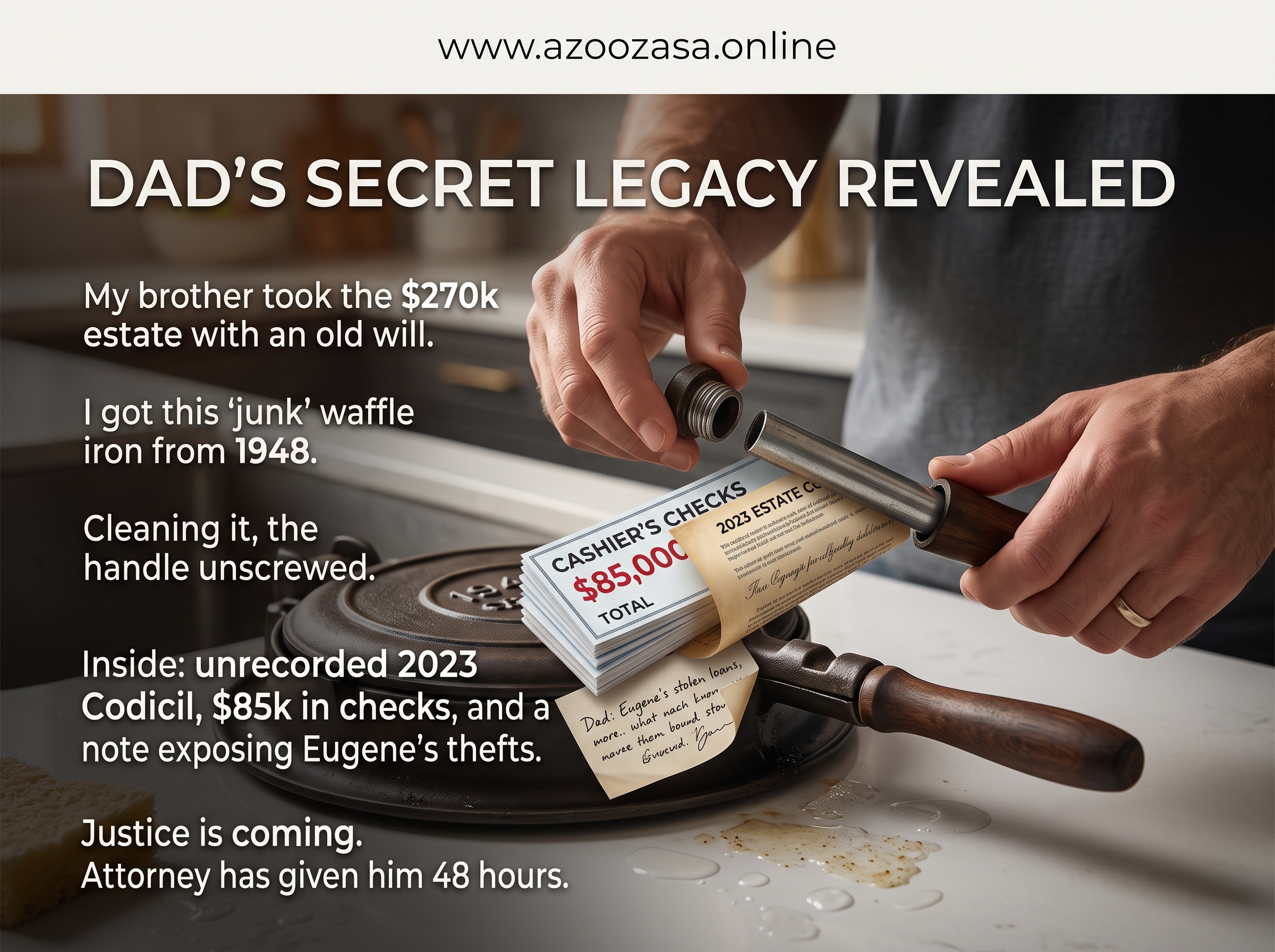
Inside was Dad’s 1948 cast-iron waffle iron. It was a behemoth of a kitchen appliance, crusted with decades of burnt carbon, polymerized grease, and patches of orange rust. Dad used to make waffles with it every Sunday morning when we were kids, a tradition he kept up until his arthritis made it too heavy to lift.
Eugene smirked, clicking the unlock button on his key fob. “I told the estate liquidators to clear out the house by Friday. Figured you might want a keepsake before it all goes to the dump. You get the junk, I get the estate. Seems fair to me.”
He drove away, the tires of his luxury car splashing through a puddle, leaving me standing alone in the rain with a rusty piece of iron.
By Tuesday evening, the anger had settled deep into my bones, hardening into a cold, heavy resentment. I couldn’t afford to fight Eugene in court. I didn’t have the retainer fees for a probate litigation attorney, and Eugene knew it. He had calculated this perfectly.
Needing a distraction, I carried the heavy cast-iron waffle maker to my kitchen sink. I laid out a wire brush, a tub of baking soda, steel wool, and a bottle of white vinegar. If this was the only piece of my father I had left, I wasn’t going to let it rot.
I started scrubbing. I poured the vinegar over the rusted plates, the acidic liquid foaming as it ate away at the oxidation. With every harsh stroke of the wire brush, I scrubbed away a piece of my frustration. I scrubbed for the vacations I never took because Dad needed care. I scrubbed for the promotion I turned down because it required too much travel away from him. I scrubbed for the fourteen years of burnt grease and broken promises.
After two hours, my knuckles were raw and my back ached, but the beautiful, dark iron was beginning to show through the grime.
I picked up the heavy top plate to clean the hinges. The vintage iron featured a thick, cylindrical wooden handle attached to a hollow steel rod that allowed the user to flip the plates. As I twisted the top plate to get a better angle with the steel wool, the wooden handle shifted.
I stopped. I gripped the wood and twisted it counter-clockwise. With a sharp metallic squeak, the handle unscrewed completely in my palm, revealing the hollow interior of the steel rod.
My brow furrowed. I peered inside the dark tube. There was something jammed inside.
Grabbing a pair of needle-nose pliers from the utility drawer, I carefully reached into the hollow rod and pinched the edge of whatever was hidden within. I pulled it out.
It was a thick, tightly rolled plastic sleeve, slightly singed at the edges from years of residual heat, but otherwise perfectly intact.
My throat went completely dry as I unrolled the plastic on my kitchen counter.
Inside was a stack of cashier’s checks, meticulously dated over the last three years, made out to me. I quickly tallied the numbers. Eighty-five thousand dollars.
Beneath the checks were two heavily folded documents.
The first was a formal legal document, stamped and notarized on June 12th, 2023. At the top, in bold letters, it read: Codicil to the Last Will and Testament of Arthur James. It explicitly revoked the 2010 will, naming me as the sole executor and primary beneficiary of the entire estate, citing Eugene’s long-term estrangement and financial malfeasance.
The second document was a piece of yellow legal paper covered in Dad’s familiar, shaky handwriting.
My hands trembled as I read the words.
My Dearest Child,
If you are reading this, it means you took the time to restore the old Griswold. I always knew Eugene wouldn’t bother with something that required a little elbow grease. He always wanted the reward without the work.
I am so sorry I kept this a secret. Last year, I discovered what Eugene has been doing. He used my social security number and the deed to the house as collateral to take out massive, fraudulent loans in my name to fund his business ventures. He’s been quietly siphoning the equity I built my entire life.
I knew if I confronted him or filed the new will with Mr. Gable, Eugene’s creditors would tie up the estate in litigation for a decade, and you would be left with nothing but legal bills. So, I quietly liquidated what I could into cashier’s checks. I drafted this codicil with a private notary.
Eugene thinks he outsmarted me. He thinks he took everything. But he only took the debt he created.
Use the checks to buy your house. Take the codicil to a shark of a lawyer, and hold your brother accountable for the loans.
I love you. Make some waffles.
Dad.
A single tear slipped down my cheek, landing with a soft tap on the yellow paper. My heart slammed against my ribs, a frantic, triumphant rhythm. Dad hadn’t been a helpless old man whose mind was slipping. He had been a quiet tactician, protecting me from beyond the grave.
I didn’t wait for the morning. I picked up my phone and called Sarah Davis, a ruthless, highly recommended probate litigator I had researched over the weekend but couldn’t afford to hire.
She answered on the third ring. I explained everything—the 2010 will, the hidden 2023 codicil, the cashier’s checks, and the written evidence of Eugene’s fraudulent loans.
“Do you have the original, notarized codicil in your physical possession?” Sarah asked, her voice sharp and fully alert despite the late hour.
“I have it right in front of me,” I confirmed.
“Listen to me very carefully,” she said, the thrill of the legal hunt evident in her tone. “Eugene has unknowingly claimed a completely fraudulent estate based on a superseded document. The moment he transferred those assets, he committed a felony. I am drafting a demand letter right now.”
By 9:00 AM on Wednesday, Sarah Davis had formally filed the 2023 codicil with the county probate court, instantly freezing all of Dad’s assets.
At 10:00 AM, she conference-called Eugene. I sat in her office, listening quietly on the speakerphone.
“What is this about?” Eugene barked when he answered, sounding irritated. “The estate is settled. I have a flight to catch.”
“The estate is far from settled, Eugene,” Sarah said, her voice smooth and dangerously calm. “I am representing your sibling. We have just filed the 2023 codicil to your father’s will, naming my client as the sole beneficiary. Furthermore, we have in our possession your father’s written testimony detailing the fraudulent loans you secured against his property.”
There was a long, agonizing silence on the other end of the line. I could almost hear the blood draining from Eugene’s face.
“That’s a bluff,” Eugene stammered, though his voice had lost all its bravado. “He was senile. No judge will honor it.”
“The notary who signed it explicitly evaluated his mental competency on the date of signing,” Sarah countered instantly. “The evidence is ironclad. Now, here is how this is going to work. You have forty-eight hours.”
“Forty-eight hours for what?” Eugene asked, panic bleeding into his words.
“Forty-eight hours to unconditionally surrender all estate assets back into my client’s control and sign a full legal confession regarding the fraudulent loans you took in your father’s name. If you do this, my client has agreed to let you handle your own creditors without filing a police report for elder financial abuse and identity theft.”
Sarah leaned into the speakerphone. “If you do not sign within forty-eight hours, I will personally walk this evidence over to the District Attorney’s office, and you will spend the next decade in federal prison. The clock is ticking, Eugene.”
She hung up the phone before he could reply.
The silence in the office was exquisite. The heavy, suffocating weight I had carried since the funeral had completely vanished, replaced by a fierce, protective pride.
That Sunday morning, I stood in my kitchen. The cast-iron waffle maker sat on the stovetop, restored to a beautiful, dark, seasoned gleam. I poured a ladle of thick, vanilla-scented batter onto the hot iron plates, listening to the satisfying sizzle as I closed the heavy lid.
Eugene had surrendered everything on Friday afternoon, exactly thirty-six hours after the phone call, his life of arrogant theft collapsing like a house of cards.
I plated the perfect, golden-brown waffle, pouring warm maple syrup over the top. As I took the first bite, the familiar, comforting taste washed over me. Eugene thought he had handed me the junk of the estate, but he was wrong. He had handed me the only thing that mattered—the truth.



0 comments