
📋 Table of Contents
The Hollow Support
The Promise of Progress
As the senior physical therapist at Green Valley Rehab, my days are measured in degrees of flexion, inches of progress, and the quiet triumphs of the human spirit. The air in our facility is a permanent blend of harsh lemon antiseptic and the faint, institutional smell of steamed vegetables, but to me, it is the smell of second chances. My job is to rebuild what time, accident, or illness has broken down.
When eighty-four-year-old Silas first arrived on my roster, I saw a woman whose body was battered, but whose mind was a fortress of absolute determination. Silas was recovering from a severe fracture requiring a total hip arthroplasty. Despite the pain, she was a model patient. She had a sharp, self-deprecating wit and eyes the color of faded denim that still sparked with life. During our first three weeks, she pushed through the grueling pain of rehabilitation. We practiced transferring from the bed to the chair, and she was already taking tentative, triumphant steps with her aluminum walker.
“I have a garden that isn’t going to weed itself,” Silas would tell me, gritting her teeth as she performed her heel slides. “Let’s get this over with.”
I was certain Silas would be walking independently within two months. She had the muscle memory, the bone density, and, most importantly, the willpower. But in the world of elder care, a patient’s willpower is often held hostage by the very people appointed to protect them.
The Shadow of the Daughter
Everything changed when Silas’s daughter, Miriam, decided to take a “more active role” in her mother’s recovery.
Miriam was a woman who wore her affluence like a suit of armor. She swept into Green Valley smelling of expensive perfume and carrying a leather binder filled with legal documents. Armed with a durable power of attorney and a healthcare proxy, Miriam informed our administration that she would be managing every aspect of her mother’s daily schedule.
It didn’t take long for the facility’s rumor mill to churn out the underlying truth. The social worker let it slip during a quiet moment in the breakroom: Silas was the beneficiary of a substantial family trust. However, the trust was structured so that control of the funds—a staggering $7,200 a month allocated for “comprehensive care management”—only transferred to Miriam if Silas was deemed physically or mentally incapable of independent living.
Almost immediately, the walls began to close in on Silas.
When I arrived for our scheduled 2:00 PM session on a Tuesday, Miriam was standing in the doorway of her mother’s room, her arms crossed tight against her designer blouse.
“Not today,” Miriam said, her voice dripping with a saccharine, hollow concern. “She’s too frail to stand. She didn’t sleep well, and I won’t have you pushing her into a heart attack.”
I looked past Miriam’s shoulder. Silas was lying in bed, awake, looking confused and remarkably small. “Miriam, consistency is critical for hip recovery,” I argued, maintaining a professional but firm tone. “If we don’t bear weight on that joint, she will lose the muscle mass we’ve worked so hard to build.”
“I know what is best for my mother,” Miriam snapped, the fake warmth vanishing from her eyes. “Cancel the session.”
The Anatomy of Decline
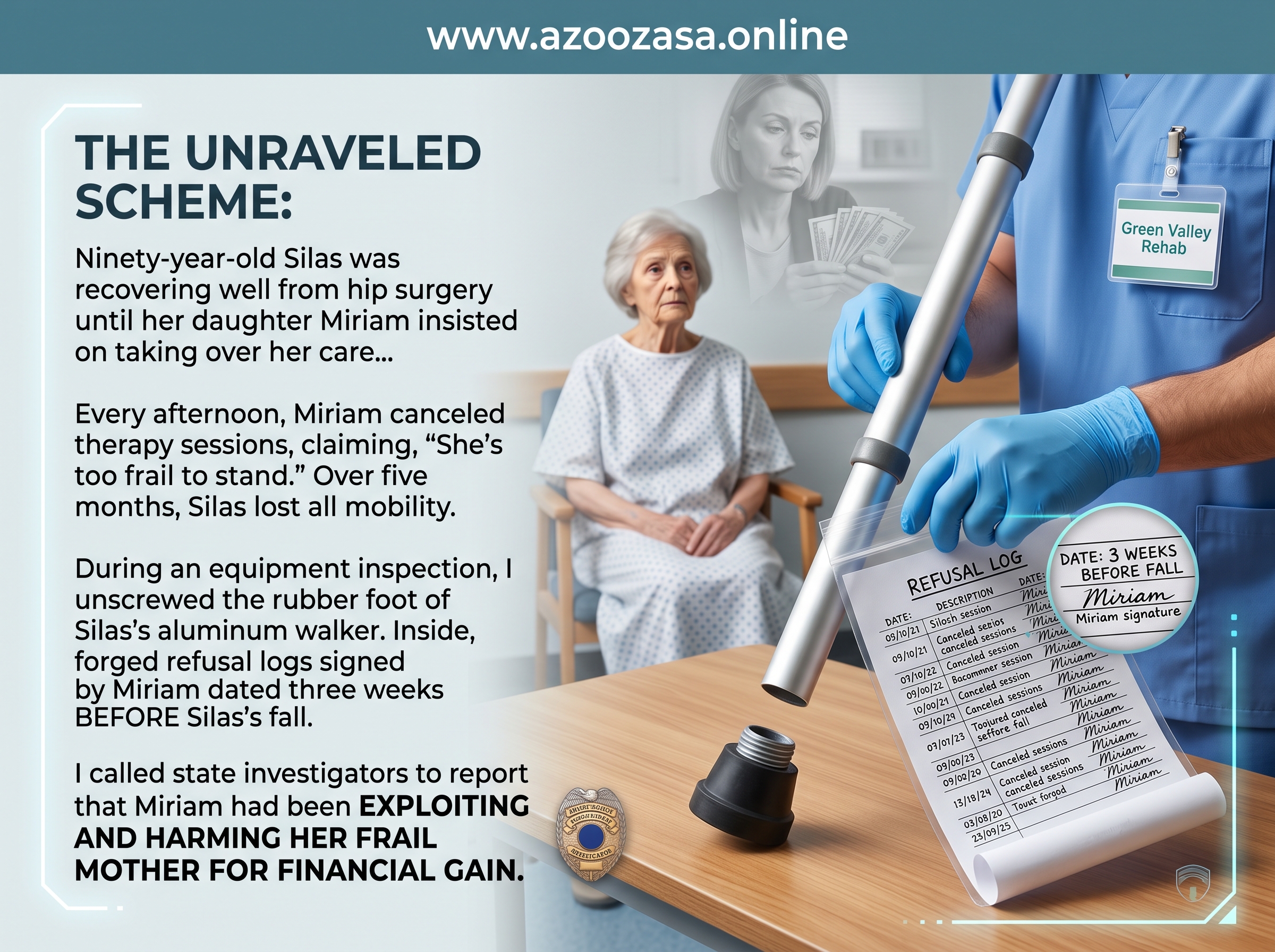
That single cancellation became a daily routine. Every afternoon, like clockwork, Miriam would find a new excuse. Silas was too tired. Silas had a slight fever. Silas was experiencing phantom pains. As the legally appointed guardian, Miriam had the ultimate authority to refuse treatment on her mother’s behalf, and our facility’s administration, terrified of litigation, tied my hands.
I was forced to become a helpless spectator to a tragedy I knew how to prevent.
Over the next five months, I watched a vibrant, fiercely independent woman wither away into a ghost. The lack of mobility triggered a devastating, predictable cascade of physical deterioration. Without weight-bearing exercises, Silas’s bone density plummeted. The muscles in her legs atrophied, turning from solid, capable tissue into loose, useless flesh.
Worse than the physical decline was the psychological defeat. Silas stopped asking about her garden. The sharp wit dulled into a heavy, suffocating apathy. She began to believe Miriam’s narrative—that she was broken, frail, and entirely dependent. The vibrant woman who had joked through her heel slides was replaced by a fragile shell staring blankly at the ceiling tiles.
By the fifth month, Silas had lost all mobility. She was completely bedbound, requiring a mechanical lift just to be transferred to a wheelchair. Miriam had won. She had successfully manufactured an invalid, securing her absolute control over the $7,200 monthly stipend.
The Discovery in the Aluminum
On a rainy Thursday afternoon, I was tasked with conducting routine equipment inspections in the storage wing. It was mundane work—checking brakes on wheelchairs, tightening bolts on shower chairs, and ensuring the rubber grips on walking aids weren’t worn down.
Silas’s aluminum walker was sitting in the corner, gathering dust. It hadn’t been used in months.
I picked it up, feeling a bitter sting of regret. As I tested the stability of the frame, I noticed the bottom right rubber foot was loose. It squeaked against the linoleum, the rubber having slightly detached from the metal tubing.
Sighing, I grabbed a wrench from my toolkit and gripped the rubber stopper, twisting it to pull it off so I could replace it with a new one. It required some force, but with a sharp pop, the rubber foot came free.
My mouth went completely dry.
The aluminum tubing wasn’t empty. Stuffed inside the hollow leg of the walker was a tightly rolled plastic sleeve, the kind used to protect documents from water damage.
My hands trembled as I pulled the sleeve out. It was covered in a thin layer of metallic dust. I unrolled it, sliding out a stack of folded, high-quality printer paper.
They were physical therapy refusal logs.
I stared at the pages, my heart hammering a frantic rhythm against my ribs. They were official Green Valley Rehab forms, completely filled out, detailing severe frailty, aggressive resistance to therapy, and an inability to stand. At the bottom of each page was Miriam’s signature, legally confirming the refusals.
But it wasn’t the signatures that made the blood freeze in my veins. It was the dates.
I scanned the top right corner of the documents. October 12th. October 14th. October 18th.
Silas had fallen and shattered her hip on November 9th.
The breath caught painfully in my throat as the sinister reality snapped into focus. These refusal logs were dated a full three weeks before Silas had even fallen. Miriam hadn’t just taken advantage of a tragic accident to seize control of the trust fund. She had laid the groundwork for it beforehand. She had fabricated a paper trail of physical decline to justify taking over the finances, but to make it entirely convincing to the trust attorneys, she needed a catastrophic event.
The documents proved premeditation. Miriam hadn’t just hindered her mother’s recovery; it was highly probable she had orchestrated the fall itself.
The Call for Justice
I didn’t go to the facility administrators. I knew they would call their legal team, dragging the process out in a swamp of red tape and liability concerns. I grabbed the papers, shoved them into my scrub pocket, and walked straight into my private office, locking the door behind me.
I picked up the phone and dialed the direct line for the State Department of Health and Human Services, specifically the division for Elder Abuse and Financial Exploitation.
“My name is Sarah, I am a licensed physical therapist at Green Valley Rehab,” I said, my voice remarkably steady despite the adrenaline coursing through my system. “I need to file an emergency report regarding patient Silas.”
The operator asked for the nature of the emergency.
I pulled the forged documents from my pocket, spreading them out on my desk. “I am reporting that her daughter, Miriam, has been intentionally orchestrating her mother’s physical decline to secure a $7,200 monthly trust fund. I have physical, hidden evidence of forged medical documents proving premeditated fraud, and I have immediate reason to believe Silas’s initial injury was not an accident, but deliberate physical assault.”
Within two hours, the quiet routine of Green Valley Rehab was shattered by the arrival of state investigators and local law enforcement. I stood at the end of the hallway, watching as Miriam, who had arrived for her usual afternoon charade, was intercepted at the front desk. The color drained from her perfectly made-up face as an investigator read her rights, escorting her out of the double glass doors in handcuffs.
Later that evening, before my shift ended, I walked into Silas’s room. She was looking toward the window, watching the rain streak the glass.
I pulled a chair up to her bedside. “Silas,” I said softly.
She turned her head, her faded denim eyes searching my face.
“Miriam is gone,” I told her, making sure my voice carried the absolute certainty of the truth. “She is not coming back to manage your care. We are taking the schedule back.”
For the first time in five months, a tiny, genuine spark flickered in the older woman’s eyes. It was a fragile thing, buried under layers of trauma and atrophy, but it was there.
“Do you think…” Silas whispered, her voice raspy from disuse, “do you think my garden has gone completely to weed?”
I smiled, feeling tears prick the corners of my eyes. “I think it needs a lot of work. So we better start with some heel slides tomorrow morning.”
If you were the therapist tasked with rehabilitating Silas after five months of forced immobility, what specific exercise would you focus on first to rebuild her shattered confidence?




0 comments