
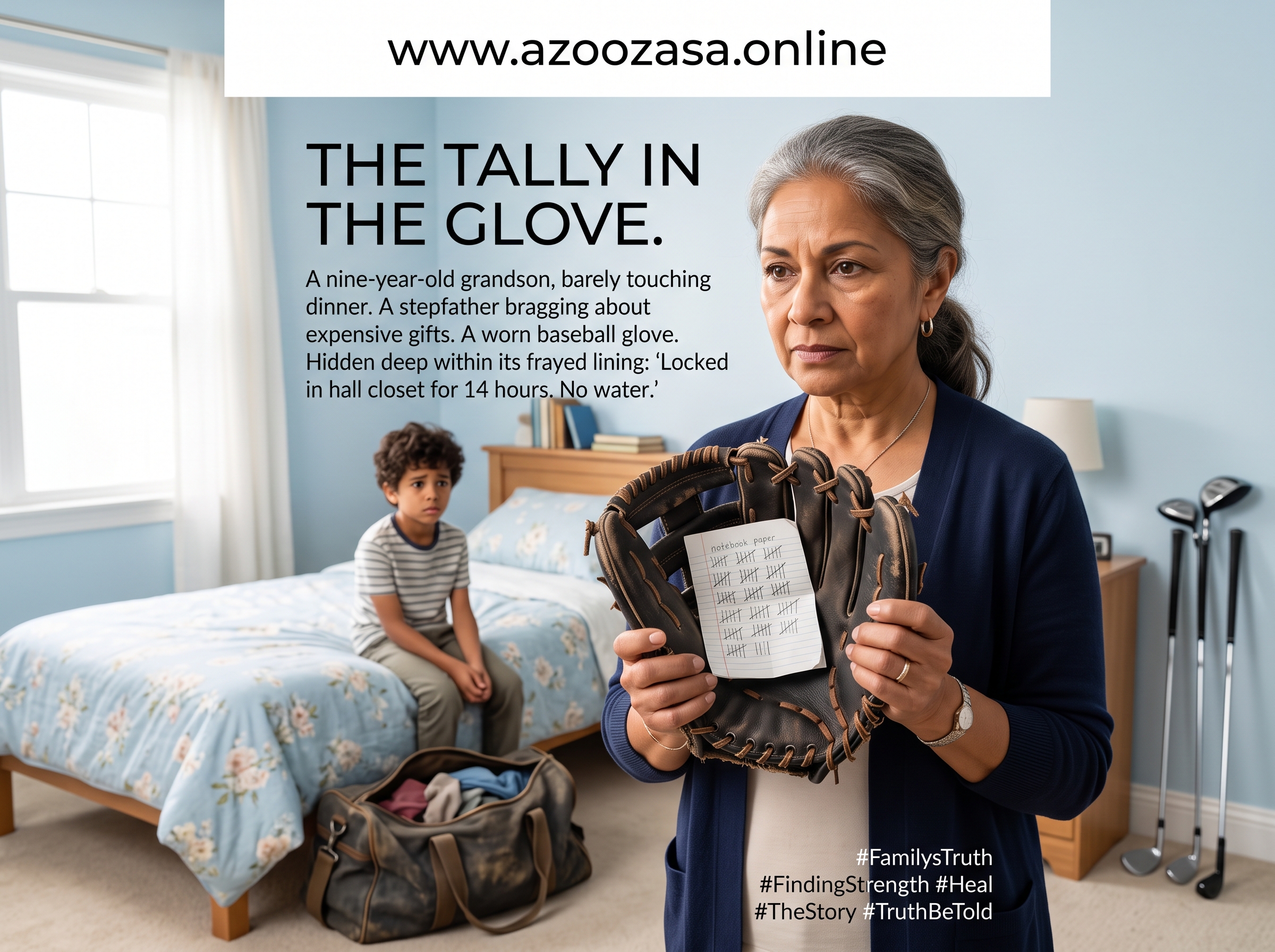
The Tally in the Glove
On the third Sunday of May, the air in my dining room felt thick, heavy with an unspoken dread that I could no longer attribute to the impending summer humidity. My nine-year-old grandson, Leo, sat at my kitchen table, barely touching his pot roast. He was a small boy for his age, with eyes that held too much of the world and shoulders that permanently stooped, as if bracing for an invisible weight.
Across from him sat Wayne, his stepfather of exactly one year. Wayne was a man who took up too much space, his loud voice booming off the floral wallpaper. He had spent the first twenty minutes of dinner bragging about the morning’s purchase.
“Top of the line,” Wayne was saying, gesturing with his fork, a piece of carrot impaled on the tines. “Three thousand, one hundred dollars’ worth of junior golf equipment. Custom-fitted clubs, leather bag, the works. I tell you, Margaret, I spoil the boy. I treat him like my own flesh and blood. Most kids would kill for a setup like that.”
I offered a tight, noncommittal smile, my eyes drifting to Leo. The boy hadn’t looked up from his plate. He was pushing a piece of meat through a pool of brown gravy in slow, hypnotic circles.
Suddenly, Leo’s fork slipped from his small fingers, clattering loudly against the fine china. It was a sharp, sudden noise that pierced the stifling room.
Instantly, Wayne’s head snapped toward the boy. The jovial, bragging mask vanished, replaced for a fraction of a second by a cold, hard glare.
Leo flinched. It wasn’t a small startle; his entire body jerked backward, his arms coming up slightly as if to shield his face, his eyes squeezing shut. He looked as if Wayne were going to strike him right there at the dinner table.
My tongue stuck to the roof of my mouth. A cold prickle of adrenaline washed down my spine. Wayne quickly recovered, letting out a forced, hollow chuckle. “Clumsy today, aren’t we, champ? Careful with your grandmother’s nice plates.”
But the damage was done. The image of Leo’s absolute terror was burned into my retinas. My daughter, Sarah, who had been quiet all evening, hurriedly reached over and wiped the spilled gravy, her eyes deliberately avoiding mine.
After dinner, the suffocating atmosphere persisted. Wayne retreated to the living room to watch the baseball game, the volume turned up aggressively high, while Sarah started clearing the dishes. I escaped to the guest bedroom under the guise of helping Leo pack his sports bag for the week.
Leo sat on the edge of the twin bed, his legs swinging silently. His new, pristine golf bag stood in the corner like an expensive monument to Wayne’s ego, but he was holding his old, battered baseball glove.
“Need some help with that, sweetheart?” I asked softly, sitting beside him on the mattress.
He handed me the glove without a word. As I took it, I noticed how thoroughly worn it was. The leather lining of the pocket was unstitched, the laces frayed and darkening with age. It was a well-loved piece of equipment, unlike the sterile golf clubs Wayne had forced upon him.
As I adjusted the webbing, my thumb brushed against something stiff hidden inside the unstitched lining. I frowned, digging my fingers under the palm padding.
I pulled out a piece of neatly folded, grimy notebook paper.
“What’s this, Leo?” I asked.
He froze. His face went entirely pale, and his breathing hitched. “Nothing, Grandma. Please put it back. Please.”
The raw panic in his voice made my heart pound against my ribs. I ignored his plea—a decision that would permanently alter the course of all our lives—and carefully unfolded the brittle paper.
It was covered in pencil tallies. Rows and rows of straight little lines, grouped by fives, spanning what looked like months of time. Dates were scribbled next to the rows. Sept 14. Oct 2. Nov 18. And next to the dates, brief, chilling notes written in a child’s shaky, desperate print.
No dinner.
Cold shower outside.
Slept on garage floor.
My eyes darted down the page, my breath catching painfully in my throat. The tallies grew more frequent in the recent months. Then, at the very bottom, dated just three days prior, was a line that made the blood freeze in my veins.
Locked in hall closet for 14 hours. No water.
I stared at the words, the graphite smudged by what I now realized were dried tears. Fourteen hours. In the dark. Without water. While Wayne bought his way out of guilt with three-thousand-dollar golf clubs. While my daughter stood by and wiped up spilled gravy.
I looked at Leo. He was trembling violently now, his knees pulled up tightly to his chest, tears streaming silently down his cheeks. He looked like a cornered animal waiting for the final, inevitable blow.
I didn’t cry. The time for tears was entirely over. A deep, primal rage ignited in the center of my chest, burning away the shock, burning away the polite, grandmotherly demeanor I had cultivated for sixty-five years.
I folded the paper carefully and slipped it into the pocket of my cardigan. I gripped the worn baseball glove tightly in my right hand, feeling the rough leather bite into my palm.
“Stay here, Leo,” I whispered, my voice steadier and colder than it had been in years. “Pack your clothes. All of them. Not just the sports gear.”
I walked out of the guest room and down the short hallway. The sounds of a baseball announcer echoed from the television, a sharp contrast to the ringing in my ears. Sarah was at the kitchen sink, the water running over the soapy dishes. Wayne was sprawled in my deceased husband’s favorite armchair, a beer resting on his knee, looking like a king surveying his conquered land.
I stepped into the center of the living room, deliberately blocking the television screen.
Wayne sighed loudly, shifting his weight. “Margaret, you make a better door than a window. It’s the bottom of the eighth.”
I gripped the glove tightly, turned my full, unblinking attention to Wayne, and said, “The game is over, Wayne. And so is your time in my family.”
He blinked, a confused smirk playing on his lips. “Excuse me? Have you had too much sherry, Margaret?”
Sarah turned off the kitchen faucet, the sudden silence in the house amplifying the crushing tension. “Mom? What’s going on?” she asked, wiping her hands on a dish towel as she hurried into the room.
I threw the baseball glove hard onto the oak coffee table. It landed with a heavy, definitive thud, knocking over a stack of cork coasters.
“Fourteen hours,” I said, my voice low, vibrating with a wrath I made no attempt to hide. “Fourteen hours in a hall closet with no water. Does that sound like a three-thousand-dollar golf swing to you, Wayne?”
The smirk instantly vanished from Wayne’s face. The color drained from his cheeks, leaving him looking sickly and grey. He sat up abruptly, the beer sloshing onto his khaki trousers, but he didn’t seem to notice. For the first time since I had met him, he was utterly speechless.
Sarah stopped dead in her tracks. “Mom, what are you talking about?”
I pulled the folded notebook paper from my pocket. I didn’t hand it to Wayne; I held it out to my daughter.
“Read it,” I commanded. “Read the tallies. Read what your husband has been doing to your son while you looked the other way.”
Sarah took the paper, her hands shaking uncontrollably. As her eyes scanned the childish handwriting, a low, agonizing sound escaped her throat—a guttural whimper of a mother waking from a nightmare only to find herself living inside one.
“It’s a lie,” Wayne barked, finally finding his voice. He stood up, towering over me, trying to use his physical size to intimidate. “The kid is a liar. He makes things up for attention. He’s disturbed, Margaret. I’ve been trying to discipline him, to make a man out of him!”
“You are not a man,” I said, stepping closer to him, refusing to yield a single inch of ground. “You are a coward who locks a nine-year-old in the dark because it makes you feel powerful. And you are leaving my house right now. If you are not out that door in thirty seconds, I am calling the police, and I will hand them this piece of paper myself.”
“You can’t do this,” Wayne sneered, though his eyes darted nervously toward the front door. “Sarah, tell her. Tell your crazy mother to back off.”
He reached for Sarah’s arm, but she recoiled violently as if burned by fire. She looked at him, truly looked at him for what felt like the first time, and the denial that had shielded her for a year finally shattered into a million pieces.
“Get out,” Sarah whispered, her voice cracking. Then, finding a reserve of strength she had long forgotten, she screamed, “Get out, Wayne! Get out of this house!”
Wayne looked between the two of us, calculating his rapidly dwindling odds. He realized the facade was broken beyond repair. With a string of vicious, defensive curses, he grabbed his keys from the console table and stormed out, slamming the heavy oak door so hard the glass panes rattled in their frames.
The silence that followed was deafening. Sarah collapsed onto the sofa, sobbing violently into her hands, the notebook paper resting on her lap like a damning verdict.
I didn’t comfort her immediately. I had a much more important task waiting for me down the hall.
I walked back to the guest bedroom. Leo was standing rigid by his bed, his duffel bag packed full of his clothes. He had heard the yelling. His eyes were wide, waiting for the punishment he was certain would follow the unearthing of his secret.
I knelt down so I was exactly eye level with him. I took his small, trembling hands in mine, rubbing my thumbs over his knuckles.
“He’s gone, Leo,” I said softly, ensuring he heard every word. “Wayne is gone, and he is never, ever coming back. I promise you that upon my life.”
Leo searched my face, scouring my expression for the lie he had grown so used to finding in adults. When he didn’t find one, a small, fragile breath escaped his lips, and he threw his arms around my neck, burying his face deep in my shoulder. I held him fiercely, feeling the frailness of his bones, silently vowing that no one would ever make him flinch again.
That night, Leo slept in my bed, safe in the very center of the mattress. Sarah slept in the guest room, beginning the agonizingly long process of facing her own failures and the road to rebuilding her son’s trust.
The next few months were a chaotic whirlwind of legal proceedings, police statements, and intense therapy sessions. The notebook paper became Exhibit A. The three-thousand-dollar golf clubs were sold immediately, the money put directly into a trust fund for Leo. Wayne attempted to fight the restraining orders, but the evidence of his cruelty, meticulously documented by a terrified child in the darkness, proved far too overwhelming for any judge to ignore.
Summer eventually faded into autumn. The heavy, oppressive air of that May Sunday was replaced by the crisp, clean breeze of October.
One Saturday afternoon, I was sitting on my porch, wrapped in a cardigan, watching the oak leaves turn brown and gold across the front lawn. The screen door squeaked open, and Leo stepped out. He looked remarkably different now. He had gained a healthy amount of weight, the permanent stoop in his shoulders had completely vanished, and the haunting darkness in his eyes had receded, replaced by the cautious, beautiful optimism of a child learning what it means to be truly safe.
He was wearing a baseball cap and carrying a scuffed-up baseball. On his left hand was the worn, unstitched leather glove. We had offered to buy him a brand-new one on several occasions, but he had staunchly refused.
“Hey, Grandma,” he said, tossing the ball lightly into the air and catching it with a satisfying smack against the leather. “Want to play catch?”
I smiled, a profound warmth spreading all the way to my chest. I stood up and smoothed my skirt.
“I’d love nothing more, Leo.”
As he ran out onto the expansive lawn, the afternoon sun catching the frayed laces of his beloved glove, I realized that some things are meant to be worn out. They carry the indelible marks of survival. That old piece of leather had held the darkest, most painful secret a child could carry, but now, it was just a glove again, ready to catch whatever came its way.



0 comments