
Title: The Corner Booth Legacy
## The Friday Ritual
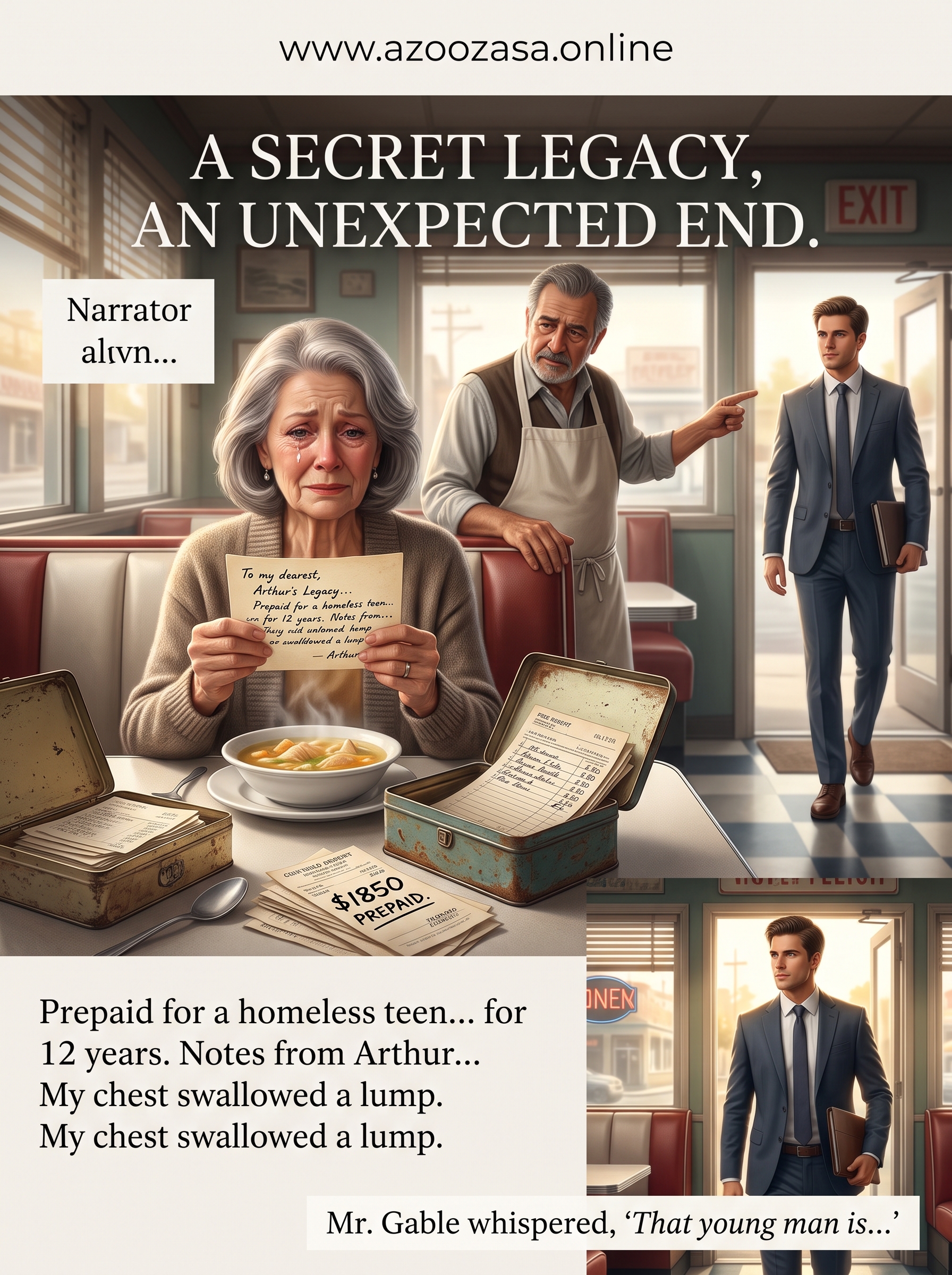
Every Friday for four years, I sat in the third booth from the window at Gable’s Diner. It was a modest place with cracked red vinyl seats and the permanent smell of roasted coffee, but to me, it was a sanctuary. It was where my husband Arthur and I shared our first date thirty-two years ago, splitting a bowl of chicken noodle soup because we were too broke to order two entrees. After his sudden heart attack, that same chicken soup became my weekly communion with his memory.
Last week, the routine shattered. Mr. Gable, his apron stained and his shoulders stooped with age, flipped the “Open” sign to “Closed” in the middle of the afternoon. He walked slowly over to my booth, carrying a faded blue tin box that had once held Danish butter cookies.
“I’m closing the diner for good at the end of the month, Martha,” he said, his voice thick with emotion. He slid the tin box across the Formica table. “Arthur made me promise to hold onto this. He told me to wait until the boy was ready, or until I closed my doors. Whichever came first.”
My hands trembled as I pried the rusted lid open. Inside lay a thick stack of faded diner receipts, neatly banded together. I tallied the amounts in my head—hundreds of weekly meals spanning over a decade, totaling exactly $1,850. Beneath the receipts lay a stack of folded, yellowed notebook paper, entirely covered in Arthur’s unmistakable, sloping handwriting.
## The Contents of the Tin
My chest swallowed a heavy lump as I unfolded the first letter. It was dated twelve years before his passing. Arthur had been keeping a secret, a quiet ledger of grace that he had funded entirely from his own modest pocket money.
“My dearest Martha, if you are reading this, it means my tab at Gable’s has finally been called in, and I am no longer sitting across from you. Forgive me for keeping this from you, but the boy had too much pride to accept charity, and I couldn’t risk bruising his dignity. I have been buying his Friday dinners.”
Arthur’s subsequent letters chronicled the life of a teenager he had noticed sleeping behind the diner’s dumpsters. The notes detailed a profound, silent mentorship between my husband and a boy he only knew as Elias. Arthur outlined the strict rules of their arrangement:
-
The Anonymous Tab: Elias was to order whatever he wanted on Friday nights, under the guise that a “local charity” had pre-paid for struggling students.
-
The Exchange of Books: Arthur would casually leave his old literature and history books in the booth, which Elias would read, annotate, and return to the exact same spot a week later.
-
The Ultimate Condition: Arthur promised Elias that if he stayed out of trouble and finished his college education, he would finally introduce himself and his wife.
Arthur died before he could keep that final promise. He had passed away just weeks after Elias started his freshman year at the state university.
## The Promise Kept
A sudden draft of autumn air broke my concentration as the diner’s front bell chimed. I looked up, wiping a stray tear from my cheek. A young man stood in the doorway. He was in his late twenties, wearing a crisp, tailored navy suit. He held a leather briefcase with an air of profound confidence, but his eyes darted around the worn interior of the diner with a soft, nostalgic reverence.
Mr. Gable wiped his hands on his apron, leaned over my table, and whispered, “That young man is Elias.”
My breath hitched. Elias walked directly toward the counter, but Mr. Gable shook his head and pointed a weathered finger toward my booth. The young man turned. When his eyes met mine, a look of immediate recognition washed over his face. He recognized me from the photographs Arthur used to keep in his wallet.
He approached my table slowly, as if approaching an altar. “You must be Martha,” he said, his voice deep and steady, though his hands gripped the handle of his briefcase until his knuckles turned white.
“I am,” I managed to whisper, gesturing to the empty red vinyl seat across from me. “Please, sit down.”
## A Debt Paid in Full
Elias slid into the booth, the very same booth where Arthur and I had fallen in love. He unlatched his briefcase and gently pulled out a heavy, framed piece of paper. He laid it flat on the table, right next to Arthur’s rusted tin box.
It was a Juris Doctor degree from the state university’s law school. It was dated just three days ago.
“He told me to wait until I was someone he could be proud of,” Elias said, his voice finally breaking. “I came here today to finally shake his hand. To tell him that the homeless kid he fed for twelve years just passed the bar exam. Mr. Gable just told me he’s gone.”
Tears streamed freely down my face, but for the first time in four years, they were not tears of grief. They were tears of an overwhelming, radiant joy. Arthur had not truly left me alone in this booth; he had spent a decade quietly building a bridge between his passing and my future.
“He was already proud of you, Elias,” I said, sliding the stack of yellowed notebook paper across the table so he could see Arthur’s handwriting. “He was proud of you from the very first Friday.”
Elias looked down at the letters, tracing Arthur’s script with a trembling finger. I called Mr. Gable over and ordered two bowls of chicken noodle soup. We sat there for hours, a widow and a newly minted lawyer, sharing a meal and the memory of a man whose quiet kindness had saved us both.
How did the transition from the widow’s isolated grief to her connection with Elias change your perspective on Arthur’s secret?


0 comments