
📋 Table of Contents
Part I: The Discovery
It was the second Tuesday of July when my eight-year-old grandson Toby visited for an extended summer weekend. While helping him dry off after a bath, I noticed a folded piece of paper tucked deep inside his left sock.
His stepfather, Vance, had bought him a $2,400 bicycle the day before, claiming the boy’s recent array of bruises was because Toby was “just clumsy” and needed a better set of wheels to keep his balance. Vance had smiled that perfect, bright smile of his when he dropped him off. He had shaken my hand, told me how much he respected me, and drove away in his spotless SUV.
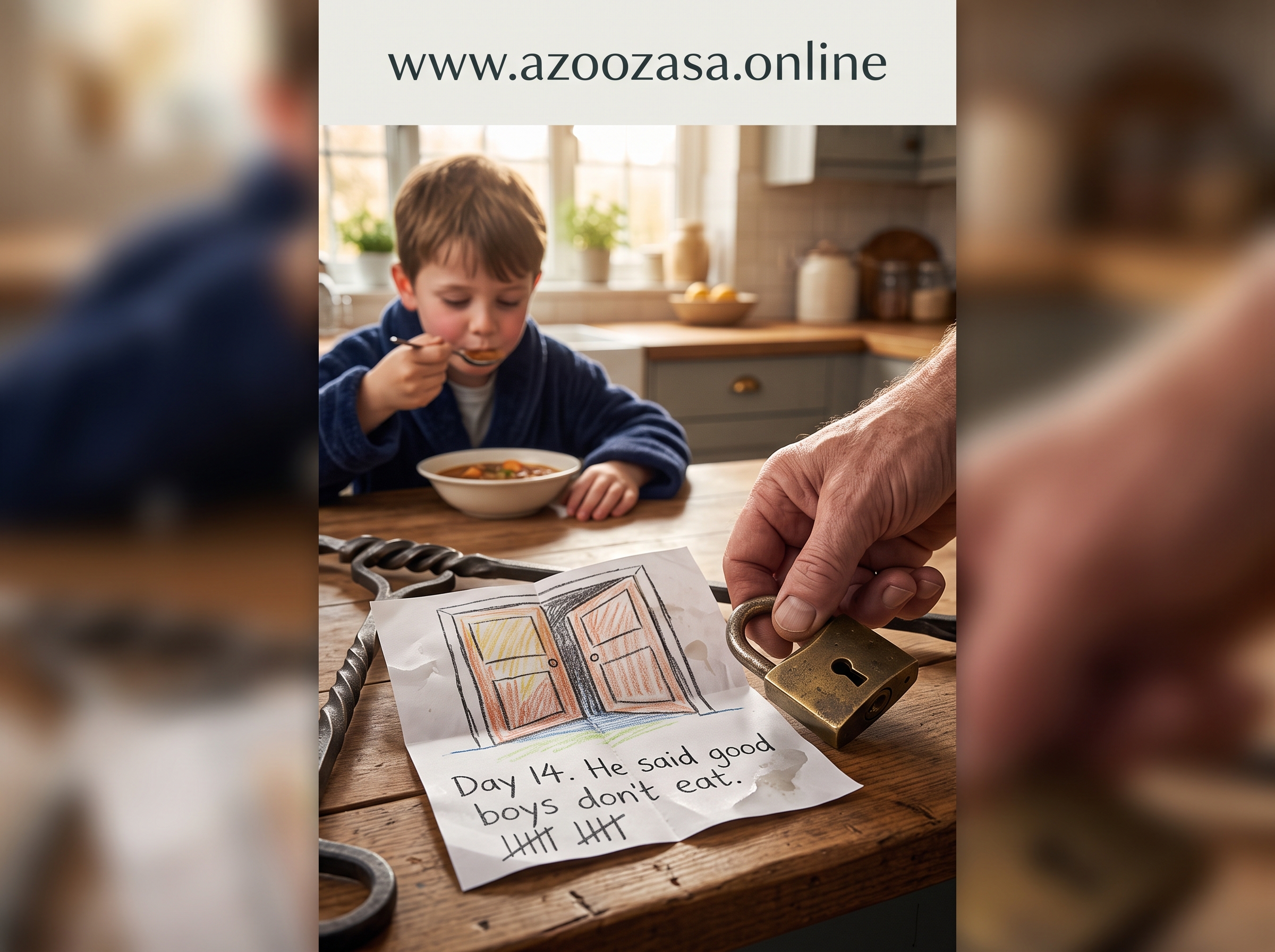
But when I unfolded the paper, my throat tightened. The damp bathroom air suddenly felt suffocating. It was a handwritten calendar of July, drawn with the shaky, desperate lines of a child. There were tallies marked under crudely sketched dark pantry doors. Below the markings, written in black crayon, were the words:
“Day 14. He said good boys don’t eat.”
For fourteen months I’d trusted that man. I had walked my daughter, Sarah, down the aisle and handed her over to him. I had toasted to his kindness, his lucrative job, and the stability I thought he brought to my grandson’s life. I set the towel down very carefully, my hands trembling with a sudden, violent rage that I had to bite my lip to suppress. I knelt on the cold tile, forcing my voice to remain soft, and asked Toby about the drawing.
Toby didn’t look at me. His hollow, dark-ringed eyes remained fixed on the floor. He lifted a small, bruised arm, pointed toward the hallway leading to my basement stairs, and whispered, “The key is under.”
Part II: The Heavy Brass Truth
I wrapped Toby in a thick, warm bathrobe and sat him at the kitchen island with a bowl of warm soup. I watched him eat. He didn’t use a spoon; he drank it directly from the rim, his eyes darting toward the front window like a stray animal expecting a kick. The sight of it broke my heart into a thousand jagged pieces.
Looking back, the warning signs had been there, disguised as everyday quirks. As I walked toward the basement door, my mind violently cataloged everything I had been too blind to see:
-
The oversized sweaters Toby wore, even in the sweltering heat of June, hiding his shrinking frame.
-
The flinching whenever a kitchen cabinet door slammed shut too loudly.
-
The ravenous way he inhaled my homemade meals, only to throw them back up because his stomach had forgotten how to process solid food.
-
The expensive gifts—like the $2,400 bicycle—which were never signs of love, but hush money for broken ribs and starving nights.
I opened the door to the basement and knelt by the top step. I ran my hand underneath the wooden tread. My fingers brushed against a piece of duct tape. I peeled it back and a heavy, brass padlock key dropped into my palm.
I walked back to the kitchen and laid the key on the counter next to Toby’s empty bowl.
“Toby,” I said gently, sitting across from him. “Whose key is this?”
“Vance’s,” Toby whispered, tracing the wood grain of the table. “He locks the pantry from the outside when Mom goes to her night shifts at the hospital. I found his spare key in his office drawer. I stole it. I hid it here so he couldn’t put me back in.”
A cold sweat broke out on my neck. Vance had been starving my grandson, locking him in the dark for hours, sometimes days, while my daughter was out saving lives. The shiny new bicycle wasn’t an apology for a clumsy fall; it was a bribe to keep Toby quiet about the key going missing.
I didn’t panic. I didn’t cry. The love of a grandfather is a warm, comforting thing, but the protective wrath of a grandfather is entirely cold and calculated.
I picked up the kitchen phone and dialed the police. I asked for Officer Miller, an old friend from my days at the rotary club. I explained the situation in sharp, factual sentences. Then, I called my daughter.
“Sarah,” I said when she answered, her voice tired from the hospital ward. “Listen to me very carefully. Do not go home tonight. Come straight to my house. I will explain when you get here, but I need you to trust me. Your son’s life depends on it.”
Part III: The Monster at the Door
At 7:00 PM, an hour before the police were scheduled to arrive to take a formal statement, headlights swept across my living room curtains. I looked out the window. It wasn’t the police, and it wasn’t Sarah.
It was Vance’s spotless SUV.
He had figured it out. He must have noticed the spare key was missing and realized Toby was the only one small enough and desperate enough to take it. He had come to do damage control.
I turned to Toby, who had gone entirely rigid on the sofa, his eyes wide with stark terror.
“Go to my bedroom,” I told him, my voice steady and commanding. “Lock the door. Do not come out until you hear your mother’s voice. Do you understand?”
Toby nodded frantically and scrambled down the hall. I heard the solid click of my heavy oak bedroom door locking. I walked into the kitchen, slid a heavy cast-iron fireplace poker into my grip, and hid it behind the doorframe. Then, I waited.
The doorbell chimed. It sounded sickeningly cheerful.
I opened the front door. Vance stood on the porch, wearing a crisp linen shirt and a pleasant, practiced smile.
“Arthur! Evening,” Vance said, rubbing his hands together. “Sorry to drop by unannounced. Sarah got held up at the hospital, so I figured I’d come pick up the little guy a day early. We’ve got a big camping trip planned tomorrow.”
“Toby is asleep,” I said, blocking the doorway with my body. I didn’t smile back.
Vance’s eyes narrowed just a fraction of an inch. His customer-service smile faltered, replaced by something cold and calculating. “Well, I can just carry him to the car. No need to wake him. We really should hit the road.”
“He’s staying right here, Vance.”
“Arthur,” Vance chuckled, though there was no humor in it. He took a step forward, invading my personal space. “I appreciate you looking after him, but he’s my stepson. I’m taking him home. Now, let me in.”
“I found the key, Vance,” I said.
The silence that followed was absolute. The charming suburban stepfather vanished, and the monster beneath the skin finally showed its face. Vance’s jaw clenched, the muscles ticking erratically. His eyes darkened, scanning the empty hallway behind me.
“You don’t know what you’re talking about, old man,” Vance hissed, his voice dropping into a guttural sneer. “That boy is a liar. He makes things up for attention. Sarah knows it, I know it. Now, you’re going to step aside, and I’m going to take my son home to discipline him.”
He lunged forward, reaching for the door handle to shove me aside.
I didn’t back down. I brought the heavy iron fireplace poker up, slamming it horizontally into his chest. The blow knocked the wind out of him, sending him stumbling backward off the porch. He hit the gravel driveway, gasping for air, his crisp linen shirt stained with dirt.
“You lay one finger on that boy again,” I warned, my voice echoing in the quiet suburban street, “and I won’t use the blunt end next time.”
Vance scrambled to his feet, his face twisted in pure fury. He took a step toward me, raising his fists, ready to beat an old man to the ground.
Then, the wail of sirens pierced the quiet evening air.
Part IV: The Aftermath
Two police cruisers turned onto my street, their red and blue lights washing over Vance’s shocked face. The fight drained out of him instantly. He looked at me, then at the approaching cars, and took off running toward his SUV.
He didn’t make it. Officer Miller and his partner had him pinned against the hood of his own car before he could even get the keys in the ignition.
An hour later, Sarah arrived. The moment she saw the crayon-drawn calendar and the heavy brass key, she broke down. She wept until she had no tears left, falling to her knees in my kitchen. She had been working eighty-hour weeks to pay off the mortgage Vance insisted they needed, entirely unaware of the private hell her son was living in.
Vance was denied bail. The police raided his house that night. They found the pantry. They found the heavy deadbolt installed on the outside of the door. They found the scratch marks on the inside of the doorframe where a starving eight-year-old boy had tried to claw his way out.
It has been six months since that second Tuesday in July. Vance is sitting in a state penitentiary awaiting trial, facing years behind bars for child abuse and endangerment. Sarah divorced him and moved back into my home, bringing life and warmth back into these old walls.
Toby is doing much better. He still flinches sometimes, and we had to throw away all the dark-colored doors in the house, replacing them with light, open archways. But the color has returned to his cheeks.
Last night, we sat around the kitchen island. Sarah was laughing at a joke I’d made, and Toby was eating a second helping of my homemade stew. He didn’t eat it like a frightened animal anymore. He ate it slowly, savoring every bite, knowing that the food would never be taken away, and the doors would never be locked again.
How did the pacing and emotional build-up of the confrontation with Vance feel to you?


0 comments