
# The Unexpected Alarm
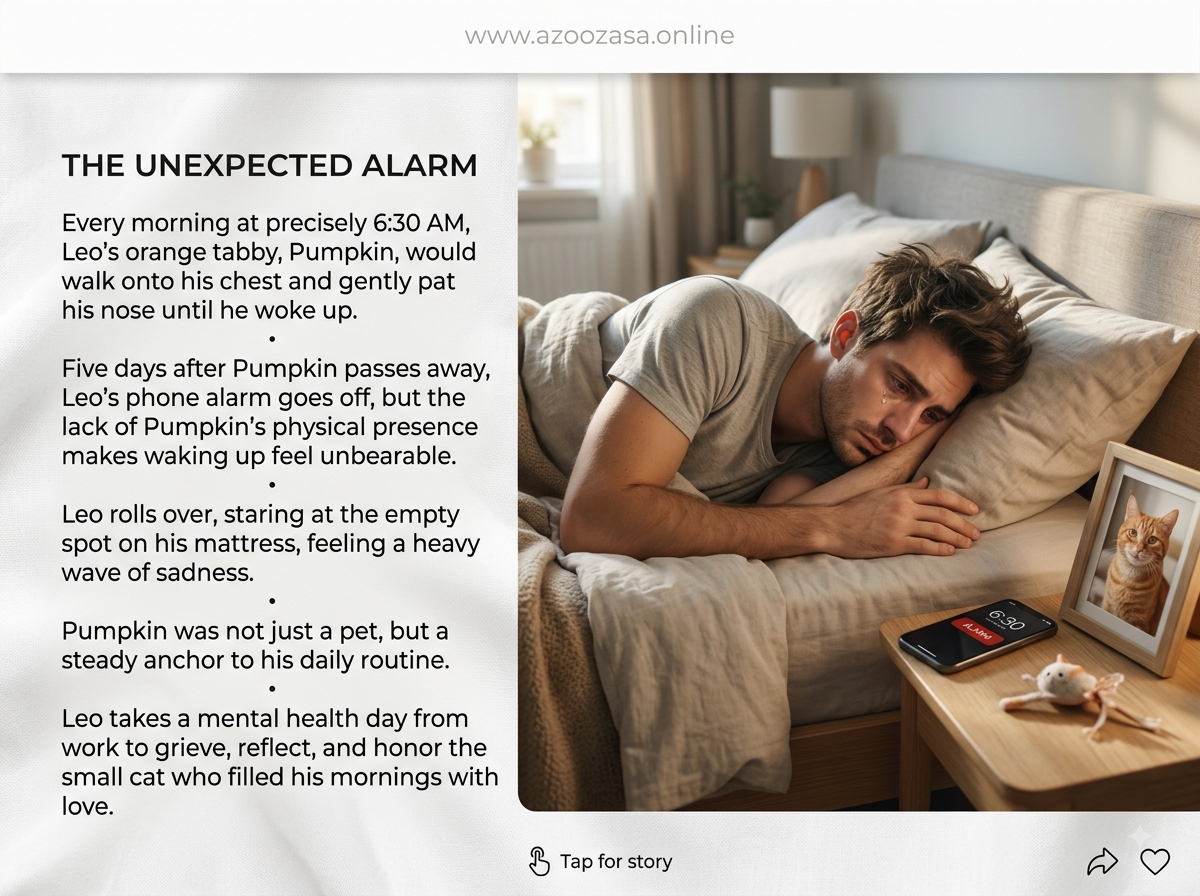
For six years, mornings in Leo’s small, third-floor apartment had followed a rhythm far more precise than any mechanical clock. At six twenty-nine AM, an orange tabby named Pumpkin would leap onto the edge of the mattress with the silent grace of a shadow. He would pause for a moment, letting his weight settle, before treading deliberately up the center of the duvet. Upon reaching Leo’s chest, Pumpkin would sink down, lower his head, and reach out one soft, white-pawed leg.
A gentle, persistent tap—*pad, pad, pad*—against the tip of Leo’s nose would follow until Leo’s eyelids fluttered open.
There was never a need for an electronic chime. Leo’s world began with the faint, comforting warmth of a purring chest, the distinct scent of dried cedar and sunshine on cat fur, and two luminous, amber eyes watching him with quiet devotion. “Alright, buddy, I’m up,” Leo would whisper every morning, scratching Pumpkin right behind his notched left ear before swinging his legs over the bed to start the day.
That rhythm vanished on a rainy Tuesday afternoon when Pumpkin’s tired heart finally gave out. The vet had been gentle, but the silence that settled over the apartment when Leo returned alone was brutal, heavy, and absolute.
Five days passed. Five days of moving through a grey, phantom existence where every habit felt like a ghost limb reaching for something that wasn’t there.
Leo stopped setting his phone alarm on the first night, unable to face the thought of waking up to anything other than Pumpkin’s soft touch. Yet, on the fifth morning, at precisely 6:30 AM, a harsh, blaring metallic song erupted from the nightstand.
Leo’s eyes snapped open. For a split second—a fraction of a heartbeat born of muscle memory and desperate wishful thinking—his brain prepared for the weight on his chest. He held his breath, waiting for the soft touch on his nose. The gentle purr. The steady warmth.
Nothing came.
The mattress was cold. The silence beneath the digital alarm was deafening. Leo reached out with an arm that felt leaden, fumbling blindly across the nightstand until his fingers smashed down on the phone screen, smothering the noise.
He rolled onto his side, staring at the empty patch of worn cotton sheet where Pumpkin used to rest his chin while Leo tied his shoes. The sudden, unyielding absence struck Leo with the force of a physical blow. Pumpkin hadn’t just been a pet; he had been the quiet anchor holding Leo’s daily existence together. In the chaotic noise of early-morning commutes, demanding job deadlines, and the lingering loneliness of living alone in a crowded city, Pumpkin had been his constant. The small orange cat was the singular creature who asked for nothing more than Leo’s presence, offering an uncomplicated, unconditional love that anchored the beginning and end of every single day.
Now, that anchor was gone, and Leo felt adrift in a vast, empty room.
He pulled the blanket over his shoulders, intending to sink back into sleep, but the knot in his throat was too tight. Tears, kept at bay through sheer momentum during the work week, finally breached his defenses. They streamed quietly into his pillow, hot and heavy, as he mourned the quiet companionship that had filled his life for six years.
At 7:15 AM, his phone buzzed with an automated calendar reminder: *Morning Team Sync in 45 Mins.*
Leo stared at the blinking screen. He thought about getting up, putting on his crisp dark suit, walking down the subway stairs, sitting in his cubicle, and pretending that his world hadn’t cracked open. He imagined answering pleasantries from coworkers, typing out emails, and nodding through meetings while carrying this hollow weight inside his chest.
Instead, Leo sat up, unlocked his phone, and typed a brief, polite email to his manager: *Taking a mental health day today. I will be offline and back tomorrow.*
He sent it before he could second-guess himself. Setting the phone face down, he let out a long, shuddering exhale. For the first time in five days, he stopped running from the absence.
The apartment was painfully quiet, but as Leo swung his feet over the edge of the bed, he decided not to fill it with background noise or television chatter. He walked barefoot into the kitchen. On the floor by the radiator sat Pumpkin’s food bowl, still holding a few dry kibbles Leo hadn’t possessed the heart to throw away. Next to it was a small ceramic water dish and a stray catnip mouse tucked under the baseboard.
Rather than hiding these things in a trash bag to dull the pain, Leo knelt on the cold hardwood floor. He picked up the tiny plush mouse, turning it over in his hands. He remembered the night he brought Pumpkin home from the shelter—a terrified, skinny stray who had hidden behind the sofa for six hours until Leo lured him out with that exact toy.
Leo spent the morning moving deliberately through the apartment, honoring the life that had shared his space. He gathered Pumpkin’s favorite things—the scratching post worn down to white fibers, the soft tartan blanket from the armchair, the small feather wand tucked behind the bookcase—and arranged them neatly on the living room rug. It wasn’t an act of clearing away; it was an act of gathering memories, making them visible and real.
Around noon, the sun finally broke through the clouds, casting long, warm rectangles of light across the apartment floor. Leo watched a bright beam settle directly onto the middle of the living room rug—Pumpkin’s absolute favorite afternoon sunbeam. So many times, Leo had walked into the room to find the orange cat stretched out long like a strip of dough, baking in the light, completely at peace.
Leo walked over and sat down right in the middle of the warm patch of sunlight. He pulled his knees up to his chest and let the warmth soak through his clothes.
He realized then that grief was not a sign that something was broken, but proof of how deeply something had mattered. The heavy sadness lingering in his chest was simply the form love took when it had nowhere left to go. Pumpkin had given him six years of unshakeable routine, gentle mornings, and quiet comfort. The best way to honor that gift was not to let his mornings become dark or bitter, but to hold space for the love that remained.
Leo reached into his pocket and pulled out his phone. He opened the alarm app. He looked at the 6:30 AM setting—the one that had gone off earlier that morning like an unwelcome intruder. He didn’t delete it. Instead, he renamed the alarm label from “Work” to “Pumpkin’s Time.”
He set his phone down on the windowsill, stood up, and opened the window an inch. The cool afternoon air rushed in, carrying the scent of rain, damp soil, and fresh green leaves. For the first time in five days, the air in the apartment felt light enough to breathe.
—
The next morning, at six thirty sharp, the soft melody of Leo’s phone alarm sounded. It did not startle him this time. Leo opened his eyes and looked at the empty spot on his mattress.
The ache was still there, sharp and lingering around the edges of his heart, but the crushing weight had shifted into something softer, like a warm quilt. He laid still for a minute, imagining the soft weight of white paws on his chest and the gentle tap on his nose.
“Good morning, buddy,” Leo whispered to the quiet room.
He swung his legs out of bed, stood up, and walked over to the window. He pushed the curtains wide, letting the pale pink light of dawn fill the room. He didn’t rush. He brewed a cup of tea, stood by the window watching the city wake up, and let the warmth of the new day settle over him. Pumpkin was gone, but the routine, the love, and the morning light remained.



0 comments