
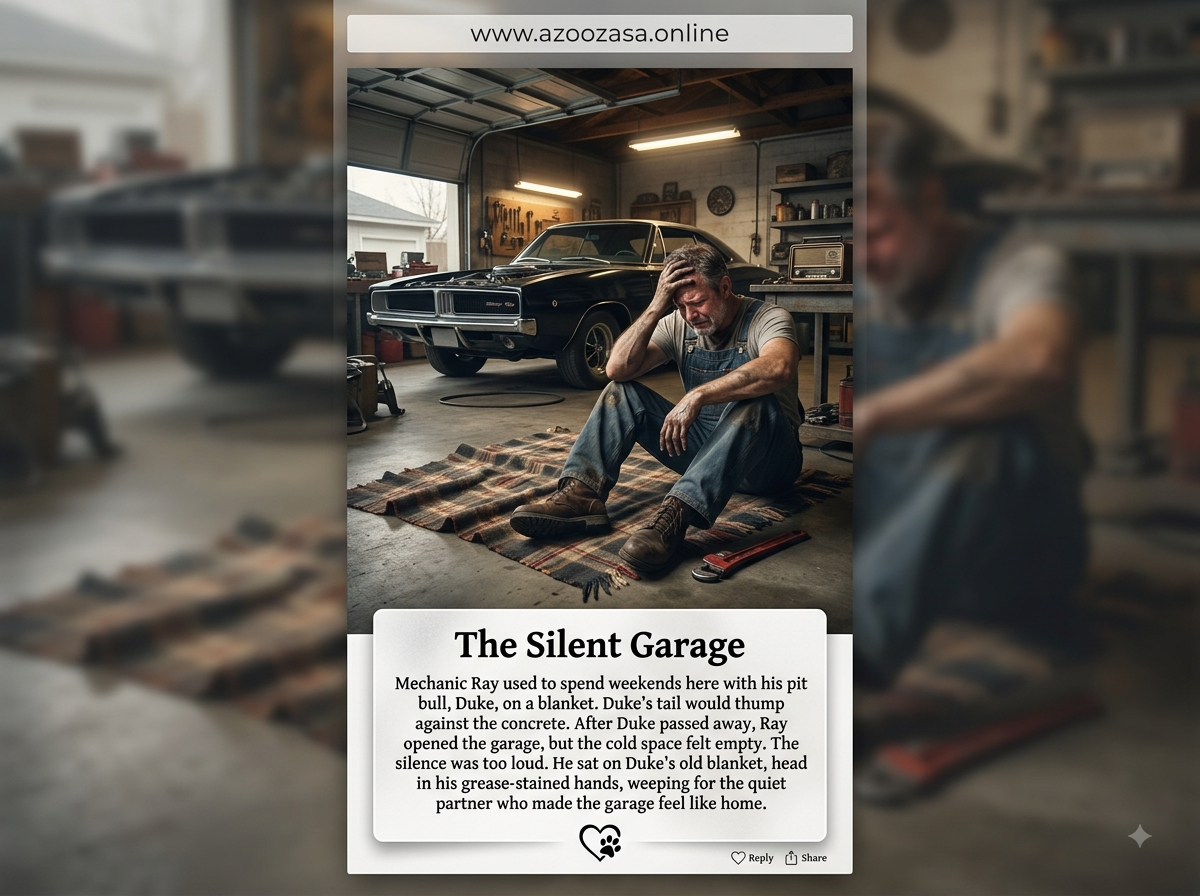
For twelve years, the rhythmic cadence of Ray’s home garage was defined not by the hum of an engine or the hiss of a pneumatic jack, but by the heavy, rhythmic thumping of a thick tail against bare concrete.
Every Saturday morning at seven o’clock sharp, Ray would roll up the heavy steel door of his workshop, the morning sunlight cutting through the dust motes to illuminate the center stage: a gleaming, half-restored 1967 Ford Mustang Fastback. And like clockwork, right behind him would trot Duke, a stocky, grey-muzzled pit bull with a coat the color of wet slate and eyes that held an uncanny, quiet intelligence.
Duke’s designated domain was an old, faded tartan blanket folded neatly in the corner, positioned strategic inches away from Ray’s main workbench. It was close enough for Ray to reach down and scratch behind Duke’s broad, velvet ears, but far enough to stay clear of falling bolts or spraying lubricant. Whenever Ray dropped a socket wrench with a loud metallic clatter, or whenever he leaned over a fender to curse softly at a stubborn, rusted manifold, Duke wouldn’t flinch. Instead, that heavy tail would beat against the floor—*thump, thump, thump*—a steady, reassuring metronome in a world of greasy metal and noise.
“Just two more turns on this bracket, big guy, and we’ll call it a day,” Ray would say, wiping sweat from his forehead with the back of a grime-caked forearm.
In response, Duke’s ears would perk up, his tail delivering another slow, thumping validation. He never needed Ray to be articulate, cheerful, or successful.
In Duke’s eyes, Ray was simply his person, and the garage was their sanctuary.
That rhythm shattered on a chilly Thursday evening when Duke’s aged legs finally gave out, his tired heart slowing to a quiet halt on the floor of the local veterinary clinic.
Two days later, Saturday arrived. Muscle memory was a cruel mechanism. Ray woke up at six-thirty, pulled on his worn denim overalls, laced up his steel-toed boots, and walked out the back door toward the detached garage. His hand reached for the handle of the overhead door out of pure, unthinking habit.
He lifted the door. The familiar metal rollers squealed along their tracks, exposing the interior to the crisp autumn air.
Usually, the opening of the door was accompanied by the soft scramble of paws on concrete as Duke trotted in to claim his spot. Today, there was only the cold draft rushing into the cavernous space. The garage didn’t smell like oiled steel and dog fur anymore; it just smelled like damp concrete and stagnant air. The space felt monstrously vast, stripped of its warmth, as empty and lifeless as a stripped-down frame rusting in a graveyard.
Ray stood in the threshold for a long moment, his chest tightening. “Come on, Ray. Get to work,” he muttered to himself, his voice sounding thin and hollow in the open driveway.
He forced his feet forward. He walked over to his tool chest, pulled out a three-quarter-inch wrench, and walked to the front of the Mustang. He needed the distraction. He needed the mechanical logic of nuts, bolts, and spark plugs—things that made sense, things that could be fixed with patience and torque.
Hoping to drown out the oppressive quiet, Ray reached up and flicked the switch on the old shelf stereo. A classic rock station blared into life, the loud electric guitar riffs vibrating off the corrugated metal walls. It was a song he’d heard a thousand times, but today the music felt intrusive, artificial, and jarringly loud. It didn’t fill the silence; it only highlighted how hollow the room actually was.
Ray leaned over the engine bay and placed the wrench onto a bolt. He pulled. His hand slipped, and the wrench tumbled out of his grip, crashing down through the engine bay before hitting the concrete floor with a loud, ringing clatter.
*Clang.*
Ray froze. Automatically, reflexively, his head turned toward the corner by the workbench. His brain desperately waited for the counterweight to the noise. He waited for the soft *thump, thump, thump* of a slate-grey tail hitting the floor to tell him everything was fine, that it was just a dropped tool, that they were still in this together.
Nothing happened.
The tool lay motionless on the oil-stained floor. The music screamed from the speakers above, but beneath it, the silence was absolute. It was deafening, heavy, and suffocating.
The wrench suddenly felt impossibly heavy in his hand. Ray dropped it entirely. He turned away from the car, his breathing shallow and jagged. His eyes drifted from the floor up to the corner of the room, settling on the old tartan blanket. It was still lying there, covered in short grey hairs, bearing the deep, curved depression where Duke had curled up for years.
The illusion of composure Ray had maintained all week cracked wide open. The stoicism he had worn at the vet’s office, the quiet nod he had given his wife, the brave face he had put on—it all dissolved in the cold, dusty light of the garage.
Ray walked over to the corner, his knees feeling strangely weak. He didn’t turn off the radio. He didn’t pick up his tools. He simply sank down onto his knees and sat directly on Duke’s old blanket.
He pulled his legs in, rested his elbows on his knees, and buried his face in his grease-stained hands. The smell of cedar oil, old wool, and Duke’s lingering coat hit him immediately. A hard, suffocating knot formed in his throat, and then the tears came—violent, heavy, and uncontrollable.
Ray wept openly in the dark corner of his workshop. He cried for the absolute loyalty he had taken for granted, for the unconditional acceptance that had greeted him every weekend regardless of how hard his week had been, and for the quiet, non-judgmental partner who had turned a cold room full of iron into a home. Duke had never cared if the Mustang started or if the paint job was flawed; he had only cared about being in the room with Ray.
The music played on the radio while Ray sat on the concrete, letting the grief wash through him until his shoulders stopped shaking and his breath leveled out.
He stayed on the blanket for a long time, watching the sun climb higher through the high garage windows. As the tears dried, leaving stiff trails on his grime-streaked cheeks, a strange sense of clarity began to settle over the heavy silence. The pain hadn’t vanished, but the agonizing sharp edges of it had begun to smooth into something softer—something that felt remarkably like gratitude.
Ray wiped his face with the back of his sleeve and looked around the shop. The Mustang was still waiting. The dropped wrench still lay on the floor.
Slowly, Ray stood up. He walked over to the stereo, reached out, and clicked the knob off. The blaring electric guitars vanished, leaving only the soft rustle of wind outside the open door.
He didn’t need to drown out the quiet anymore.
Ray walked back to the corner, picked up the folded tartan blanket, and gently brushed off the dust. Instead of throwing it away or stowing it in a cabinet, he carefully laid it back down, neatly aligning its edges with the base of the workbench just as it had always been.
He picked up the wrench from the floor, turned back to the exposed engine of the Fastback, and leaned over the fender. He set the jaw of the tool against the rusted bolt, braced his weight, and pulled until the metal yielded with a sharp, satisfying snap.
“Not a bad start,” Ray whispered into the stillness, his voice steady and soft.
He glanced back over his shoulder toward the tartan blanket in the corner. There was no tail thumping against the floor, but as the afternoon sun warmed the concrete, the quiet garage didn’t feel quite so empty anymore.



0 comments