
# The Kitchen Counter Sentinel
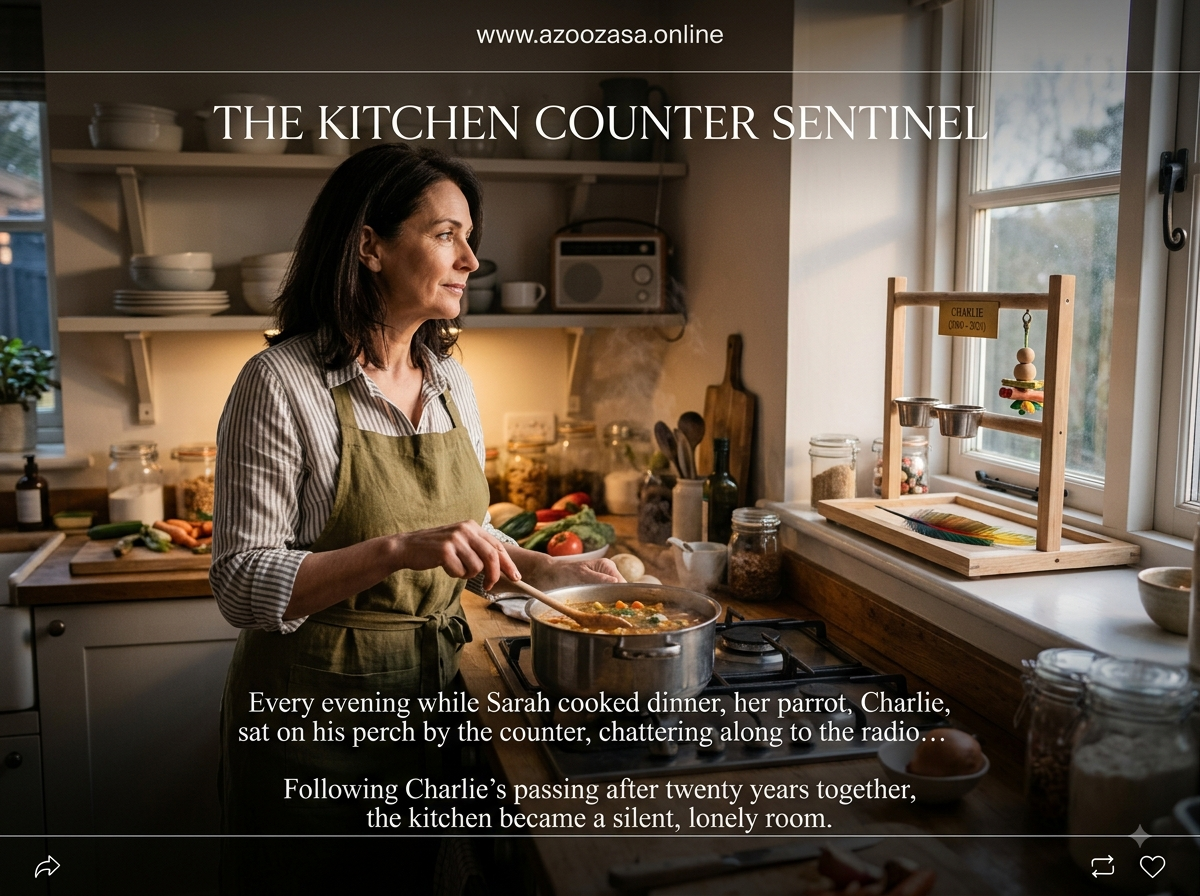
For two decades, six o’clock in Sarah’s kitchen was defined not by the setting sun or the ticking of the antique mahogany wall clock, but by the energetic scraping of a curved black beak against polished birch. The routine was sacred, uninterrupted by seasons, heartbreak, or the steady, quiet creep of middle age. Sarah would step to the counter, tie the canvas apron strings around her waist, and turn the dial on the vintage transistor radio perched beside the spice rack.
Before the jazz standard could even warm the air, a sharp, joyous screech would ripple across the room.
That was Charlie. An African Grey with feathers the shade of storm clouds and a tail like a flick of lit matchstick, he had commandeered the T-shaped wooden perch in the sunlit corner beside the cutting board when he was barely a fledgling. For twenty years, Charlie was Sarah’s shadow, her audience, and her most vocal companion. He was a creature of immense intellect and wicked humor, capable of picking up the subtle nuances of Sarah’s life with an uncanniness that often startled visitors.
When Sarah was happy, chopping onions with a light rhythm, Charlie would perform a triumphant little dance, rocking from foot to foot while making the precise sound of a popping wine cork. When she sighed in fatigue after a long shift at the local library, he would soft-whistle a gentle, ascending cadence—a sound he had learned from her father years ago, preserved in his feathered chest like an audio time capsule.
But his grandest performance was reserved for dinnertime. As the garlic sizzled in olive oil, Charlie would launch into a full-scale duet with the radio, chiming in with off-key trills, mimicking the hiss of the sauté pan, and offering a laugh that was an exact, breathtaking replica of Sarah’s own burst of genuine hilarity.
He was the kitchen’s sentinel, keeping watch from his wooden throne, demanding his tax of diced bell peppers or raw sunflower seeds, filling every corner of the house with a vibrant, chaotic warmth.
Then came the Tuesday evening when the perch remained empty.
It had happened with the quiet swiftness that often accompanies the end of a long life. Charlie had tucked his head beneath his wing on a cold Sunday night and simply drifted away, leaving behind a body as light as a handful of dry autumn leaves and a home utterly stripped of its voice. Two days had passed, but time in the house had lost its accustomed texture. It had stretched out, becoming thin, rigid, and cold.
Sarah stood in the doorway of the kitchen, her hand resting on the smooth brass doorframe. The room was bathed in the amber glow of the setting sun, casting long, slender shadows across the linoleum. The silence in the room was not merely the absence of sound; it was a physical weight, a thick, heavy blanket that pressed against her chest and made every breath feel labored. On the counter lay the cutting board, a pile of washed carrots, and a bunch of fresh parsley. Life demanded that she eat, that she keep moving, that she continue the motions of living even when the heart of her home had stopped beating.
She forced her feet forward, her slippers clicking against the floor tiles—a solitary sound that echoed with painful clarity. She reached for the radio. Her fingers trembled as she clicked the knob. A smooth, melancholic trumpet melody tumbled from the small speaker, filling the airwaves with brass and velvet. She picked up her chef’s knife and began to slice a carrot.
*Thump. Thump. Thump.*
The rhythmic bite of the blade against the wood was met with nothing. No cheerful whistle to match the tempo. No sudden, theatrical imitation of a ringing telephone to make her jump. No feather-ruffling sound from the corner. The radio played on, a lonely solo performance in an amphitheater designed for two.
Sarah stopped. The knife remained pressed against the orange disc on the board. She waited, her instincts, honed by twenty years of habit, bracing for the inevitable chatter that always followed the sound of food preparation. Her ears strained, desperate for the raspy, affectionate *“Good girl, Sarah”* he would murmur when he wanted a treat. But there was only the low hum of the refrigerator and the distant, fading trumpet.
Her eyes drifted slowly, almost against her will, toward the corner of the counter. There stood the birch perch, empty and pristine. A small ring of worn wood near the top marked the exact spot where his sharp talons had gripped for decades, smoothing the bark down to a golden sheen. A single, small crimson feather sat trapped in the crevice where the crossbar met the stand, glowing like an ember in the low sunlight.
The knife slipped from her fingers, clattering loudly against the wooden board. Sarah sank onto the kitchen stool, her hands flying to her face as the dam built over the last forty-eight hours finally gave way. The tears came in a sudden, violently cathartic rush, shaking her shoulders. She wept for the quiet. She wept for the lost music. She wept for the absurd, profound realization of how completely her identity, her daily peace, and her evening sanity had been anchored by a two-pound bird with a heart as vast as the sky.
For two decades, she had never truly cooked alone. He had been her confidant, her entertainer, the feathered archivist of her life’s happiest moments. Without him, the room was just four walls, a stove, and a counter—a shell of a life that felt suddenly, impossibly too large for one person.
She buried her face in her apron, smelling the faint, lingering scents of dried lavender and old wood, allowing the sorrow to wash through her until her breathing finally slowed to ragged, shallow gasps. The radio was playing a slow piano piece now, soft and contemplative, mirroring the dying light outside the window.
Wiping her wet cheeks with the back of her wrist, Sarah looked up. The sun had dipped below the horizon, leaving behind a twilight sky painted in shades of deep violet and soft rose. The crimson feather on the perch caught the last faint glimmer of light, standing out bold and defiant against the darkening room.
Sarah stood up slowly. She did not box up the perch. She did not pack it away in the attic alongside old photograph albums and broken dust-covered trinkets, as her sister had gently suggested earlier that morning. Instead, she took a clean, soft cloth and gently wiped the light dust from the birch wood, taking care not to disturb the small red feather resting in the joint.
She picked up the perch and moved it two feet to the left, setting it securely on the wide wooden sill of the kitchen window, where it overlooked the garden he had loved to watch on summer mornings. Framed against the evening sky, the perch stood tall and proud—a permanent monument, a sentinel’s post overlooking the haven they had shared.
Sarah turned back to the cutting board. She picked up the knife. The silence was still there, but it was no longer heavy or suffocating. It had softened into a quiet reverence, a spacious hall built by twenty years of unyielding love and laughter.
She resumed chopping the carrots, the blade moving in a steady, deliberate beat. As she worked, she drew a deep breath, adjusted the radio volume just a fraction higher, and began to whistle—a clear, soft, ascending cadence. It was the same tune her father had taught her, the same tune Charlie had sung back to her a thousand times. The music was not gone; it had simply changed performers. And as her melody floated across the warm, quiet kitchen, Sarah smiled through her tears, knowing that the sentinel’s song would live on in the house forever.



0 comments