
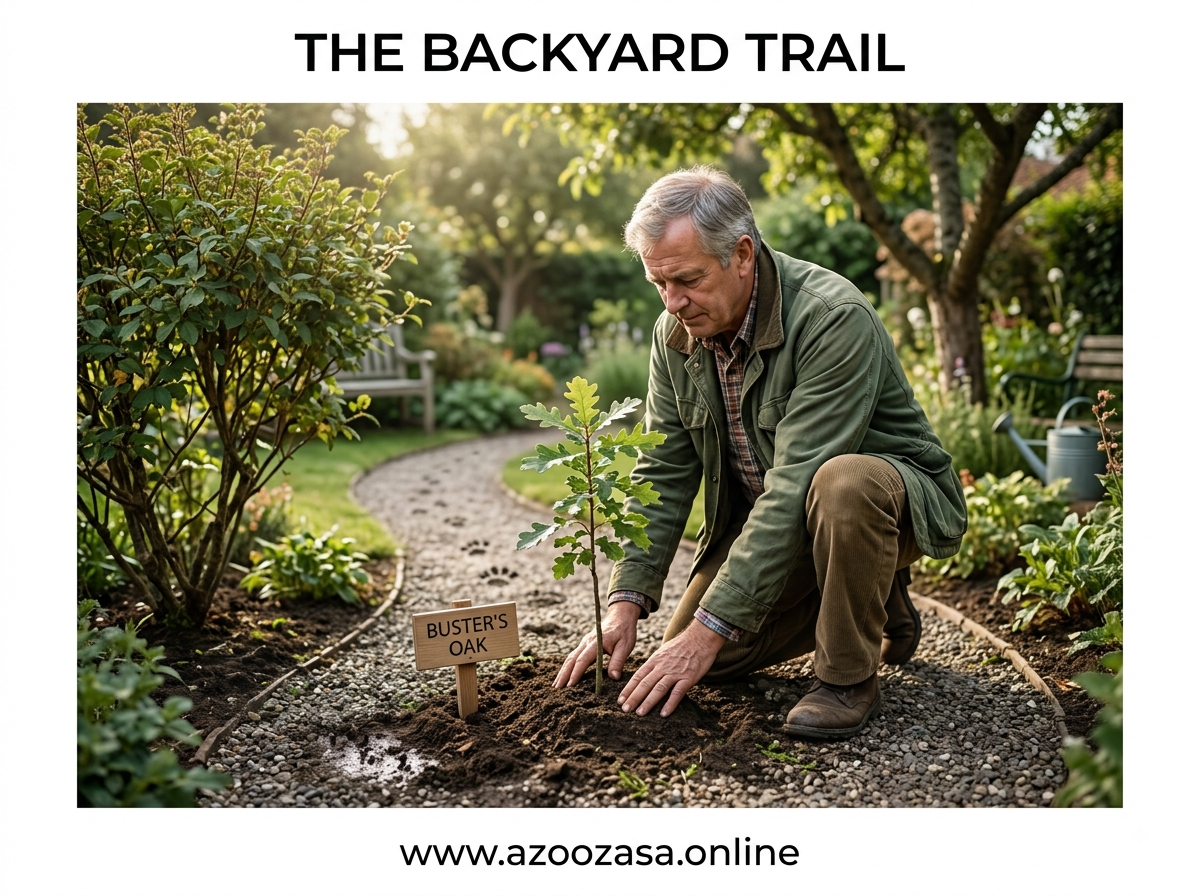
The gravel had a sound that belonged only to Buster. It was a light, rhythmic crunch, slightly uneven on the right side where age had stiffened the dog’s hip, accompanied by the quiet hum of a brass tag ticking against his collar.
For twelve years, that sound was the metronome of Arthur’s afternoons.
Arthur had laid the path himself during the summer Buster lost his sight to cataracts. Before the gravel, the backyard had been a hazard of exposed pine roots, slate stepping stones, and sudden drops near the flowerbeds.
Blind and disoriented, Buster had taken to sitting by the back door, his nose twitching at the scents of soil and bloomed iris, too timid to venture into the dark.
Arthur, a retired master gardener whose hands were permanently lined with dry earth, refused to let his companion spend his final years trapped on the porch. He spent three weeks digging out a three-foot-wide trench that snaked through the entire yard—a smooth, continuous loop that avoided every root, stone, and thorn bush. He filled it with fine, rounded pea gravel that wouldn’t hurt tender paws.
He taught Buster to navigate it through touch and sound. The gravel offered a clear texture underfoot that told the old beagle he was safe. On either side of the loop, Arthur planted scented markers: sweet alyssum near the sharp turn by the shed, damp moss along the shade of the fence, and dwarf lavender right at the apex of the curve.
Buster learned the map of his world through his feet and nose. Within a month, the blind dog was trotting the loop independently, his head low, ears sweeping the ground like velvet pendulums.
Now, six weeks after the quiet vet visit that had left the house vast and hollow, Arthur walked the path alone.
It was four in the afternoon. The summer heat was beginning to yield to the cool breath of evening. Arthur stepped onto the gravel, but he didn’t move forward immediately. He stood at the threshold, waiting for the ghost of that rhythmic crunch. The silence of the yard was heavy, broken only by the dry rasp of cicadas in the high oak canopy down the street.
He began to walk. Without Buster setting the slow, sniffing pace, Arthur’s long stride felt unnatural on the small stones. He slowed down intentionally, shortening his steps, letting his worn leather boots slide through the loose gravel.
Near the midpoint of the loop, where the path bent sharply around an overgrown hydrangeas bush, Arthur stopped. The sunlight filtered through the leaves, casting a dappled grid of light and shadow across the ground. He looked down.
There, pressed into a patch of earth where the gravel had thinned out near the edge of the border, was a faint set of indentations. Four small, rounded depressions, barely deeper than a coin, preserved in the hardened summer clay. Buster’s favorite spot. Whenever the sun hit this particular bend, the old dog would collapse into a deliberate, heavy sigh, lying across the path so that Arthur would have to sit down beside him to get past.
Arthur stared at the tiny imprints. A sudden, sharp constriction seized his chest, tightening until his breath caught in his throat. The grief didn’t come as a gentle sadness; it hit like a physical weight, dropping him to his knees right in the middle of the gravel.
The rough stones dug into his trousers, but Arthur didn’t care. He reached out a trembling, soil-stained hand and pressed his palm flat against the dried clay next to the paw prints. The earth was warm from the sun. He closed his eyes, leaning his forehead against the wooden border of the garden bed, and let the quiet tears fall into the dirt. He missed the weight of the dog’s chin on his knee. He missed the smell of cedar and cornchips that clung to Buster’s fur after a nap. Most of all, he missed the purpose the dog had given to this small plot of land. Without Buster, the path was just a pile of stone leading nowhere.
Arthur sat there until the shadows lengthened and the warm clay began to cool. When he finally opened his eyes, he was staring directly at the empty space at the very center of the loop—a circle of neglected lawn that the gravel path wrapped around like an embrace.
He wiped his face with the back of his wrist, his gardener’s mind beginning to shift, quietly and instinctively, from mourning to creation.
The next morning, Arthur drove his rusted pickup truck to the local nursery where he had worked three decades ago. He bypassed the colorful perennials, the potted roses, and the delicate maples. He walked straight to the back lot where the native hardwoods were kept, searching until he found it: a young White Oak, standing seven feet tall in a heavy burlap root ball. Its trunk was sturdy, straight, and wrapped in smooth grey bark, its leaves a vibrant, deep green.
“An oak takes fifty years to mature, Art,” the young clerk at the register said as they loaded the heavy tree into the truck bed. “You sure you don’t want something faster? A birch or a crabapple?”
Arthur adjusted his cap and looked at the green sapling. “No,” he said softly. “This one is right.”
Back home, Arthur brought his shovel, pickaxe, and wheelbarrow out to the backyard. He didn’t clear away the gravel path; instead, he worked within the sanctuary it created. Right at the geometric center of the loop—precisely adjacent to Buster’s favorite sunny spot by the hydrangea—Arthur marked out a wide circle.
He began to dig.
The labor was hard, honest work that made his old muscles ache and his hands calloused once more. He chopped through dense turf, levered out heavy clay, and loosened the deep soil, breathing in the rich, earthy scent of the ground. Every spadeful of earth felt like an offering. He dug the hole twice as wide as the root ball, smoothing the sides and scoring the bottom so the young roots could penetrate easily into the deep earth.
When the pit was ready, Arthur rolled the oak sapling into position. He carefully sliced away the burlap and wire basket, teasing out the outer roots with his fingers so they wouldn’t girdle the tree as it grew.
“There you go,” he whispered to the roots. “Spread out.”
He shoveling the rich, amended soil back into the hole, packing it gently with the heel of his boot. He built a shallow ring of dirt around the base to catch rainwater, then topped it with a thick layer of organic wood mulch. Finally, he brought out the hose and let a slow, steady trickle of water soak deep into the tree’s core.
When the work was done, Arthur walked the perimeter of the gravel path one more time.
The path was no longer a monument to an absence; it had become an aisle surrounding a living center. The low branches of the young oak reached out toward the loop, casting a delicate, lace-like shadow over the very spot where Buster’s paw prints lay preserved in the earth.
Arthur stepped into the shade of the sapling and sat down on the wooden border. He stretched his legs out across the gravel, resting one hand on the sturdy, young trunk of the oak.
In fifty years, he knew, he would be long gone, but this tree would be massive. Its thick, gnarled roots would sink deep into the soil beneath the gravel, anchoring it to the earth. Its vast, sweeping canopy would stretch across the entire yard, dropping acorns in the autumn and casting a cool, thick blanket of shade over the gravel loop below.
Anyone who walked the path in the decades to come would be forced to follow the curve, guided by the grand tree at its center, walking the exact same circle a blind old beagle had once trod in the sun.
Arthur leaned his head back against the young trunk and breathed in the cool air rising from the freshly watered earth. For the first time in six weeks, the quiet in the yard didn’t feel empty. It felt like a promise. He closed his eyes, listened to the rustle of the oak leaves in the afternoon breeze, and smiled.




0 comments