
The digital clock on the dashboard glowed 7:42 PM, casting a harsh, emerald light across the weary lines of Sarah’s face. For twelve hours, the emergency room had been a theater of chaos—shouting medics, blaring monitors, weeping families, and the relentless, suffocating rush of adrenaline that required an ER nurse to keep her hands steady while the world around her unraveled. Her feet felt like they were encased in lead, and a dull, throbbing ache pulsed behind her eyes.
Yet, as she pulled her sedan into the familiar driveway and killed the engine, a strange, persistent warmth began to bloom in her chest.
It was the anticipation that always carried her through the final, grueling hour of her shift. Copper would be waiting.
For eight years, Copper had been her anchor. He was a rescue beagle with soulful brown eyes, floppy velvet ears that smelled faintly of autumn leaves, and a tail that wagged with such enthusiastic whole-body intensity that his entire back half would wiggle in circles. No matter how brutal the shift had been—no matter how many tragedies she had witnessed or how heavy her heart felt—walking through her front door meant stepping into an atmosphere of absolute, unconditional love. Copper would be right there in the entryway, dancing on his tiptoes, letting out a soft, excited huff before rolling over onto his back for belly rubs.
Sarah grabbed her tote bag, walked up the porch steps, and pushed the key into the lock. It turned with a crisp, metallic click.
She swung the door open, a tired smile already forming on her lips, ready to call out his name.
“I’m home, buddy,” she murmured softly.
Then, the smile vanished, dying instantly on her lips.
She was met with absolute, heavy silence.
There was no clicking of claws on the hardwood floor. There was no joyful whining, no bounding shadow rushing down the hallway to greet her. Instead, the house lay dormant, dark, and terribly still. The air felt thin, stripped of the comforting, doggy warmth that usually filled the entryway.
The realization struck her like a physical blow, knocking the remaining breath from her lungs. Copper had passed away peacefully two days prior, his little heart finally giving out after a sudden illness. Two days of veterinary clinics, paperwork, and quiet tears—and yet, the deeply ingrained muscle memory of her routine had completely bypassed her grief, expecting everything to be just as it always was.
The weight of the past twelve hours at the hospital, compounded by the crushing, bottomless expanse of her personal loss, crashed over her all at once.
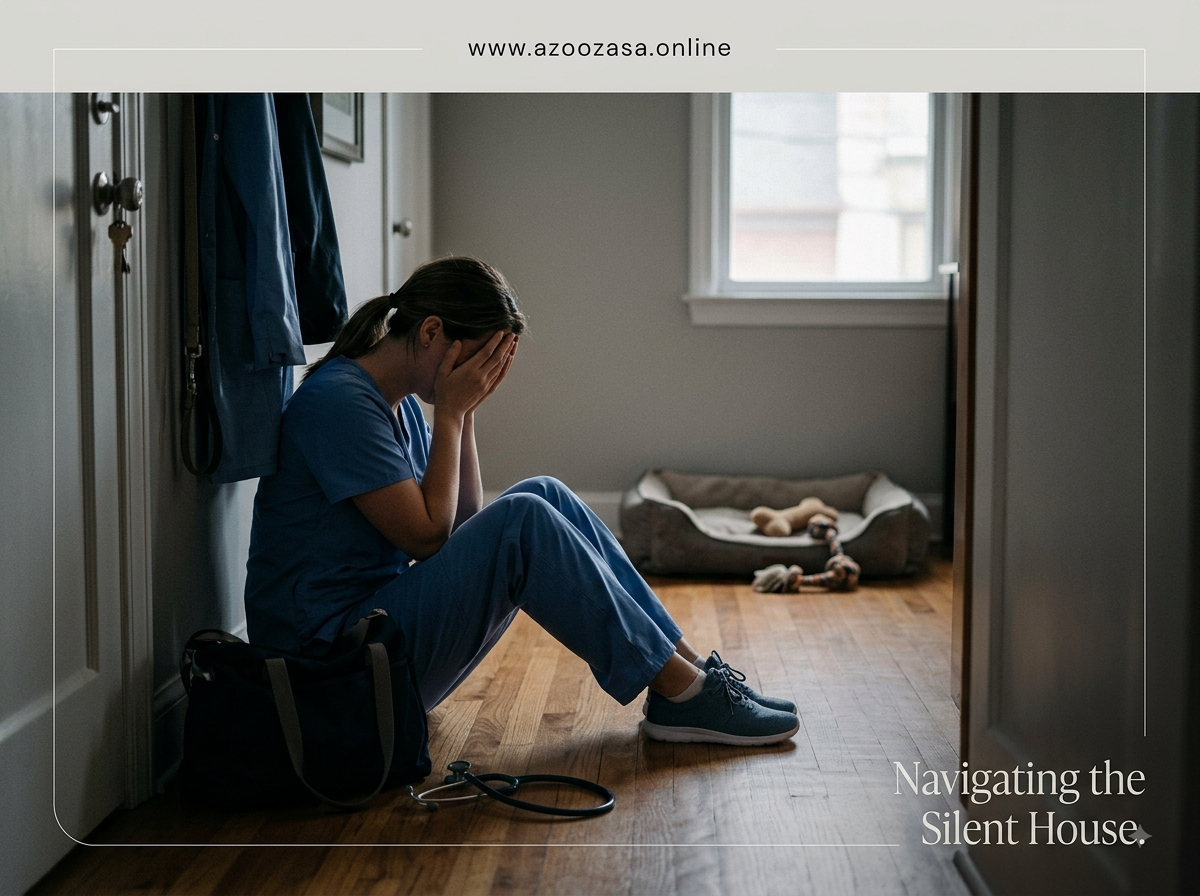
Sarah’s knees buckled. She let go of her heavy tote bag, watching it thud lifelessly against the floorboards, and slid down the wall until she was sitting directly on the cold hardwood. She pulled her knees up to her chest, buried her face in her hands, and let out a broken sob.
The house felt impossibly, terrifyingly large. Every creak of the old floorboards, every hum of the refrigerator, seemed magnified in the absence of his presence. Without Copper’s soft ears to hold, without his rhythmic breathing pressed against her side during the long, restless nights after a trauma shift, Sarah felt completely unmoored. The silence wasn’t just quiet; it was deafening.
For the next week, navigating the house felt like walking through a minefield of ghosts.
Every corner held a lingering echo. His food bowl still sat in the kitchen nook, washed and turned upside down, a permanent monument to an empty routine. His favorite faded red chew toy remained wedged under the living room armchair, where he had batted it during a game of solitary tug-of-war weeks ago. Sarah couldn’t bring herself to move them. To pack away his things felt like an act of erasure, a finality she wasn’t strong enough to face.
Working at the hospital became even more grueling. When she returned home in the dead of night, there was no warm body to cuddle, no soft weight to remind her that life existed outside the sterile walls of the emergency department. She would sit on the edge of her bed in the dark, staring at the empty space at the foot of the mattress where Copper always curled into a tight, golden-brown crescent.
Grief, she realized, was not a straight line. It came in suffocating waves that dragged her under when she least expected it—while pouring her morning coffee, while folding laundry, or while passing a man walking a beagle in the neighborhood park. On those days, the lump in her throat threatened to choke her, and the house felt less like a home and more like a mausoleum of memories.
The turning point came on a rainy Tuesday, nearly a month after Copper’s passing.
Sarah had just finished a brutal night shift, capped off by the loss of an elderly patient whose peaceful passing reminded her painfully of her own recent heartbreak. By the time she unlocked her front door, she was hollowed out, her emotional reserves completely depleted.
She stepped inside the dark entryway. The same old silence greeted her, heavy and oppressive. But instead of dropping her bags and collapsing into tears immediately, she paused.
She looked down at the empty floorboards where Copper used to dance. She thought about the eight years of pure joy he had given her—the way he had stayed by her side through nursing school, through her first night shifts, through breakups, and through the quiet, lonely nights when the world felt too heavy to bear. He hadn’t just been a pet; he had been a guardian of her spirit, absorbing her stress and returning it as unwavering affection.
A quiet thought drifted through her exhausted mind: *He wouldn’t want me to live in the dark.*
Sarah reached out and switched on the hallway lamp, bathing the room in a warm, soft glow. She walked into the kitchen, picking up a small notepad and a pen. It was time to clear out his bowls, not to erase him, but to make space for the legacy he had left behind.
She spent the afternoon transforming a corner of the living room. She took Copper’s favorite red chew toy and his shiny collar, placing them gently on a small wooden shelf beside a framed photograph of him running through a sunlit field of tall grass, his ears catching the wind. She lit a small, unscented candle and placed it beside the frame.
As the small flame flickered to life, casting a gentle, dancing light against the wall, Sarah felt something shift inside her chest. The heavy, suffocating ache didn’t magically vanish, but the sharp edges of the pain softened. The silence in the house didn’t feel quite so terrifying anymore; it felt peaceful, filled with the enduring echo of a love that time couldn’t touch.
Later that evening, sitting on the sofa with a warm cup of tea, Sarah looked over at the little memorial shelf. The house was still quiet, but it was no longer an empty void. It was a space held together by the warmth of a good dog who had taught her how to love deeply, how to heal, and how to carry the light forward, even when the world grew dark.



0 comments