
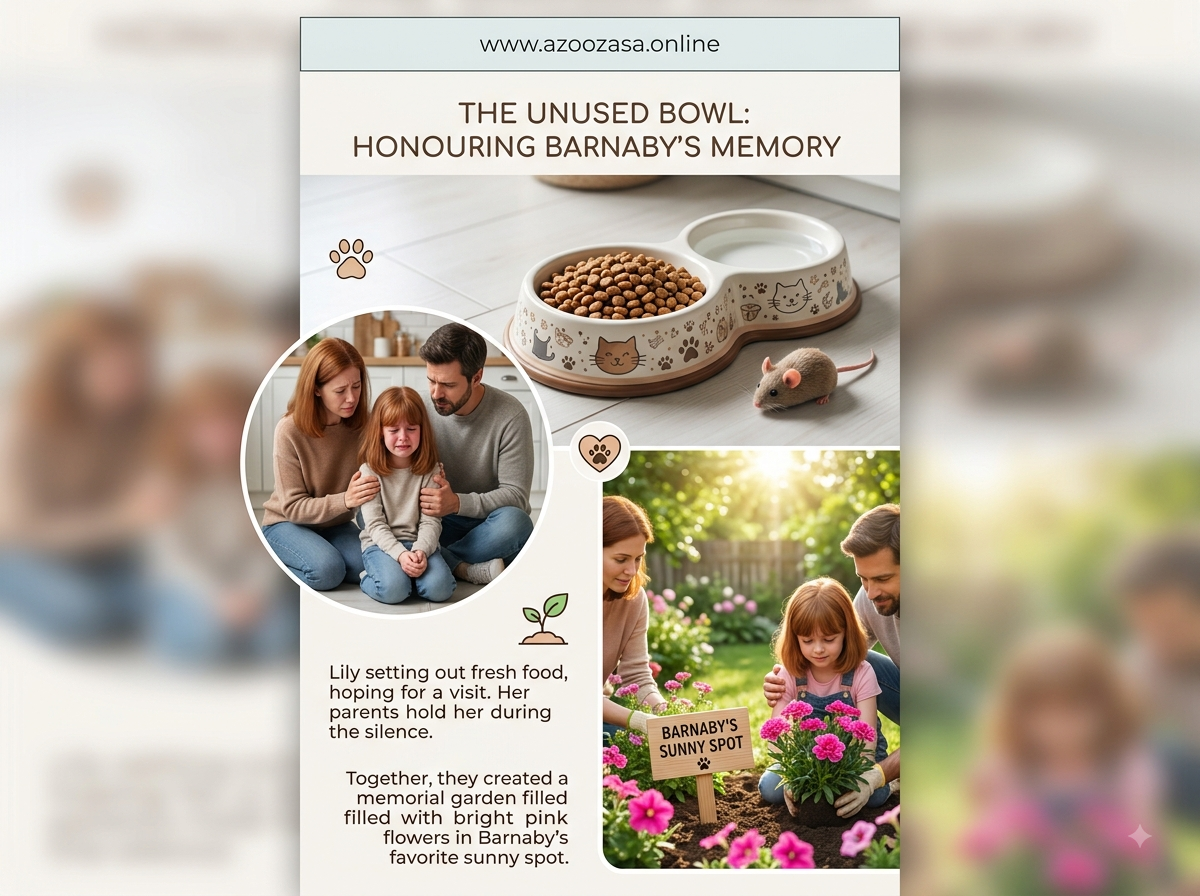
The house felt fundamentally different. It was not just quiet, but deeply, achingly hollow, as if the walls themselves were holding their breath, waiting for a familiar sound that was never going to come. For eight-year-old Lily, this silence was deafening. It was a heavy, oppressive thing that pressed against her ears the moment she woke up in the morning and followed her like a dark, creeping shadow until she finally went to bed.
For as long as her memory could reach—back to the hazy, sunlit days of learning to walk and grasping onto furniture for balance—there had always been Barnaby.
He was a sturdy orange tabby cat with a rumble in his chest that sounded like a distant, comforting engine. He was not just a family pet; to Lily, he was a guardian, a silent confidant, and a constant, reassuring fixture at the foot of her bed. Every single night, his warm, vibrating weight had anchored her to sleep, keeping the monsters at bay. Now, the space at the end of her floral blanket felt terribly cold and unfathomably vast. Two weeks had passed since Barnaby’s heart had finally given out, peacefully, in his sleep. Two weeks of Lily waking up and instinctively reaching down, only to grasp empty air and crisp, undisturbed cotton sheets.
Yet, downstairs in the kitchen, a quiet rebellion against this harsh reality took place every single evening. Tucked into the far corner, nestled safely between the white refrigerator and the wooden pantry door, sat two ceramic bowls.
One was painted with tiny, faded blue fish; the other was a simple, solid matching blue. They were perfectly clean, save for the nightly offerings Lily insisted upon making.
“Lily, sweetie, it’s time for dinner,” her mother, Sarah, would call out from the dining room, her voice gentle but carrying a fragile, worried edge.
Lily would always arrive in the kitchen a few minutes early, clutching the small, crinkling bag of premium dry kibble. She would carefully measure out a handful—exactly the amount Barnaby liked, not too much, not too little—and slowly pour it into the fish-painted bowl. The satisfying *clatter* of the kibble hitting the ceramic was the only sound in the house she allowed herself to find comforting. Then, she would take a small plastic cup, fill it with fresh, cool water from the tap, and pour it into the solid blue bowl, watching the water settle perfectly still.
“Just in case,” she whispered to the empty air, her voice small but fiercely determined. “Just in case he gets hungry on his way to visit.”
Her parents, Sarah and David, watched this daily ritual with breaking hearts. They had read the articles and books on how to help children process early grief. They knew that routines offered a sense of stability in a world turned upside down, and they intuitively understood that taking away the bowls too soon might feel to Lily like erasing Barnaby’s existence entirely. But seeing their vibrant daughter clinging to the ghost of their beloved tabby, night after night, was a different, sharper kind of agony.
David had tried, just once, three days after the passing, to gently wash the bowls and put them away in the high cupboard. Lily had walked in, seen the empty corner where her friend’s things belonged, and let out a scream that shattered the morning calm—a sound of such pure, unadulterated panic that David immediately took them back down, apologizing profusely, his own eyes welling with tears.
The bowls stayed. The nightly kibble remained. And every morning, before Lily woke up, Sarah would silently empty the untouched food back into the bag, wash the bowls out, and place them back in their corner, ready for the evening’s heartbreaking routine. They didn’t push. They didn’t tell her that spirits don’t eat dry kibble, or that Barnaby wasn’t coming back. They just loved her through the strange, suspended animation of her mourning.
It happened on a Tuesday. The sky outside the kitchen window was bruised with the dark purple and heavy gray of an impending summer storm. The air inside the house was thick, humid, and terribly still. Lily went to the pantry, pulled out the crinkly bag, and scooped out the kibble. But as she poured it into the bowl, her hand slipped. A single, star-shaped piece of kibble bounced out, skittering loudly across the linoleum floor and spinning to a halt near the oven.
Lily froze, staring at it. Normally, this was the moment Barnaby would have darted out from under the dining table, a blur of orange fur, to bat the stray piece around the floor before crunching it happily. She waited, her breath caught in her throat. But there was no orange blur. There was no rhythmic *crunch, crunch, crunch*. There was only the low, mechanical hum of the refrigerator.
The reality of the silence finally breached the fortress of her denial. It wasn’t a sudden, loud realization, but a slow, crushing weight that buckled her small knees. She dropped the bag of food. It spilled across the floor, a brown, chaotic mess. Lily didn’t try to clean it up. She just sank down onto the cool linoleum, right there in the corner next to the pristine bowls, pulled her knees tightly to her chest, and began to weep. It wasn’t the frantic, panicked crying of a scraped knee or a lost toy. It was the deep, sorrowful wailing of a broken heart finally acknowledging its own fracture.
The sound brought Sarah and David running from the living room. They stopped abruptly in the kitchen doorway, taking in the scene: the spilled food scattered like debris, their tiny girl curled into a ball of sheer misery, and the unused bowls sitting innocuously amidst the tragedy.
They didn’t speak. David didn’t run for a broom; Sarah didn’t offer a tissue or a meaningless platitude about time healing all wounds. Instead, they crossed the room and sat down right on the hard floor with her. David folded his long legs awkwardly, wrapping his large, protective arms around Lily’s shaking shoulders. Sarah pulled Lily’s head onto her lap, gently stroking her daughter’s soft, damp hair.
“He’s not eating it,” Lily sobbed, her voice muffled and wet against her mother’s jeans. “He’s not coming back to eat it, Mom.”
“I know, baby,” Sarah whispered, her own tears falling freely now, landing silently on the sleeve of Lily’s shirt. “I know he’s not.”
“I miss him,” Lily choked out, her small frame heaving with the effort of crying. “I miss his motor. I miss his scratchy tongue waking me up.”
“We miss him too,” David said, his voice thick and wavering with emotion. “He was the best boy. The absolute best friend you could have asked for.”
They sat there for a very long time, an island of shared grief on the kitchen floor. They let the storm outside finally break, heavy rain lashing furiously against the window, mirroring the immense emotional release happening inside. They didn’t rush her to stand up. They didn’t try to fix it, because they knew they couldn’t. They just held the space for her profound sadness, letting her know that it was perfectly okay to be broken, and most importantly, that she didn’t have to be broken alone.
Eventually, the heavy, body-shaking sobs subsided into quiet hiccups, and then into a heavy, peaceful exhaustion. Lily sat up slowly, wiping her red, swollen eyes. She looked down at the spilled food, and then at the two ceramic bowls.
“Can we… can we pack them away now?” she asked, her voice raspy and exhausted.
Sarah nodded slowly, her heart aching with pride for her daughter’s bravery. “Only if you’re truly ready.”
“I think I am,” Lily said, wiping her nose with the back of her hand. “But I really don’t want to forget him. I’m scared if his stuff is gone, I’ll forget.”
“We will never forget him,” David promised, squeezing her shoulder gently. “Never. But I think we need a better place to remember him than sitting on the kitchen floor.”
The next morning, the summer storm had passed, leaving behind a world that looked scrubbed clean and smelling sharply of wet earth and ozone. Saturday dawned bright and surprisingly clear. After a quiet breakfast, David and Sarah led Lily out the back door and into the backyard.
In the far left corner, near the base of the old, sprawling oak tree, the morning sun always pooled in a warm, perfect golden rectangle. It had been Barnaby’s absolute favorite spot in the entire world. He would spend hours out there, stretched out to an impossible length in the grass, baking his orange fur in the heat, only occasionally twitching a majestic ear at a passing butterfly or a noisy blue jay.
David had already been out early that morning. He had turned the soil in that sunny patch, making it loose, rich, and dark. Beside the freshly tilled dirt sat three small plastic pots holding vibrant, blooming flowers. They were bright, unapologetic, joyful pink—dianthus and impatiens that looked incredibly full of life against the green lawn. Nearby sat a smooth, flat river stone David had found.
“We thought,” Sarah began softly, handing Lily a small, metal hand trowel, “that instead of feeding him kibble he can’t eat, we could plant something beautiful right in the exact spot he loved most. That way, every time we look out the kitchen window, or every time you want to go talk to him, you can come here. And you can watch something grow, just like our love for him keeps growing.”
Lily looked at the patch of dark earth, then at the bright pink flowers. A small, wobbly smile touched her lips for the very first time in two long weeks.
She took the trowel and knelt in the dirt. Her parents knelt in the grass beside her. Together, their hands quickly covered in rich, dark soil, they carefully transferred the flowers from their plastic pots into the earth. They gently patted the dirt around the fragile roots, securing them in their new home. When the flowers were planted, David handed Lily the smooth river stone, and she placed it carefully at the center of the blooms.
When they were finished, David fetched a small green watering can, and Lily gently showered the new plants. The water darkened the soil further, soaking deep into the earth to give life to the bright pink blooms.
Lily stood back, wiping a smudge of dirt from her cheek, leaving a faint brown streak. She looked at the bright splash of color against the green grass. It wasn’t the same as a warm, vibrating orange cat sleeping at the foot of her bed. It wouldn’t purr when she stroked it, and it wouldn’t greet her at the door. But it was a living, breathing testament to the profound love they had shared for so many years.
She didn’t need to leave the kibble out anymore. The ceramic bowls were safely washed, dried, and packed away in a special, sturdy memory box on the top shelf of her closet, right next to his favorite feather wand and his collar. The kitchen corner was empty now, but as Lily looked down at the bright pink flowers swaying gently in the warm morning breeze, she realized her heart wasn’t. It was full to bursting with eight years of wonderful memories, a pure love that would never fade, and a quiet, beautiful corner of the world that would always, forever, belong to Barnaby.




0 comments