
The Bitter Cup: What the Coffee Cart Hid
There is a specific kind of silence that settles over a hospital rehabilitation ward just after the day shift ends. It is not a peaceful quiet, but an exhausted one. The rhythmic, frantic beeping of monitors slows down, the fluorescent lights seem to hum a little lower, and the frantic squeak of rubber-soled shoes on linoleum finally fades. After fifteen years as the head nurse at Oak Creek Rehabilitation Center, I had learned to read that silence. I had also developed a sixth sense for when something within it was terribly, fundamentally wrong.
My unease had a name, and it was Mrs. Evelyn Tate.
At eighty-five years old, Evelyn was as fragile as spun glass. She had come to our ward three weeks prior, recovering from a devastating fall that had fractured her hip and left her with a spiderweb of deep purple bruises across her delicate arms. When she first arrived, she was a fighter. She pushed through the grueling physical therapy sessions with a grimacing smile, chatting weakly about her days as a high school choir director and her beloved rose garden.
But then, her son Arthur began his daily visits.
Arthur Tate was a man who took up too much oxygen in whatever room he entered. He wore immaculate, sharp suits that smelled aggressively of expensive cedar cologne, a scent that never quite managed to mask the sharp tang of antiseptic that defined our ward. From the moment he first crossed the threshold of Room 214, the temperature seemed to plummet. More disturbingly, Evelyn’s entire demeanor fractured. The vibrant, resilient woman vanished, replaced by a trembling, silent shell. She would pull the thin hospital blanket up to her chin, her knuckles white, her eyes darting frantically toward the door whenever a footstep echoed in the hall.
Arthur was unrelenting. He treated the medical staff not as professionals, but as incompetent servants. His primary target, however, was his mother’s pain management protocol.
“You’re drugging her into a stupor,” he hissed at me one afternoon, cornering me by the nurses’ station. His eyes were cold, flat, and devoid of a son’s empathy. “She’s groggy and lazy. She didn’t even recognize me today. I demand you cut her pain relief immediately. She needs to be alert to sign some critical family documents.”
“Mr. Tate,” I had replied, keeping my voice level and professional despite the anger boiling in my chest. “Your mother is recovering from major orthopedic surgery. The morphine is necessary to manage her pain so she can participate in her physical therapy. We are following the attending physician’s exact orders.”
He had leaned in close, his voice dropping to a menacing whisper. “We’ll see about that.”
I had reported the interaction to the attending doctor and flagged it for the hospital’s social worker, but Arthur was legally her medical proxy. He was cunning, always staying just barely on the right side of the law, presenting himself to the administration as a concerned, if overbearing, family member. But I saw the terror in Evelyn’s eyes. I knew it was abuse. I just couldn’t prove it.
Until yesterday.
It was a Tuesday afternoon, just past four o’clock. The shift change was underway, a chaotic shuffle of passing charts and whispered updates. I was exhausted, nursing a persistent headache and longing for the quiet of my car, when I stepped out of Evelyn’s room. She had been crying silently, her heart rate elevated, writhing in pain that shouldn’t have been present so soon after her scheduled medication round.
As I walked down the corridor, I spotted the hospital’s volunteer coffee cart.
The cart was a staple of Oak Creek, pushed by a rotating cast of cheerful community volunteers who offered weak coffee, chamomile tea, and stale graham crackers to visiting families. Today, it was being operated by Clara, a timid college student fulfilling her community service hours.
I watched Clara as she pushed the heavy metal cart away from the visitor’s lounge. Something was entirely wrong. Clara’s shoulders were hunched, and her hands were trembling so violently that the ceramic mugs clattered against the metal surface. She looked pale, terrified, and she was checking over her shoulder with the panicked urgency of a hunted animal. As she passed Room 214, she flinched.
My nurse’s intuition, honed over thousands of twelve-hour shifts, flared to life.
“Clara,” I called out, quickening my pace to catch up to her.
She froze, her spine snapping rigidly straight. When she turned to look at me, her eyes were wide and swimming with unshed tears. “Yes? Yes, ma’am?”
“Are you alright, sweetheart? You look terribly pale.”
“I’m fine,” she stammered, her gaze darting to the floor. “Just… just finishing my rounds. I need to take the cart back to the kitchen.”
“Before you do,” I said, pasting on my warmest, most disarming smile, “I desperately need a cup of tea. It’s been a brutal shift. Do you mind?”
“No. No, of course not.” She fumbled with the hot water carafe, her hands shaking so badly she nearly missed the styrofoam cup.
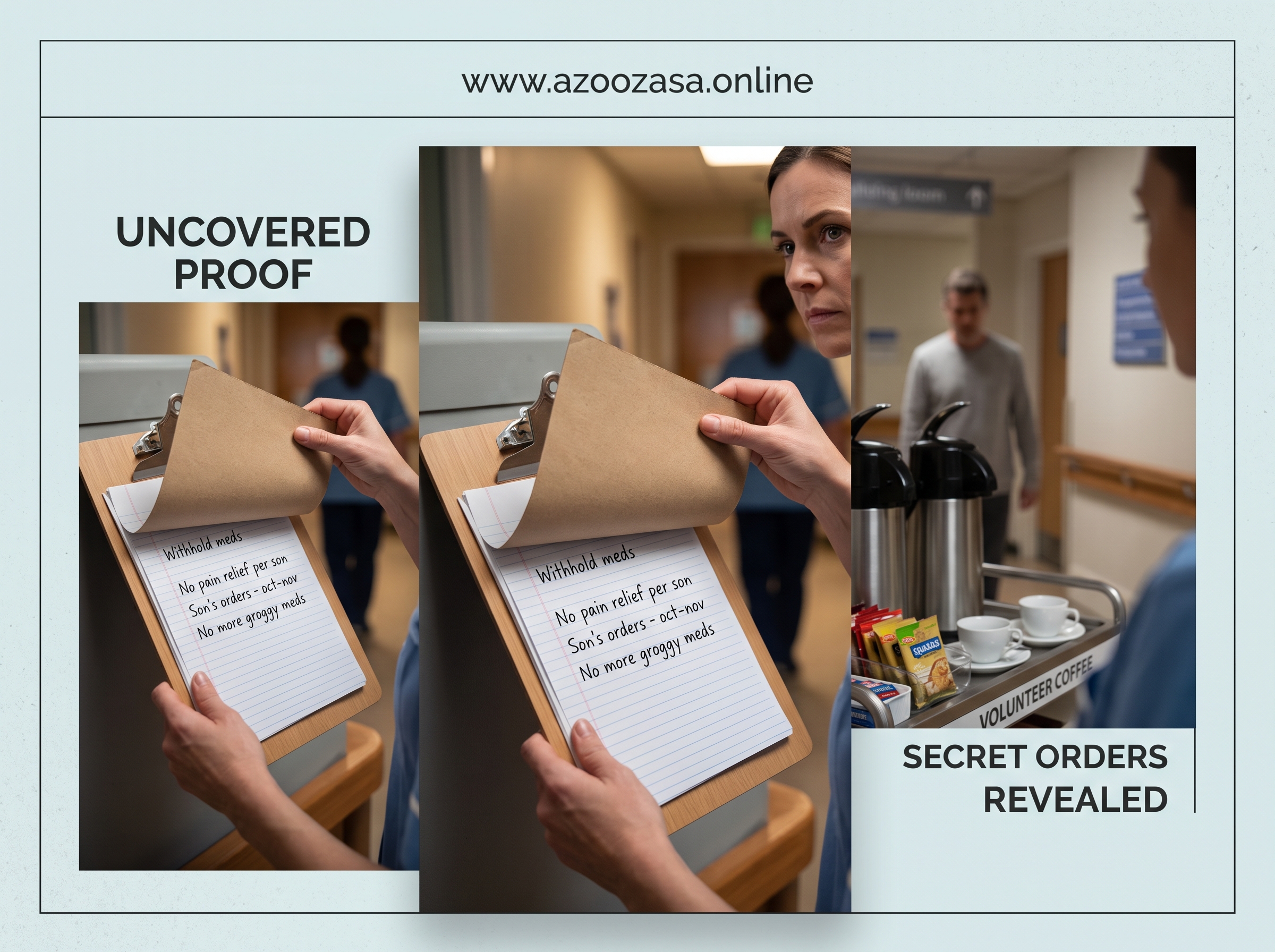
While her attention was focused on pouring the scalding water, I stepped closer to the cart. My eyes scanned the neatly arranged sugar packets, the stir sticks, and the donation box. Then, my gaze landed on the heavy, wooden clipboard the volunteers used to track inventory and record which rooms they had visited.
It looked oddly thick.
The clipboard had a rigid cardboard backing, meant to provide a sturdy surface for writing. But the cardboard was bowed outward, slightly warped, as if something had been wedged tightly beneath it.
“Did you drop this recently, Clara?” I asked casually, resting my fingers on the edge of the clipboard.
Clara gasped, dropping a tea bag onto the floor. “Please don’t,” she whispered, her voice cracking. “He said he would get me expelled. He said he knew people at my university.”
The blood ran cold in my veins. He.
Without waiting for another word, I slid my fingernails under the thick cardboard backing of the clipboard and pulled. The glue holding it together gave way with a dry tear.
A thick stack of folded, pale yellow papers spilled out, tumbling onto the lower shelf of the cart.
I picked up the first piece of paper, unfolding it. It was a handwritten note, the ink pressed so hard into the paper it left physical indentations.
Date: October 12th.
Instruction for Night Charge: Half dose only. Tell her she already took it. Keep her compliant. The lawyer comes on Thursday.
I picked up another, my hands now shaking as badly as Clara’s.
Date: November 3rd.
Skip the 8 PM entirely. If she complains, document it as dementia-related confusion. Bonus is in the usual spot.
Date: November 15th.
Do not give the breakthrough meds. She needs to sign the estate transfer tomorrow morning. I need her awake, even if she hurts.
There were dozens of them. Nearly three months of handwritten notes documenting specific, calculated orders to withhold pain medication. Arthur hadn’t just been bullying the staff; he had been orchestrating a covert, paid-for denial of care. He had found a corrupt nurse on the night shift—someone willing to falsify charting in exchange for cash—and he had been using the innocent, terrified volunteer’s coffee cart as a dead drop to pass his instructions and coordinate the abuse.
I looked at Clara. She was openly weeping now, leaning against the wall for support.
“He forced me,” she sobbed. “He stopped me in the parking lot two months ago. He told me if I didn’t leave the clipboard in the third-floor stairwell for ten minutes every shift, he’d make sure my nursing school application was destroyed. He said it was just family business. I didn’t know what the notes said, I swear I didn’t know!”
“I know, Clara,” I said softly, gathering the stack of papers and clutching them tightly against my chest. “I know.”
I didn’t go to the hospital administration. They would have formed a committee, launched an internal review, and Arthur would have had time to cover his tracks and move his mother to another facility.
Instead, I locked the notes in my office safe, walked directly to the charge desk, and dialed the local police precinct, asking for the elder abuse task force.
Four hours later, the rehab ward was crawling with uniforms. The silence of the evening shift had been completely shattered. Two officers were quietly interviewing Clara in the breakroom, assuring her she was a victim of coercion, not a suspect. Another team was going through the night shift charting, comparing the falsified medication records against the horrifying timeline of Arthur’s handwritten demands.
I sat in the small, windowless consultation room at the end of the hall, the stack of yellow papers resting on the table between me and Detective Russo, the lead investigator. He had spent the last twenty minutes reading through the notes, his jaw ticking, his expression growing darker with every page he turned.
He finally looked up, tapping his pen against the table. “This is a nightmare,” he muttered, his voice heavy with disgust. “He was torturing his own mother just to force her into signing over the family estate. He kept her in agony so she’d be lucid enough to hold a pen, and confused enough to not realize what she was signing. And he bought off one of your staff to do it.”
“He exploited our trust,” I said, my voice steady despite the adrenaline still coursing through my system. “He turned this hospital into an instrument of torture.”
“We have units dispatching to Arthur Tate’s residence right now,” Detective Russo said, leaning forward. “And we are pulling the financial records of every night nurse who worked this floor in the last ninety days. We are going to lock him away, and we are going to find out exactly who inside this building helped him do it.” He looked at me, a genuine respect in his tired eyes. “You saved her life today. What made you stop that cart?”
I thought about Evelyn Tate, lying in Room 214. I thought about the way she shrank into her sheets, the way her pain had been weaponized against her by the very person who was supposed to protect her. I thought about the absolute sanctity of the vow I had taken as a nurse to advocate for those who could not advocate for themselves.
I looked at the lead investigator and said, “Because when someone is truly suffering, the truth always finds a way to bleed through, even if you try to hide it under a clipboard.”
The next morning, the ward felt different. The air was lighter. The corrupt night nurse was escorted out in handcuffs just before dawn, and Arthur Tate was sitting in a county holding cell facing a mountain of felony charges.
When I walked into Room 214 for my morning rounds, Evelyn was sitting up slightly. For the first time in weeks, the tension was gone from her shoulders. The pain medication was properly flowing through her IV, bringing a soft, peaceful flush back to her pale cheeks.
She looked at me, her eyes clear and unburdened by fear. She didn’t know the full details of what had happened during the night, only that Arthur wasn’t coming back, and that she was finally safe.
“Good morning, dear,” she whispered, offering me a weak, beautiful smile.
I walked over, gently taking her fragile, bruised hand in mine. “Good morning, Mrs. Tate,” I smiled back, the weight of the previous day finally lifting from my shoulders. “Let’s get you properly healed, shall we?”


0 comments