
📋 Table of Contents
The Keeper of the Cellar
The summer of 2026 brought a heatwave so severe that the ground in Oakhaven fractured like shattered porcelain. For three weeks, the temperature hovered above a hundred degrees, baking the moisture out of the soil and warping the ancient timber of our family farmhouse.
I was sitting on the back porch, listening to the agonizing groan of the settling house, when a sharp, violent crack echoed from the side yard.
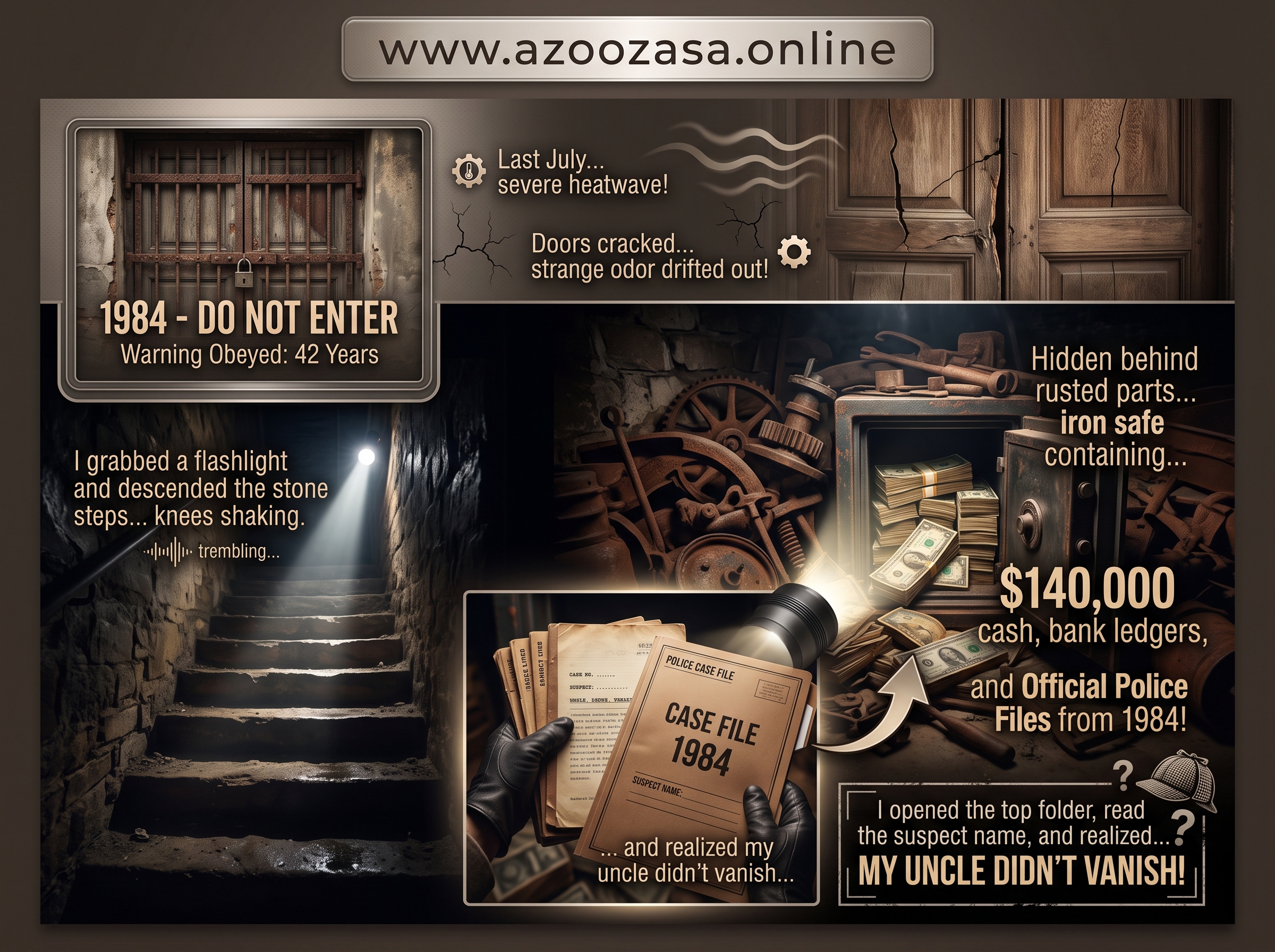
I set down my iced tea and walked around the wraparound deck. The heavy, slanted oak doors of the storm cellar—bolted shut and chained since I was a child—had succumbed to the elements. The wood had dried and warped so violently that the rusted iron padlock had been ripped directly out of the rotting frame. The right door sat slightly ajar, exposing a sliver of the pitch-black abyss below.
From that narrow gap drifted a strange, heavy odor. It wasn’t just the smell of damp earth or moldering leaves; it was a sharp, copper-like metallic scent that coated the back of my throat and made the hairs on my arms stand up.
My father, Elias Vance, had locked those doors in the autumn of 1984. I was eight years old when he sat me down at the kitchen table, his face as hard and unyielding as granite. “If you go down there, you leave this family,” he had said, his voice completely devoid of warmth. “You forget you ever had a father, and you never come back. Do you understand me?”
It was a terrifying ultimatum. For forty-two years, through my childhood, my adolescence, and long after my father passed away quietly in his armchair, I had obeyed. The cellar became a ghost story, a forbidden corner of my own property.
But my father was gone. The lock was broken. And the metallic smell was growing stronger.
Beneath the Foundation
I retrieved a heavy-duty Maglite from the kitchen drawer and pulled on my work boots.
As I pulled the splintered oak door back, the hinges shrieked, a sound of protest from a tomb that hadn’t been disturbed in over four decades. I shined the bright beam of the flashlight down into the gloom. The stone steps were slick with decades of unbroken condensation. I began my descent, my knees shaking with a mixture of deeply ingrained childhood fear and overwhelming adult curiosity.
With every step I took away from the blistering July heat, the air grew unnaturally cold. The temperature dropped by at least thirty degrees by the time my boots hit the compacted dirt floor of the cellar.
The space was smaller than I remembered. The walls were lined with rotting wooden shelves that had long since collapsed under their own weight. At the very back of the cellar, pressed against the stone foundation, sat a massive pile of rusted John Deere tractor parts—heavy iron axles, a cracked engine block, and oxidized gears that my father claimed he was saving for scrap.
But as my flashlight swept over the pile, the shadows didn’t align. The parts weren’t just tossed there; they were meticulously stacked to form a barricade.
I wedged my flashlight under my arm and began hauling the heavy, rusted metal aside. The jagged edges of the iron bit into my palms, leaving streaks of red-brown rust across my skin. After ten minutes of exhausting labor in the damp cold, the barricade was cleared.
Hidden inside an alcove carved directly into the dirt wall was a heavy, industrial iron safe.
The Iron Vault
The safe was ancient, painted in a chipped, faded olive drab. The combination dial was completely fused by rust, but the locking mechanism had been severely compromised by the moisture. I walked back up the stairs, grabbed a three-foot steel crowbar from the garage, and returned to the dark.
I wedged the flat edge of the crowbar into the seam of the safe’s door and threw my entire body weight against the steel bar. The metal shrieked. I adjusted my grip and shoved again, my boots slipping in the mud. With a sudden, violent snap, the internal tumblers shattered, and the heavy door swung open, kicking up a cloud of trapped, stale air.
I fell to my knees and aimed my flashlight into the vault. It was meticulously organized, preserving a snapshot of a life abruptly halted. Inside, I found:
-
Bundled Currency: Row upon row of fifty and hundred-dollar bills, wrapped in brittle rubber bands that snapped the moment I touched them. A quick estimation easily put the sum at $140,000.
-
Financial Records: Three black, leather-bound bank ledgers filled with my father’s precise, cramped handwriting, detailing anonymous wire transfers to offshore accounts between 1980 and 1984.
-
Official Documentation: A thick, expanding manila folder bearing the unmistakable blue crest of the Oakhaven County Sheriff’s Department—where my father had served as Chief Deputy for thirty years.
My breath caught in my throat. I reached for the police folder, the heavy cardboard softened by the ambient humidity of the cellar. The faded red stamp across the top read: HOMICIDE – ACTIVE INVESTIGATION.
The Burden of Inheritance
I sat cross-legged on the damp floor, the fortune in blood money ignored beside me, and opened the police file.
The first page was a carbon-copy incident report dated October 12, 1984. It detailed the brutal armed robbery of the Oakhaven Regional Bank. Two security guards had been shot and killed, and a staggering amount of cash had been stolen. The town had been paralyzed by the violence.
I flipped to the second page. It was a suspect profile.
The black-and-white photograph clipped to the page was a mugshot from a prior, minor arrest. I stared at the face looking back at me. He had the same sharp jawline as my father, the same deep-set eyes, but with a wild, reckless smile that my father never possessed.
The name typed beneath the photograph was Julian Vance. My uncle.
I opened the top folder, read the suspect name, and realized my uncle didn’t vanish into the Mexican desert like the family story had always claimed.
The final document in the folder was a handwritten confession, penned in my uncle’s chaotic scrawl. It detailed the robbery, the murders, and his plea for his older brother—my father, the Chief Deputy—to help him escape across the border.
I lowered the file, my hands trembling violently.
The metallic smell in the cellar wasn’t just coming from the rusted safe or the decaying tractor parts. I shined my flashlight past the open safe, toward the back of the dirt alcove where the earth had noticeably subsided into a shallow, rectangular depression. Protruding just slightly from the compacted dirt was the corner of a heavy, industrial blue tarp, stained a deep, oxidized brown.
My uncle didn’t vanish. My father made sure he could never be found.
Elias Vance was a man who believed in absolute, unwavering law. But he was also a man who fiercely protected his family’s name. When Julian arrived at the farmhouse that night in 1984, hands covered in innocent blood and holding a bag of stolen cash, my father was faced with an impossible choice. He could arrest his own brother, sending him to the electric chair and destroying the Vance family legacy in this small town. Or, he could dispense his own brand of dark, silent justice.
He chose the cellar.
He executed his brother, buried him beneath the foundation of our home, locked the stolen cash and the evidence in a vault, and threw away the key. He sacrificed his own soul to protect the town from a murderer, and to protect me from the shame of being a killer’s nephew.
“If you go down there, you leave this family.”
The warning finally made horrifying sense. My father knew that if I ever discovered the truth, the illusion of the righteous, perfect lawman would shatter. The family I thought I belonged to was built over a graveyard.
I stood up, the damp cold of the cellar seeping deep into my bones. I looked at the $140,000 in stolen cash. I looked at the police files that could finally close a forty-two-year-old cold case and give two grieving families closure. And then I looked at the blue tarp protruding from the earth.
I walked back to the stairs, picked up the splintered pieces of the cellar door, and stared out at the blinding July sun. I was standing perfectly on the threshold between my father’s dark loyalty and the blinding light of the truth, completely unsure which side I was going to choose.
What specific aspect of Elias and Julian’s relationship leading up to the 1984 robbery would you like to explore next?


0 comments