
📋 Table of Contents
The Blueprint of Forgiveness: A Fifteen-Year Divide
The sound of the brass deadbolt sliding into place is the loudest noise I have ever heard. It is a sound that has echoed in the hollow chambers of my mind for exactly fifteen years, five thousand four hundred and seventy-five days of self-imposed exile.
When my son Caleb was eighteen, I was a man entirely consumed by the sterile, unforgiving arithmetic of wealth. I was the senior partner at a prestigious downtown financial firm, a man who measured human worth in quarterly margins and offshore portfolios. Caleb was supposed to be my successor. I had his life mapped out with absolute precision: a degree in finance from my alma mater, a corner office by twenty-five, and a senior partnership by thirty-five.
But Caleb had always been different. His hands were always covered in dirt, his pockets full of whittled wood and sketched designs. On the evening of his eighteenth birthday, he stood in the foyer of our immaculate, quiet house, holding a beat-up duffel bag. He had emptied his childhood savings account—exactly $3,200—and enrolled in a vocational trade school for carpentry.
“I don’t want to move invisible money around a screen for the rest of my life, Dad,” he had said, his voice trembling but his jaw set with a stubbornness he had inherited entirely from me. “I want to build things that last. I want to build things that matter.”
“If you walk out that door, you are throwing away an empire to swing a hammer,” I had yelled, the veins in my neck bulging. “You’re ruining your life. And if you leave, don’t ever expect to come back.”
He hadn’t yelled back. He had just looked at me with a profound, quiet pity, hoisted the bag over his shoulder, and walked out. I slammed the heavy oak door behind him and turned the deadbolt with a sickening click.
I spent fifteen years in a sprawling, silent house. Fifteen years of cold, quiet holidays, eating turkey dinners alone at a dining table built for twelve. I built my empire, and in the process, I turned myself into an island.
The Magazine and the Mirror
Last Thursday, the fortress of my pride finally crumbled.
My neighbor, a retired architect named Henry, had flagged me down as I was getting my mail. He handed me a glossy copy of the State Architectural Quarterly. He didn’t say a word; he simply tapped a manicured finger against the cover story and walked away.
I took the magazine inside, poured myself a glass of scotch, and put on my reading glasses. The headline read: The Green Foundation: How One Local Builder is Redefining Community.
Beneath the bold text was a full-page photograph of a man in a hard hat and a high-visibility vest, standing in front of a stunning, modern, eco-friendly housing development. He had a thick, sawdust-dusted beard, broad shoulders, and a quiet, confident smile.
It was Caleb.
I read the article three times, the ice melting in my glass, the words blurring as tears I hadn’t shed in a decade and a half spilled onto the glossy pages. Caleb hadn’t just become a carpenter. He had built a highly successful green construction company from the ground up. He employed thirty full-time tradesmen with full benefits. But the paragraph that shattered me entirely was buried on the second page:
At the heart of Caleb Vance’s enterprise is a unique non-profit arm. Using a percentage of profits from commercial builds, his company purchases abandoned lots and builds fully sustainable, accessible, and rent-free homes for elderly, disabled veterans. “My grandfather served,” Vance noted in our interview. “And I believe a society is only as strong as the shelter it provides for its most vulnerable.”
I looked around my cavernous, echoing living room. I looked at the expensive leather furniture, the imported rugs, and the sheer, overwhelming emptiness of my life.
The Ledgers of Two Men
| Metric | My World (The Firm) | Caleb’s World (The Trade) |
| Foundation | Liquid assets and offshore margins | Reclaimed timber and poured concrete |
| Output | Quarterly shareholder dividends | Free, sustainable housing for veterans |
| Legacy | A locked door and fifteen quiet years | Thirty employees and a community rebuilt |
I had told him he was ruining his life. The devastating truth was that he had taken his $3,200 and built a life of staggering meaning, while I had taken millions and built a mausoleum.
The Job Site
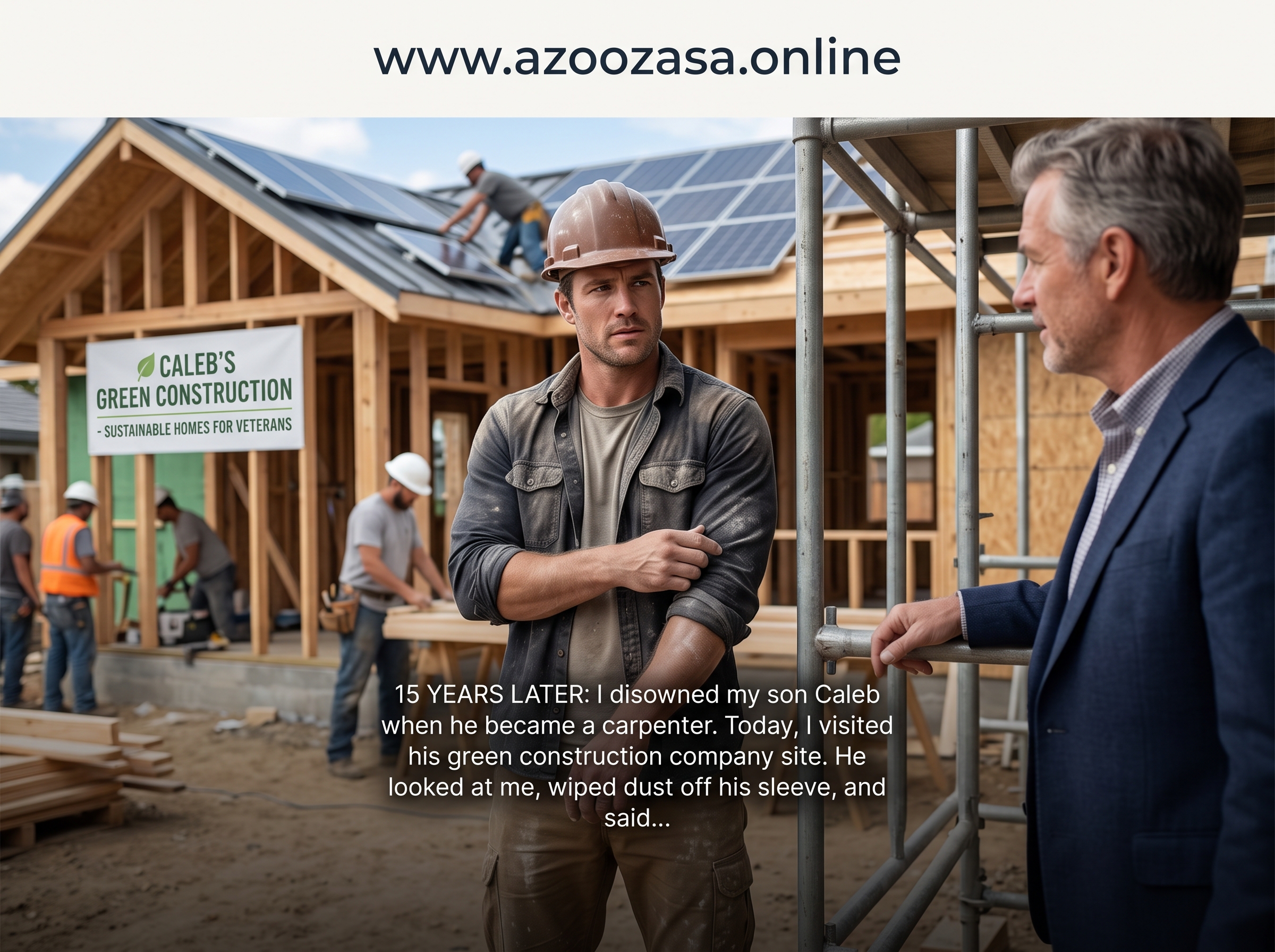
I drove to his main job site on a Tuesday morning. The address listed in the magazine brought me to a sprawling lot on the edge of the city. The air was thick with the scent of raw pine, diesel exhaust, and the sharp, metallic tang of welding torches. It was a symphony of creation.
I parked my pristine Mercedes a block away, suddenly feeling intensely self-conscious in my tailored Italian suit. I walked slowly toward the perimeter fence, my heart hammering a frantic, terrifying rhythm against my ribs. What right did I have to be here? I had locked him out. I had abandoned him when he needed a father’s blessing.
I stood near a massive scaffold, the summer sun beating down on my shoulders, and watched him.
He was standing near the center of the site, holding a rolled-up blueprint, directing a crew of roofers with authoritative, sweeping gestures. He commanded the space not with fear, which was how I managed my boardroom, but with genuine, earned respect. I watched him laugh at a joke one of the foremen made, the sound carrying over the hum of the power saws. It was a rich, warm laugh.
He finished his conversation, rolled up the blueprint, and turned around.
For a fraction of a second, his eyes swept past me. Then, they snapped back. The laughter faded from his face, replaced by a look of profound shock. The noise of the construction site seemed to instantly evaporate, leaving only the heavy, electric silence stretching across the dirt lot between us.
I couldn’t move. My feet were rooted to the concrete.
Caleb slowly walked toward me, navigating the uneven terrain of plywood and rebar. He stopped about five feet away. Up close, I could see the faint lines of stress and weather around his eyes, the physical toll of building an empire with his bare hands.
Caleb looked at me, wiped a thick layer of drywall dust off his sleeve, and said, “You’re a long way from the financial district, Dad. I hope you didn’t wear your good Italian loafers. There are nails everywhere.”
His voice wasn’t laced with venom. It wasn’t dripping with the bitterness I had anticipated. It was remarkably steady, tinged with a cautious curiosity.
“I…” My voice cracked. The commanding executive who could silence a room of hostile shareholders was suddenly reduced to a trembling old man. “I read the article, Caleb. In the architectural magazine. Henry brought it over.”
Caleb nodded slowly, slipping his calloused hands into the pockets of his denim work pants. “Yeah. The PR team said it would be good for the non-profit side of things. Did you like it?”
“I liked it,” I whispered, the tears returning, blurring the edges of his yellow vest. “Caleb, I didn’t just come here to talk about a magazine.”
I took a shaky breath, the weight of fifteen years of foolish pride pressing down on my chest.
“When you were eighteen, I told you that you were throwing your life away,” I said, the words scraping against my throat. “I told you that you were making a mistake. But the only mistake made that night was mine. I looked at the empire you’ve built here, Caleb, and I realized something terrifying. I spent my whole life making a living, but you… you actually made a life. I was wrong. I was so incredibly wrong, and I am so, so sorry.”
Caleb stood perfectly still. The wind rustled the blueprints in his hand. He looked away for a moment, staring up at the wooden skeleton of the house his crew was framing. I could see the muscles in his jaw working as he processed a decades-worth of silence.
When he looked back at me, his eyes were bright, but his posture had softened.
“Fifteen years is a long time to hold a grudge, Dad,” Caleb said quietly.
“I know,” I replied, my voice breaking. “And I don’t expect you to forgive me today. I don’t even expect you to let me into your life. But I couldn’t spend another day on this earth without looking you in the eye and telling you how deeply proud I am of the man you became without me.”
Caleb looked at my expensive suit, then down at my polished leather shoes, which were already accumulating a fine layer of white construction dust. A small, bittersweet smile tugged at the corner of his mouth.
“We’re pouring the foundation for the next veterans’ duplex this afternoon,” Caleb said, gesturing with the rolled-up blueprint toward the back of the lot. “It’s loud, it’s messy, and it’s going to ruin that suit.”
He took a step forward and extended his hand.
“But if you want,” Caleb continued, his voice thick with an emotion that mirrored my own, “you can come take a look. We can start there.”
I looked at his outstretched hand—rough, scarred, and covered in the dust of honest labor. I reached out and gripped it firmly, feeling the immense, unyielding strength of my son. It wasn’t a perfect reconciliation. Fifteen years of absence couldn’t be erased with a single handshake. But as he led me through the maze of scaffolding, pointing out the architectural lines of a home meant to shelter the forgotten, I knew we had finally laid the cornerstone. The lock on the door was broken, and for the first time in a decade and a half, I was finally ready to learn how to build.


0 comments